Gordon Hayward recalls 4 difficult days of free agency
Hayward thought the Heat's pitch would be tough to beat. Then he visited Boston.
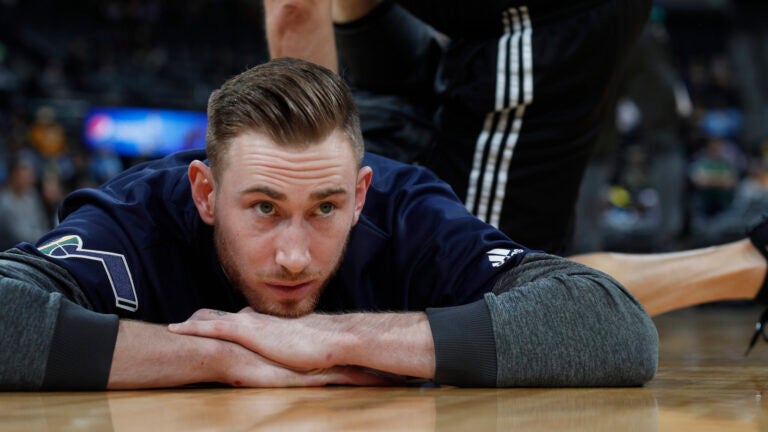
Many Celtics fans spent their four-day Fourth of July weekend frantically checking their phones for the latest news on whether Gordon Hayward would leave the Utah Jazz and sign with the Boston Celtics.
Of course, Hayward’s ultimate decision is now official. But in a podcast Monday with ESPN’s Adrian Wojnarowski, the Celtics’ new swingman revealed what those four indecisive days were like from his perspective — bouncing between three cities, toiling with his choice until the last minute.
Saturday, July 1
Hayward and his wife, Robyn, woke up in Miami for a breakfast meeting that Saturday with Heat president Pat Riley.
“Miami was a spot where the more and more we talked about it, the more and more it looked like it would be a really, really good fit for me,” he told Wojnarowski.
Hayward said he and his agent, Mark Bartelstein, had created a weighted point system of different pros and cons for each team.
“Miami was always near the top of the rankings,” he said.
Hayward said Bartelstein warned him ahead of time that after meeting Riley he would be ready to sign with the Heat on the spot. After touring the team’s facilities and meeting with Riley and Heat coach Erik Spoelstra, Hayward said that was indeed the case. He also noticed that everyone at the Heat meeting wore their NBA championship rings.
“I think the text I sent to Mark was, ‘Wow, that’s going to be really tough to beat’ or something like that,” Hayward said. “I asked Robyn and she said something like she could really see herself living there.”
Going to Boston the next day, Hayward said he had to make an effort to put the Heat aside in his mind and meet the Celtics with “a clean slate.”
Sunday, July 2
Hayward said his arrival in Boston was strikingly different than Miami, to which he and Robyn took a private plane, were given a police escort, and were brought to the hotel through a back door.
“First class as far as security is concerned,” he said of the Miami visit.
Hayward took a commercial flight to Logan airport, where he and his wife were simply greeted by Celtics coach Brad Stevens and assistant coach Micah Shrewsberry.
“No security whatsoever,” he said. “I’m taking pictures at baggage claim with fans. Like just completely the opposite.”
However, Hayward said he felt “an immediate sense of familiarity” reuniting with Stevens, his former coach at Butler University.
Unlike in Miami, it was Stevens himself who drove Hayward to the hotel in Boston.
“We got lost a couple times along the way,” Hayward said.
In Boston, Hayward said Al Horford met him and his wife for breakfast and stayed with them the whole day. Isaiah Thomas and his wife met up with them later for dinner. According to Hayward, the focus of their discussions were “Banner 18.”
In addition to his meetings with Celtics management, Hayward said he did a film session with Stevens, who showed him how the team would hypothetically play with him on the court.
“I did leave there with the same type of feeling, like, ‘Man, that would be incredible,'” Hayward said.
Stevens even drove him back to the airport, where Hayward and his wife had a six-hour flight to catch back to San Diego.
“My mind was already just torn, like, I don’t know what to do,” he said.
Monday, July 3
Finally, Hayward’s last meeting was in San Diego with the Jazz, which he described during Monday’s podcast as “emotional.”
Hayward said the team pitched him on finally bringing a championship to Utah, after experiencing everything from the low points of playing on a struggling team earlier in his career to progressing to become a second-round playoff team this year.
“The final word was, ‘We need you to come back to take another step, and let’s do it,'” Hayward said, noting that Jazz coach Quin Snyder had actually coached him for more years than had Stevens.
That night, Hayward said he had a nervous “stomach feeling” of anxiety over the decision. He went through the pros and cons of each team with his wife. Meanwhile, he said his phone was blowing up with texts from members of all three teams.
“There was still doubt in my mind when I went to sleep,” he said.
Tuesday, July 4
Hayward had said he expected to make his decision by that Tuesday. Though he had whittled the choice down to between the Jazz and Celtics, he woke up still undecided. Hayward said he had Bartelstein go through both team’s pitches the next morning.
“I was like, ‘Mark, dude, I don’t know what to do now,'” he recalled. “‘They both sound really, really good. How are we going to make this decision?’”
It was later that morning (Hayward was still on West Coat ) when “the leak” happened. Hayward said he was leaning toward the Celtics when the reports seeped out that he had chosen Boston, but that he was still truly undecided between the two teams.
“My phone’s blowing up and I’m like, ‘Mark, are you seeing this? Apparently we just made a decision,”’ Hayward recalled.
Barstelstein had to then go refute the news to reporters.
“Now I felt like there was a lot of pressure, because everyone’s already saying the decision’s been made and I still wasn’t for sure thinking Boston is the way to go,” Hayward told Wojnarowski.
After a few hours to let things settle down, Hayward said he finally came around to a decision: Boston.
As he explained in his Players’ Tribune announcement, there were multiple factors why he ultimately picked the Celtics: The city of Boston’s “winning culture,” the team’s illustrious history, the current cast of management and players, and, of course, his former coach.
“Not just for the relationship that we’ve built off the court — but also for the one that we started building on the court, all of those years ago, in Indiana,” Hayward wrote.
Before posting the article, however, he had a “dreaded” call to make, informing the Jazz that he would be leaving. Hayward said Snyder was understanding and didn’t try to change his mind.
Asked by Wojnarowski, Hayward struggled to identify the tipping factor in his decision to join the Celtics.
“It was a different feeling in Boston that I had,” he said. “It was like a gut feeling.”
Listen to the full podcast here.