Inside the Celtics’ Draft-night trade for Ray Allen
'I just had a gut feeling': How Danny Ainge's risky move kick-started the Big 3 era.
Paul Pierce wanted help, if he wanted to be in Boston at all.
Rebuilding an NBA team is difficult, and it’s especially hard without luck. The Celtics finished the 2006-07 season with the league’s second-worst record, but the capricious (devious?) NBA Draft Lottery slotted them 5th. There would be no Greg Oden or Kevin Durant.
Before Kevin Garnett dug his knuckles into the TD Garden parquet for some impromptu pushups, before the Celtics’ 17th NBA title, before Ubuntu, Celtics president of basketball operations Danny Ainge was the steward of a bad team and an unhappy superstar.
In the summer of 2007, Ainge was confronted with a choice: continue to build through the draft, or gamble on the future for immediate help. Ten years removed from the Ray Allen deal, the principles involved say the path to a championship was never Larry O’Brien crystal clear.
An aging superstar
Something would have to change.Pierce’s 9th NBA offseason was one of his worst. He had hesitations about Ainge, and was unsure of whether or not he wanted to stay in Boston. “It was definitely a low point,” Pierce said during a recent interview.”I just thought I didn’t have a future in Boston when I was looking at it.” The ’06-07 Celtics are an example of what happens when an NBA team tries to build around a single superstar. Alongside the 25-point per game scorer Pierce were promising big man Al Jefferson and guards Delonte West and Tony Allen — all in their second seasons. Rajon Rondo was a rookie. Veteran forward Wally Szczerbiak supplemented the scoring with 15 points per game.When Pierce went down with an injury that December, the team struggled to stay afloat, running off a string of 18 straight losses in January and February before finishing the season 24-58.“A lot of those games I didn’t play in,” says Pierce. “But it definitely was a low point. I mean I’m like, ‘Geez.’ I’ve never been a part of anything like that. It was like we didn’t see anything positive coming from it. We had an All-Star who was entering his prime, and I get hurt and we go on an 18-game losing streak. It was discouraging for me.”Pierce and Ainge began talking, about the upcoming draft, and about players the Celtics could acquire via trade. “Me and Danny stayed in constant contact about it,” says Pierce.Ainge says now he wasn’t specifically trying to appease the 29-year-old Pierce with trade talks, but rather improve the team as a whole. But he acknowledges, “We were trying to maximize Paul. Paul was a fantastic Celtic, and our team wasn’t good enough.”

Celtics Delonte West and Paul Pierce share a spot on the bench. (Matthew J. Lee/Globe Staff)
The anatomy of a deal
“I’ve tried many times to get players the quality of Ray Allen and have failed,” says Ainge. “Or chose not to go there, or not even have the other team have anything to do with trading a player of that caliber.”The Celtics boss is talking about the trade that eventually landed Allen in ‘07, but he could be talking about any offseason in which he’s tried to make a big move.For all of its importance, the trade — which netted Allen and eventually caused Garnett to come to Boston, forming a Big 3 between Pierce, Garnett, and Allen that won a title and went to another NBA Finals — was almost never consummated. Ainge says he tried for months to acquire Allen, the All-Star shooting guard out of UConn who averaged 26.4 points for the SuperSonics the year before Boston traded for him.“Seattle had a new regime” says Ainge. “And I felt like maybe we had a chance to get Ray because of this new regime and they’d wanna move in a different direction. They had a high draft pick. I thought there might be a chance there, but they were very tough in dealing with us. They wanted a lot in return, and it wasn’t as easy as we thought.”Seattle’s GM at the time, Sam Presti, said in the days following the deal that Boston was the aggressor, and pushed hard for the move.“We had multiple conversations and worked on it for a while,” says Ainge. “It didn’t happen in a day. Sam again taking over a new team so forth. This was an opportunity for them and an opportunity for us.”In the month before the draft, the Celtics and Sonics were stricken with bad and good luck, respectively. While Seattle earned the No. 2 pick in the NBA lottery — and a shot at Oden or Durant — Boston slipped to fifth.

Celtics head coach Doc Rivers and general manager Danny Ainge show their disappointment as they speak to the media at the team’s practice facility following the NBA Lottery in which Boston ended up with the 5th pick. (AP Photo/Elise Amendola)
But the bad bounce in the lottery has proven to be a blessing for Boston. Pierce recalls that if the Celtics had landed Oden or Durant, he might have preferred not to be around as the Celtics rebuilt around their young core. As it happened, Boston’s poor luck ignited conversations between Pierce and Ainge about other players.
“It was either gonna be Ray Allen or Shawn Marion, I remember at the time,” says Pierce. “And he asked me who would I like to play with. And I said Ray because I felt like Shawn, me and him kind of played the same position and would get in each other’s way. And I was just like, ‘I think Ray would be a perfect fit.’ A day before or a couple days before we pulled off the trade, we talked about it.”
“I remember that I had conversations with Paul about Shawn,” says Ainge. “I had coached Shawn in Phoenix and was a big fan myself. I had conversations with Paul but I don’t remember us being close to doing a deal with Marion. It might have been just an idea of a player I could try. … I had numerous conversations with Paul about different players around the league. Paul was a big fan of Ray, but there were other players that we were trying to acquire at the same time.”

Ray Allen was a bonafide star for Seattle in 2006.
Just because the Celtics had a chance to get Allen doesn’t mean they were set on pulling the trigger. Ainge says he talked with Celtics owner Wyc Grousbeck about making the move with Seattle right up until Draft night. Allen’s health was a concern –he had just had ankle surgery –but there was another factor.
“We had had a lot of conversations about Kevin Garnett leading up to the draft,” says Ainge. “And then it all sort of fell apart.”
Ainge was pushing hard for Garnett, and the pursuit had leaked into the press.
“KG did not want to come to Boston with just him and Paul,” says Ainge. “He didn’t think that was enough. So KG was reluctant at that minute to commit his future. He just had one year left on his contract, he did not want to come to Boston and make a long-term commitment based on that, and we weren’t gonna pay the price that it took to get KG without a long-term commitment from him.”
Ainge decided to make the move for Allen, selecting Jeff Green with the No. 5 pick and sending Green, West, and Szczberiak to Seattle for Allen and second-round pick Glen Davis. In the process, Ainge says the Celtics traded away the pick Minnesota had coveted in the Garnett negotiations. If those talks were to continue, Boston would need to come up with something else to offer.

Jeff Green wore a Celtics cap on draft night, but not for long.
“I was hopeful,” says Ainge. “I knew there was a possibility to get KG. But honestly if we had Paul, Ray, and Al Jefferson, who was a good young player at that time, we wouldn’t be as good a team — Al’s not as good a player as KG, we all knew that — but he was an up and coming player that was trending upward. It would have been a good offseason for us, and it would have elevated our team.
“But if we have a team with KG, then that’s a home run. “
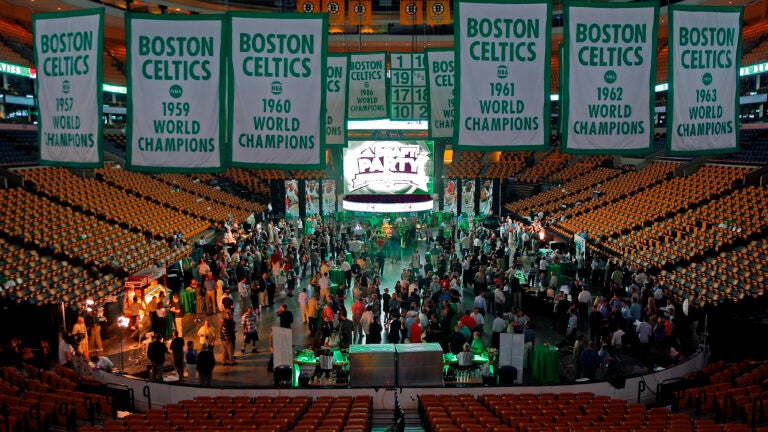
In a column on the night of the draft, the Boston Globe’s Dan Shaughnessy — who attended a draft night party for season ticket holders on the floor of TD Garden — lampooned the move.
The Celtics dumped the No. 5 pick and 23-year-old West and brought 31-year-old Allen on board. They said no thanks to the likes of Yi Jianlian, Corey Brewer, Joakim Noah, and Brandan Wright. No need for Green or Sean Williams.
“Everybody falls in love with the draft,” Ainge said, insisting that this is not a change in philosophy. “I’m not sure if any of these players in the draft are going to be as good as Ray Allen.”
Hmm. That one could come back to haunt him.
Shaughnessy also alluded to the possibility of moves to come:
Of course, there is the distinct possibility that the Celtics are not yet done. Makes sense. Maybe they still can get Kevin Garnett and storm the Eastern Conference with fossils Pierce, Allen, and Garnett. Maybe we’d all be OK with that. But it flies in the face of “the plan” they’ve pitched. And it strikes one as a major gamble.
Because if they don’t get Garnett, if this really is it … the Celtics look ridiculous.
Anything’s possible
There was enough time between the acquisition of Allen and the eventual trade for Garnett for Pierce to consider life with himself and Allen as the new Celtics core.“We were coming off one of the worst seasons all-time,” says Pierce. “I knew getting Ray Allen would definitely put us back in the playoffs. That’s all I could ask for after coming off that type of season at the time. The East wasn’t that strong. But I definitely think with me and Ray we still would have been able to put together like 49 or 50 wins without Kevin for sure.”Behind the scenes, Ainge was still working on the deal for Garnett.
“We were gonna continue to pursue it,” says Ainge. “Without having any assurance from KG, I just had a gut feeling that obviously Paul and Ray would be a lot more attractive to KG. But that’s really all I knew.”

Ray Allen threw out a ceremonial first pitch at Fenway Park on July 2, 2007. almost a month before the Celtics acquired Garnett. Afterward, he visited with Sox manager Terry Francona and the team in the dugout. (Jim Davis/Globe Staff)
Allen visited Boston to throw out a first pitch at a Red Sox game, and Pierce says the two talked about the team’s possibilities as two stars surrounded by a young corps. But the Garnett possibility lingered.
“I just remember us having phone conversations, and saying, ‘Man we have a chance to do something here,” says Pierce. “Right after we traded Ray it was just a lot of buildup like. ‘Hey, we’re trying to get Kevin Garnett, too.'”
As Ainge continued to work, he found that the same things that made Allen available also applied to Garnett.
“Ray and KG were the ones that had some possibilities,” says Ainge. “After you are dismissed on other players, Ray and KG and Paul were all on lottery teams at the time. And I think the teams are evaluating the best paths for their futures. And I think they were in their early 30s, and that’s when teams contemplate what direction they wanna go. And you can see that even happening in the league now. So that’s where both franchises were, and that’s why we were able to get both of those deals done.”
Garnett didn’t tell Ainge that the Allen deal had increased his desire to come to Boston, nor did he tell Pierce. For weeks, the Celtics weren’t sure if they’d made the right move.
“I remember I tried to reach out to Kevin,” says Pierce. “He didn’t return my call. But I remember talking to Antoine [Walker]. It was like a wedding in California. A lot of people don’t know, but it was Gary Payton’s wedding they all went to. Antoine was there, Kevin was there. And for some reason Antoine called me and was like, ‘There’s a chance ya’ll can get Kevin, they’re up here at the wedding talking about it.’ And I was like, ‘What?’ And I tried to reach out to him, but he didn’t really talk until after the trade finally went through.
“I didn’t really think it was possible,” Pierce adds, “until it happened.”