4 takeaways from the Celtics’ decision to trade the No. 1 pick
The Celtics' trade of the No. 1 pick opens up plenty of possible paths for the franchise.
COMMENTARY
Danny Ainge sent shock waves throughout the NBA world this weekend after reportedly agreeing to trade the No. 1 overall pick in the 2017 Draft to the Philadelphia 76ers for the No. 3 overall and a protected 2018 first-round pick from the LA Lakers (via Philadelphia).
The aggressive move has left Celtics fans with more questions than answers as the NBA Draft looms just days ahead. Why would the Celtics move down instead of taking what many believed was the No. 1 consensus pick in Markelle Fultz? Was the deal with the Sixers a prelude to another bigger trade, or just a way for the Celtics to improve their asset collection while building with an eye toward the future? And what doors could now be opened in the aftermath of a trade that’s expected to become official on Monday? Let’s examine the possibilities as the dust starts to settle from an eventful weekend.
1. Ainge has divided assets to give him more flexibility in potential trade talks
A No. 1 overall pick is one of the best assets a team can have in the NBA, but the lofty value and cost certainty of that selection makes it hard to justify moving it for anyone other than a few talented names. With that short list of players likely unavailable to Boston, the Celtics have potentially created more trade options for themselves by splitting the No. 1 pick into a couple of likely top-5 selections. That path bares risk, but it allows the Celtics to pursue a dual track of trading for a star (i.e. Jimmy Butler or Paul George) without mortgaging as much of the team’s future. It’s a lot easier to swallow giving up a lottery pick when you have already leveraged your No. 1 pick into a second cost-controlled high lottery selection.
2. The current Celtics backcourt can breathe a sigh of relief for the moment
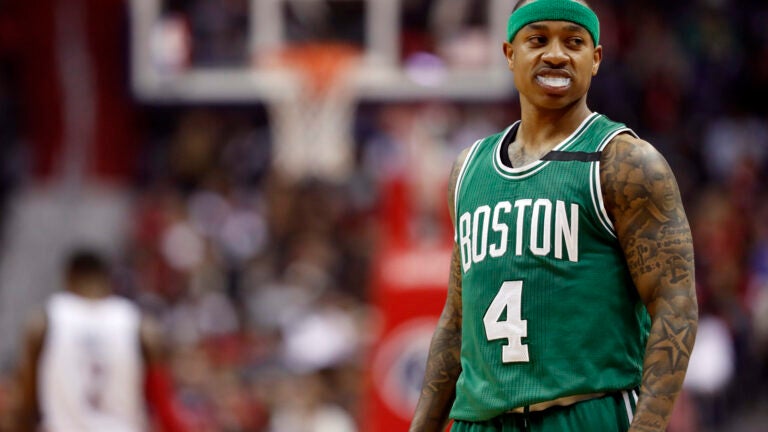
Ainge has some tough decisions to make about members of the C’s backcourt in the next 12 months with expensive contracts in free agency looming for Isaiah Thomas, Avery Bradley and Marcus Smart. The insertion of Markelle Fultz into that mix would have all but guaranteed the Celtics would be saying goodbye to at least one and maybe two members by the summer of 2018. While passing on Fultz doesn’t guarantee that trio will be back next season, moving down to No. 3 in the draft (a position where wing prospects are expected to be the best players on the board) indicates that Ainge is content building with some members of his current backcourt core. The possibility remains that a piece like Bradley or Smart may be moved in a package for a star, but Thomas can rest a bit easier knowing he doesn’t have to look over his shoulder at a No. 1 overall pick gunning for his job next season.
3. Waiting out the Warriors and Cavaliers and building primarily for the future is still a possibility
While we are almost certain to hear endless trade rumors in the coming weeks, there’s still a real chance this trade was made with an eye towards the long view for the C’s future here. Ainge reportedly has his eyes on Josh Jackson or Jayson Tatum at No. 3, two players he likely viewed with long term potential that wasn’t far behind Fultz. By adding the protected 2018 Lakers pick to the C’s collection, Boston has a legitimate chance to add two more studs in the very top heavy 2018 draft class since the Celtics own the Nets’ unprotected pick in 2018 as well. Building with that kind of talent for the long term would not push the Celtics towards contending in the next two years, but could ultimately give the Celtics the best chance at taking down the Cavaliers and Warriors down the road. Nabbing an elite superstar like Anthony Davis in a year or two via trade may also become more doable if Ainge has proven young players with star potential to move, instead of just the allure of future top picks.
4. Signing a max contract without sacrificing current talent on the roster just became a bit easier
One silver lining of the C’s moving down from No. 1 to No. 3 in the draft is payroll management for this summer. The No. 3 pick will earn a starting salary roughly $1.4 million less than the No. 1 pick in the first year of his rookie deal, and that saved cash will prove beneficial (if the pick is kept). The Celtics already need to open up more salary cap space on the roster to sign a max free agent like Blake Griffin or Gordon Hayward this summer, but they won’t necessarily need to trade a rotation player like Avery Bradley or Terry Rozier now in order to do so. Instead, a less painful path to max salary cap room (waive Tyler Zeller and Jordan Mickey, stash Guerschon Yabusele, trade Demetrius Jackson) will enable the Celtics to avoid making any trades strictly for fiscal reasons.