Donnie Wahlberg talks new Celtics-Lakers documentary and toughness of the ’80s NBA
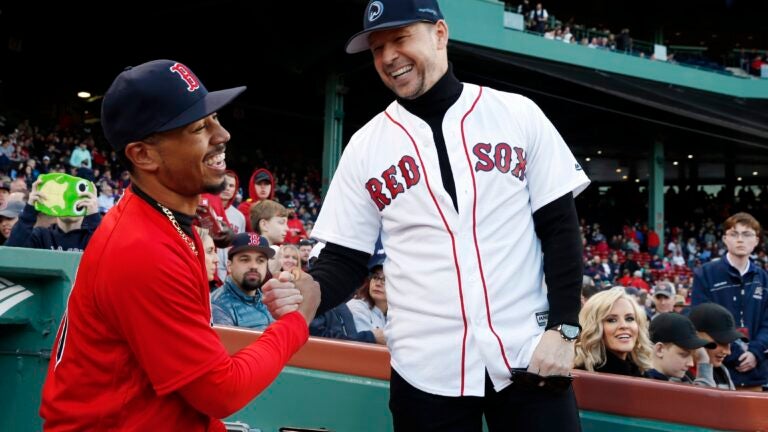
A conversation with actor, erstwhile New Kid, and bona fide NBA junkie Donnie Wahlberg, who is a narrator of ESPN’s 30 for 30 epic “Celtics/Lakers: Best of Enemies,” which premiered Tuesday night:
You’re the voice of the Celtics in this, while Ice Cube tells the Lakers story. How did you get involved in the project, and how long did it take you to say yes.
Wahlberg: I got a text from Chris Herren [the subject of a past 30 for 30] sort of out nowhere asking, ‘Hey, would you be interested in narrating a 30 for 30?” I said sure, not knowing all of the details, and he told me to call [director/producer] Jon Hock to let him know I’d be interested in doing it. Called him, he told me what it was about, and I believe my response was, ‘I would narrate that 30 for 30 for a grilled cheese sandwich. And I’ll pay for it.’’’
If you grew up in the ‘80s with the Celtics-Lakers rivalry at its pinnacle and the teams themselves essentially standing as metaphors for their cities, you know and appreciate the magnitude of what it meant. The teams were brilliant and the hatred was real. But what will basketball fans who didn’t live through it take away from the film?
Wahlberg: Fans of our generation know the details so well, the Celtics history and Red [Auerbach] and [Bill] Russell and the rich history, so maybe for us it’s not a lot of new ground. But for the country, it’s been a long time since these dynasties clashed in the ‘80s, and though we had a mini-rebirth of it a few years ago, and the reminder that this gives you of what it all meant and how contested it was is almost profound.
I mean, juxtaposing it against the Finals that ended last night, it’s going to be eye-opening for people unfamiliar with the depth of the rivalry and their legacies. You didn’t see a Kevin Durant situation or a LeBron James situation back in this rivalry. These guys were their own super team and they stayed together. They were united in a hatred for each other, even if in the end they ultimately respected each other.
Did you learn anything new during the voice-over process?
Wahlberg: Subtle things. I didn’t know that James Worthy grew up idolizing Cedric Maxwell, and then hated him to death when they were facing each other. They were both from North Carolina schools, Worthy looked up to Max, and then Max gives him the choke sign in the ’84 Finals when he’s shooting free throws. You would have thought they always hated each other, but that’s how it was.
I suppose I didn’t know about Bill Russell’s retirement ceremony being a private thing with no fans permitted. I probably had heard that before and it was kind of striking to see the images from it. But more than learning anything, it was really just about reliving it all.
The five-hour total run time over the three parts of the series allows for exploration not just of the teams during the different eras, but of the culture of the respective cities. The time spent on the Watts riots or the busing crisis here offers nuance and context, but I have to say, I wasn’t expecting it.
Wahlberg: I’m glad there is that depth to the project. I was on those buses. When I was recording the narration, I was talking to Jon Hock about it. I was one of those kids. I was bused from Dorchester to Roxbury, so I was in the minority in the school. As painful and tragic as that process was at that point in time, I like to think I’m part of the success story in Boston. At that time, everybody was outside the buses and going crazy, the kids on the bus were learning and adapting and being exposed to the things that the busing plan was created to do, emotionally and intellectually as well as physically. I know my life wouldn’t have turned out the way it did had I not been on those buses.
Did you hate the Lakers? Looking back and getting those reminders of how incredible the rivalry was, it seems impossible to have any lingering animosity to either side no matter your rooting interest.
Wahlberg: I think this was the case with most fans in that I evolved with Bird. As his respect for Magic Johnson grew, my respect for Magic Johnson grew. I felt a greater appreciation for Magic Johnson as the years passed and their mutual admiration became more known to us. When Magic showed up at Bird’s retirement ceremony with a Celtics shirt on, those moments built that respect for him.
I’ll never forget Bird’s press conference when he said Magic’s the greatest he has ever seen. I could see the hurt in Larry’s face when he said that, but it also made me comfortable to think, ‘OK, his version of the Lakers got the better of this rivalry, and that’s OK.’ If Bird can respect that and look up to Magic that way, I can too.
It astounds me that Magic isn’t mentioned more often in the argument of the greatest player ever to play. If Larry Bird thinks of him that way, there’s not another person’s opinion I need to hear.
I love the NBA now, and I know you’re still a genuine fan. But do you regard the ‘80s as the pinnacle?
Wahlberg: I respect the players who are and were great, no matter the time or place. I don’t respect the debate, you know, where we’re trying to coronate a player as the greatest of all-time four years into his career.
A little diversion on that, but I was at a game in 2010 and Hubie Brown was the color commentator for the broadcast. I was in the front row at the Garden and I walked over to him and said, ‘Why do you guys keep saying LeBron is the greatest of all time?’ And he said, ‘Oh, he will be, he’ll be the greatest of all time.’ I said, ‘Hubie, can you honestly tell me that LeBron James is better than Bernard King?’ Obviously Hubie was King’s coach at the height of his powers with the Knicks. And Hubie said, ‘You know what. I can’t say that.’ I said, ‘Exactly! Exactly!’’’
Now, LeBron has obviously passed Bernard King and a lot of other guys seven years later, but the debate is always so quick. Steph Curry, two years into his career, we’re asking if he’s the greatest shooter of all time. Sure, the kid is amazing and we’re seeing him do things no one else has done.
But if he’s playing in the ‘80s, it’s a different game. The players are more advanced now. It’s different athletically. But if you just watch the trailer for the 30 for 30, the 15-second trailer, there are three instances that would get you a three-game suspension now that probably weren’t even called a foul then.
Does that make it better or worse? I don’t know, but that definitely makes it harder. Larry Bird ass-bumping Michael Cooper into the photographers’ row is a lot worse than what Draymond Green got suspended for last year when he may or may not have punched LeBron James in the crotch. You knew when you got punched back then.
Chad Finn can be reached at [email protected]. Follow him on Twitter @GlobeChadFinn.