Which Celtics free agents probably won’t be back next season?
Unlike past offseasons, heavy roster turnover is expected this summer.
COMMENTARY
The Celtics came within three wins of advancing to the NBA Finals in 2017 and have the ability to retain most of the team’s roster this year in free agency. For many franchises, that would be a best-case scenario, but Danny Ainge is not your typical executive. The Celtics’ president of basketball operations knows that Boston still has a long way to go to become a contender and is set on shaking things up to achieve that goal.
“I feel like it doesn’t really matter what we’ve accomplished. If we’d lost Game 7 against the Wizards, I don’t feel any different than if we’re where we are today,” Ainge told Steve Bulpett of the Boston Herald. “I know that we’re good. I know that we’re not great. I know that we still have more to do, and, you know, that next step is by far the hardest.”
“We have a lot of good players,” Ainge later added, “but we need some great ones.”
In order to land those great players via trade or free agency, the Celtics will have to say goodbye to some of their current ones. Here’s a look at some of the team’s pieces that are set to hit the open market and the likelihood that they will or won’t be back in Boston.
Salary Cap Primer
You can read the full details here about the particulars of free-agent signing rights. The important thing to remember as it pertains to these Celtics free agents is that Ainge can’t sign his own free agents with Bird Rights and have the necessary salary cap space to sign a max free agent like Gordon Hayward or Blake Griffin. Barring a big trade, it’s one or the other. With that in mind, let’s take a closer look at each individual Celtics free agent:
Get ready to say goodbye (less than 10 percent chance of returning)
Amir Johnson: It was just two years ago that Johnson was the “highlight” signing of the C’s offseason, inking a two-year, $24 million deal. The 30-year-old helped transform the Celtics into a top-notch defense, but his role has steadily been on the decline in the past six months. He failed to play more than 18 minutes in a single playoff game, and the team couldn’t overcome his offensive limitations. With Croatian big man Ante Zizic set to join the team next year, the demand for a big body like Johnson will decrease as well. Boston will also need to renounce Johnson’s big cap hold ($18 million) in order to open up max salary cap space, which will almost surely happen. The 12-year veteran may have something left in the tank, but we aren’t likely to see it in Boston.
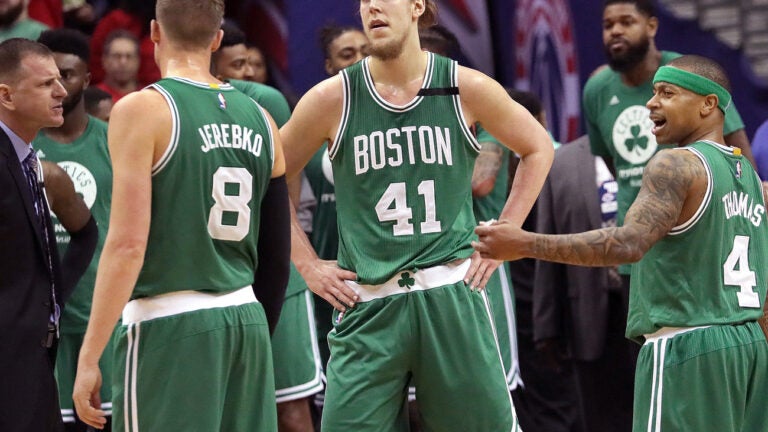
Jonas Jerebko: The high-energy power forward saved some of his best play of the year for the postseason. He helped rally the Celtics to a win in Game 3 over Cleveland and provided some strong contributions in Game 4 as well. Despite an up-and-down shooting season, Jerebko played up to his $5 million annual salary and likely could be had for a similar price this offseason. The problem for Ainge once again is carving out max salary cap space. If the Celtics are going to land a big fish like Hayward, they are going to need to open salary cap room by all available means. Barring a big trade, Jerebko’s reasonable $9 million cap hold won’t be able to be kept on the books. His Bird Rights will likely be renounced early in free agency, which will probably be the end of Jerebko’s stint in green.
James Young: The first piece of draft capital the Brooklyn Nets sent to Boston (2014 first-round pick) in the blockbuster KG/Pierce deal has provided a very underwhelming return during his first three years in green. Young, the No. 17 overall pick in the 2014 NBA Draft, is still just 21 years old, so there’s still plenty of time for him to blossom. The Celtics effectively passed on keeping him around beyond this season last October when they declined his $2.7 million team option for the 2017-18 season. The Celtics wisely determined they would be better off using that money for max salary cap room, and Young showed nothing this season that would change the team’s mind on that. Some rebuilding team will take a chance on Young to develop, but the time for him to do it in Boston has run out.
Not likely to re-sign (20-30 percent chance of returning)
Kelly Olynyk: Restricted free agents almost always remain with their original teams, but Olynyk could prove to be an exception on this front. The problem for Boston is that even though Olynyk is a restricted free agent, it doesn’t mean he won’t cost the Celtics salary cap room. His $7 million salary cap hold will be a roadblock to signing a max free agent, so barring a trade of another player (Avery Bradley?) to free up more salary cap room, the Celtics won’t be able to retain him and bring aboard a guy like Hayward.
Now what happens if the Celtics miss out on a max free agent? That’s the scenario in which Olynyk returns. Boston could still target less expensive names on the free agent market (with non-max salary cap space) and still re-sign Olynyk to a new deal. However, it’s reasonable to wonder:
1) How much is Olynyk worth?
2) Would the Celtics be better served spending that money elsewhere?
With bigger names (Isaiah Thomas, Marcus Smart, etc.) set to hit the open market next summer, the Celtics might not be able to tie up $10+ million per year in Olynyk and afford their other pieces. When you consider that reality, it’s possible Olynyk will be back, but it will have to be at a team-friendly price.
Decent chance of sticking around (50/50 chance of returning)
Gerald Green: The oldest member of the Celtics’ roster proved to be a game changer in the postseason as Green’s presence in the starting five against the Bulls helped turn around that first-round series. Still, Green didn’t play well enough in the regular season to justify a raise beyond the veteran’s minimum, and that’s exactly why he could be back in Boston next year. The Celtics probably won’t need to sacrifice salary cap space to keep him (a veteran’s minimum deal doesn’t eat up salary cap space) and the veteran swingman knows the system now, making him an asset for Brad Stevens. Green may try searching for a bigger bench role elsewhere, but the 6-foot-7 forward is incredibly the most likely Celtics free agent to be back in this group.