4 things we’ve learned about the Celtics without Isaiah Thomas
COMMENTARY
What you find when you Google “Isaiah Thomas” these days are a bunch of columns making the case the Celtics are better without their All-Star point guard.
“Thomas, for all of his offensive brilliance, is a ball stopper,” writes Dieter Kurtenbach of Fox Sports, who cites Thomas holding the ball for 5.5 seconds per possession in the playoffs, longer than LeBron James or Steph Curry. “And without him on the court, the ball is moving again. The Celtics had 28 assists on 42 made field goals in Game 3 and 26 on 35 in Game 4.”
SB Nation’s Tim Cato argues that the Celtics might not only be better right now without Thomas, they might be better without him long-term.
The columns are wildly premature — two and a half games does not a legitimate sample make — but Boston’s brief stretch of playing without Thomas against Cleveland has provided some insights as to what life might look like without him.
Here’s what the Celtics have learned playing without Isaiah in the Eastern Conference Finals:
They aren’t better off without him, but they don’t stink.
Basketball is a results-based business, and by results alone, it’s easy to conclude the Celtics might be better without Thomas. With Thomas on the floor they lost Games 1 and 2 of the Eastern Conference Finals by an average of of 28.5 points. Without Thomas they won Game 3, and took a halftime lead in Game 4.
But results alone don’t mean anything in a four-game sample — if the Celtics lose by 15 tonight, for example, the entire better-without-Isaiah theory goes out the window.
What we can learn from the sample is the Celtics play differently without IT. The ball movement Kurtenbach mentions in his column is a real thing, and manifests itself in plays like this one in Game 5, where Kelly Olynyk beats LeBron to the hoop for the layup:
KO with the reverse pic.twitter.com/lEodTFR3yj
— Boston Celtics (@celtics) May 24, 2017
Or this one, where Jonas Jerebko finds himself wide open in the corner after an Al Horford drive-and-dish:
Jerebko wide open 👌 https://t.co/fOa5JaESIf
— Boston Celtics (@celtics) May 24, 2017
The first half of Game 4 is easily the best the Celtics have played all series, but it’s probably not the best they’ve played all playoffs — Game 5 against the Wizards, when Isaiah and the Celtics were firing on all cylinders, comes to mind.
Still, the Celtics can look good without Thomas, except in the 4th quarter of games against a team with three superstars. Because as Chad Finn points out in his column after Game 4, games in which Kyrie Irving goes off for 42 points make it painfully clear the Celtics miss their own version of Kyrie when it matters.
They can lock in on defense — sometimes.
The Celtics are a better defensive team without Thomas, and clearly benefit on that side of the ball when the relentless Smart plays in Thomas’s sted.
Picked off and finished for 2 https://t.co/B0ix3pL6LK
— Boston Celtics (@celtics) May 24, 2017
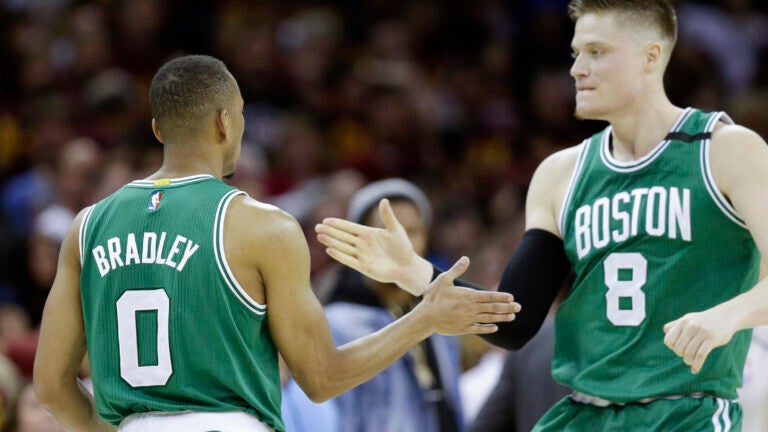
But the Celtics’ sometimes porous defense can’t all be blamed on Isaiah. Smart and Avery Bradley were on the floor a lot in Game 4, when Irving scored 42 points. And while the duo was on the floor to help hold Cleveland to 19 points in the 1st quarter in Game 4, they were also on the floor to allow the Cavs 93 points on 38 of 55 shooting the rest of the game.
Gary Washburn writes that the Celtics’ defense wasn’t there when they needed it, and he’s right. With or without IT, the defense has to be better for longer stretches.
Marcus Smart is a tenacious defender and a courageously bad shooter.
On Wednesday, Deadspin’s Tom Ley wrote a post titled, “Show me your favorite Marcus Smart highlight”, with the premise being, in his words, “Has Marcus Smart ever done anything remotely cool or impressive in an NBA game?”
It’s a troll-y, funny question for those of us who watch Smart regularly and routinely see him make defensive plays like this.
But Ley’s post was also a commentary on Smart’s offense, which to the naked eye looks about as bad as the shooting percentages indicate. Smart made 7 of 10 3-pointers in Game 3, and he probably won’t do that again. He’s not going to start replacing Thomas’s scoring production, at least not completely.
But you have to admire the conviction with which Smart shoots. There have been dozens of games this season when Thomas is sitting and Smart puts the offense on his back, sometimes to Boston’s detriment. But guys like Al Horford, Jae Crowder, and Avery Bradley aren’t always willing to take big shots in big moments. Smart has no conscience.
If only he could make a few more of them.
Brad Stevens is a brilliant coach — and flexible one.
After the Celtics traded for Thomas in February of 2015, Brad Stevens spent an entire summer building the entire Celtics’ offense around him.
And it’s worked — No. 1 seed, 28.9 points per game for Thomas. So it’s even more impressive Stevens is changing his offense on the fly in the Conference Finals.
Parts of Games 3 and 4 were clinics in ball movement — here’s Olynyk again moving without the ball and laying it in.
KO 🔨🔨🔨 https://t.co/x8d0h4beWH
— Boston Celtics (@celtics) May 24, 2017
The Celtics don’t have anyone besides Thomas who can reliably create his own shot, but when Boston’s offense is clicking, it can look like it doesn’t matter.
“They run different things just because of IT being a huge piece of the puzzle for them offensively,” says James. “So they had to kind of reshape, and that’s the beauty of having Brad Stevens as your coach.”
Cavs coach Tyronn Lue even went as far as to say Boston’s offense is harder to prepare for than Golden State’s, noting “Brad’s got them moving and cutting and playing with pace and everybody is a threat.”
Then there are the out of bounds plays, so good that even Celtics players are surprised.
We’re seeing just how good Brad Stevens is in this series.