How the Celtics scout the NCAA Tournament
Austin Ainge explains what the Celtics are looking for during March Madness.
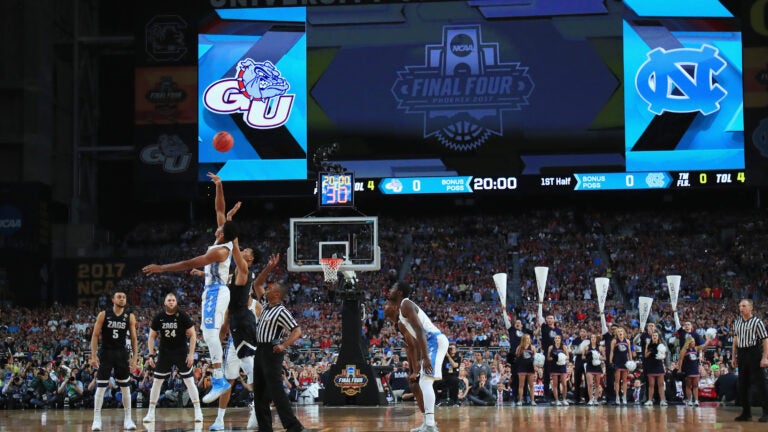
The NCAA Tournament always provides a bigger stage to top prospects in an upcoming draft class, but what does it mean to the NBA teams around the league that have already spent months tracking some of the biggest names in college?
That’s a question that many Celtics fans were probably left wondering after watching potential lottery picks like De’Aaron Fox and Lonzo Ball square off during March Madness the past couple weeks. How much would Fox outplaying Ball in that head-to-head battle actually matter in the long run?
In order to answer that question, Boston.com caught up with Celtics director of player personnel Austin Ainge to learn more about what the franchise looks for when comparing tournament games to a player’s overall body of work. The 2017 NBA Draft will mark the third straight year that the Boston Celtics will have a collection of at least four picks, including one guaranteed to fall in the top-4. With so much ground to cover, it’s a busy time for Ainge and the rest of the front office.
Q: How do you guys break down where to watch the NCAA Tournament? [Assistant general manager] Mike Zarren posted 4 TV set up in Danny Ainge’s office, is that the usual setup?
Our staff, all together in a room, will watch 53 games these four days (on 4 TVs): 48 NCAA, 2 Celts, 2 Claws, 1 Euro. Lots of good debates! pic.twitter.com/TLfWgZMT7D
— Mike Zarren (@mikezarren) March 17, 2017
Ainge: In general, we watch from Danny’s office. Occasionally, there will be a specific matchup we want to see or go to. I had a regional guy or two out at the sites, but most of us were in the office. We kind of use it as a time to have some meetings about the general list of guys and some rankings. It’s kind of a good time to get everyone in the office, where usually we are spread out scouting different things.
Q: How do you guys decide what game goes on the big screen?
Ainge: We rotate it a lot so if a team gets up 25, we’ll switch to another game. It’s fluid throughout the day, but the prospects we are most interested in will get the big screen.
Q: With nearly 12 hours of games on the opening days of the tournament, I imagine there was a lot of Chipotle delivery during the day?
Ainge: Absolutely. There are definitely some Chipotle runs.
Q: What are the advantages to watching the NCAA games together as a staff on TV versus watching it live in person?
Ainge: You learn more live, right? Live is better. By the NCAA Tournament, we’ve already seen the guys live a number of times. We use that time to kind of have meetings and discussions about the players and start the general process of getting our draft board and workout lists, who we need more information on. It’s kind of an end-of-the-season recap, we use it at that.
Q: So you guys are trying to create some fuller draft boards and tiers at that point in the process?
Ainge: We’re tweaking and discussing all the way up until draft day. There is usually no finite beginning or end. We usually have all of our scouts out at conference tournaments and it’s a good time to have everyone together [in the office] and have some meetings before the draft workout process starts. We’ll share some notes on the conference tournaments and what we’ve seen throughout the season.
Q: After watching these players all year long and even years before, what are you watching for specifically around tournament time? Is it how prospects handle a bigger stage or something more than that? Do you care about how players do little things like handle short rests in conference tournaments?
Ainge: [In conference tournaments], It’s more about that the freshmen now have a lot of experience, right? Tough teams in your conference know [a player’s] strengths and weaknesses and try to take them away. There are some differences, but it’s all in context. No one thing matters too much, but everything matters a little bit. It’s all about adding it up.
Q: How much more weight, if any, do you guys give NCAA Tournament games over regular-season games or draft workouts, combines, etc.?
Ainge: It’s just one game in the body of work. The teams with the real small schools that don’t get to play a lot of good teams, the few games they do play against good teams, it matters a little more when you’re evaluating, whether that’s an early non-conference game or a tournament game. The kids that play a lot of big games against good teams, it’s just another game.
Q: It’s clear that players get bumps on mock drafts and among fans’ perspectives if they have a good tournament. How real is that and do you guys do anything specific to temper those reactions internally?
Ainge: No, I don’t think that matters. I don’t think it affects anyone that much. Most scouts I talk to have their minds made up by December [about prospects]. I don’t think that’s a real big issue.
Q: How much does the age of a player affect how much stock you put into a player’s NCAA performance? More leeway if they are an 18 -year-old freshman on big stage for first time vs. 22-year-old senior?
Ainge: It does. Age always has to be taken into account, but not anymore for the tournament compared to the regular season. We really just don’t weigh the tournament that differently.
Q: Does the sheer number of picks you guys have in any draft change the way you scout a season?
Ainge: Every year in the draft, we always talk about how we have to be ready for picks 1-60 no matter what, because you never know what trades are going to happen. I think probably on some level, if you have eight picks in a draft, you do focus a little more. It’s a little easier. I don’t think there are any real process differences. We evaluate even more, evaluate into the hundreds of players. You’re going to evaluate those guys in the following year in the D-League and Europe. For the next 5-10 years, you are going to evaluate a lot of them so you just start and try to get to know everybody.
Q: Any instances with you guys in past tournaments where a player has significantly helped or hurt themselves in the tournament?
Ainge: I would have to go back and look, but I think small conference guys that do really well against weaker competition, then come to the tournament and continue to do it against higher level competition, I think that helps them the most and vice versa. It hurts them the most too if they struggle.