Should the Celtics go after Paul George or Jimmy Butler?
In an ideal world where the Celtics had their pick, which player is a better fit?
COMMENTARY
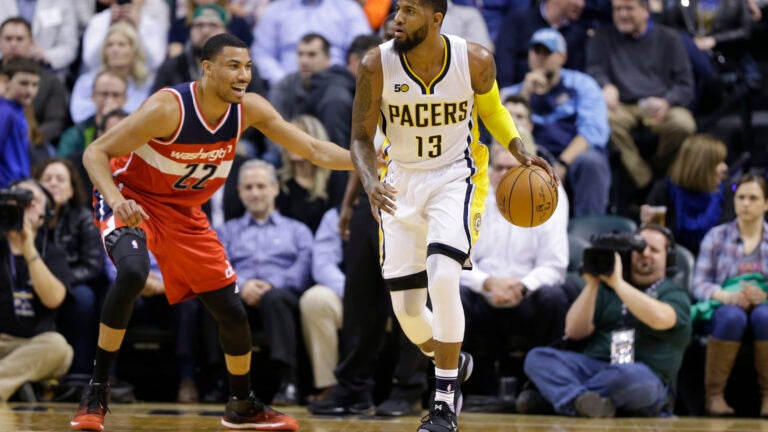
Paul George is really good. So is Jimmy Butler. In recent days, the Boston Celtics have been linked to both. If you had to pick a most likely outcome, it would be that the Celtics acquire neither of them, retain their draft pick cache, and dream on Markelle Fultz for another few months. Putting together blockbuster trades is hard, especially when the clock is ticking, as it currently is to Thursday afternoon’s trade deadline. But frankly, focusing on the most likely outcome is a little boring. Let’s have some fun. Who would you rather have – Butler or George?
For the purpose of this exercise, let’s assume the cost is the same, just to simplify things. Now, before we get to the stats and game theory, let’s get some basic facts down. George is listed as in his age-26 season this year, and Butler his age-27 season, but the actual difference in their ages is just 230 days, or 63 percent of one year. They’re pretty close in age, in other words. They are both listed as pretty close in weight as well – 220 lbs. for George vs. 231 for Butler. At 6’9”, George’s listed height is two inches taller. Butler is slightly cheaper and is signed for one more year than George – Butler is signed through the 2019-2020 season, while George is a free agent after 2018-19 — though the last year of each of their contracts is a player option. In other words, trading for George only guarantees that you would have him for the remainder of this season and all of next season.
Contract length is one of the important differences between the players, who match up pretty evenly. Let’s examine some traditional statistics.

I use “per 36 minutes” instead of “per game” statistics here, because it’s a more even comparison, since the two don’t play the exact same number of minutes per game. On the top, we have this season’s statistics and on the bottom, the last three seasons, counting this season. George missed most of the 2014-15 season, but that isn’t as relevant here since we’re using all rate statistics. As you can see, they’re pretty even. Butler is a better shooter than George from the field, but George is better from long range and from the free throw line (though certainly Butler’s free throw percentage is excellent). They’re both adept at stealing the ball, but not really a force anywhere else, though Butler’s assists have improved this season.
On to the advanced metrics.

A lot of these may be less familiar. You can find the definitions to them at Basketball-Reference’s Glossary if you’re interested. There are three important takeaways. The first is that they’re both great shooters and not-so-great rebounders. We already had discovered that, but it’s nice when the advanced stats line up with the traditional stats. Second, Butler has been a more efficient player, as noted by his lower TOV% (turnover percentage) and his higher PER (player efficiency rating). This is true for both blocks of time. Third, Butler gets to the rim far more frequently than George does, and launches far fewer threes.
Taking that one step further, we can look at Basketball-Reference’s splits by shot distance. When we do, we find that 44.6% of Butler’s shots come from 16 feet and out, while 62.8% of George’s shots do. Butler takes almost precisely double the shots that George does at the rim (0-3 ft.). So, perhaps the better question is what sort of player is going to fit better in Boston’s current system? The answer there would almost certainly be George.
This season, the 33.8% of the Celtics’ shots come from three-point land, which is the third highest in the NBA behind only Houston (38.0%) and Cleveland (35.4%). Boston also takes more than 52 percent of their shots without dribbling (52.7%), which is the fourth-highest percentage in the NBA, behind only Golden State (56.4%), Houston (53.9%) and Memphis (53.7%). George is more equipped to shoot in this type of environment. One of the way the NBA breaks out shot attempts is by catch-and-shoot, which is the same as no dribbles, and George’s effective field goal percentage is 57%, whereas Butler’s is 49.5%. George’s three-point percentage in these situations shows a similar edge – 41.1% for George vs. 33.8% for Butler. And George holds these edges even though he has taken far more shots in these situations – 251 shots for George to 100 even for Butler. For reference, the Celtics leader in these categories is Isaiah Thomas at 60.9% and 41.9%, respectively. George would be second-best on the C’s in both categories, slightly ahead of Kelly Olynyk and Jae Crowder.
Of course, the question could also be do the Celtics want a better version of the players they have now, or do they want a player who can take the ball to the hoop like Butler does? Brad Stevens is a good enough coach to adapt to either player, so it may not matter, but the two players certainly do have distinct styles.
The only other major factor would be injuries. If you subscribe to the theory that George is more damaged because he already missed nearly a whole season, you’d tip your cap toward Butler, who has never missed more than 13 or so games at a time. Then again, the stats say George has been just as good after his injury as he was before it. If anything, he’s been better. His PER and 3PT% have gone up, and his FT% has gone up by almost 50 points. And despite the missed time, George has player nearly 2,000 more minutes in his career than has Butler.
Paul George is really good. So is Jimmy Butler. The Celtics would be very fortunate to add either player. Both would make it much more difficult to double team Isaiah Thomas once the playoffs begin, and both can be counted on to pour in points and play respectably in all other phases of the game. Their different styles of play set them apart, as does the fact that Butler is under contract for an additional season. There is no wrong answer here, but if the priority is to make a run this season, George might be the better fit, as putting him into the mix would require the fewest adjustments to Boston’s current offensive scheme.