
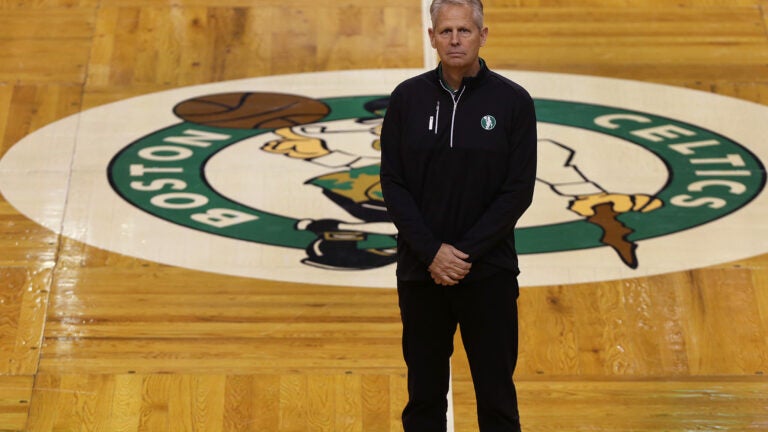
Outtakes and insights from a conversation with Celtics boss Danny Ainge
One way he tries to gain an edge for the Celtics? By finding players with an edge.
COMMENTARY
If you didn’t catch it the 44 or so times I sent it out on the social-media rounds, I have a profile on Celtics boss Danny Ainge in the latest Boston Globe Magazine. The piece is focused on this particular place and time for the Celtics and the quest to build another championship team. Check it out here.
Ainge was as candid as always — he mentioned almost offhandedly that there was a time when he considered trading Paul Pierce to Minnesota to unite with Kevin Garnett there — and he had plenty of interesting things to say that didn’t make the cut.
Here are a few of his other thoughts, including on what he learned from Red Auerbach and the side to Brad Stevens we don’t get to see.
On putting a premium on players with an edge: “I had one brother [Ainge had two older brothers] who was a Marcus Smart-type of competitor, a very, very highly competitive. I don’t think we ever finished a game. That’s where I first learned the value of intensity, of having an edge. Every coach every fan wants players to play with maximum effort. It’s a talent, and it’s a hard thing to acquire.
“I think it’s easier to become a better shooter than it is to learn to become an intense player. Delonte West and Tony Allen, they were two of my favorite players I’ve ever drafted. And that’s what stands out about a lot of the people that I draft. But not all of them. Maybe my favorite guy I ever coached was Jason Kidd. And Jason played with an amazing edge. Larry had that edge to him too. All those guys I’ve mentioned, their teammates wanted to play with them.
“People value it different. Maybe I overvalue it. I like it when I see it in player, but I also like great shooting and great length, and size, and rebounding. We were the fourth-ranked team in the NBA in defense last year with a 5-foot-8 starting point guard and no rim protectors. That tells you a little bit that the strength of the team was our perimeter defenders. That little edge is good, but not only that, it’s contagious. They see that from a well-established player, and they realize that’s the level you have to play at to really be successful.”
On working with coach Brad Stevens: “I told Brad right away, ‘I don’t want to surround you with a whole bunch of veteran NBA coaches. I want you to be you. Let’s figure this out together.’ And he’s done that.
“There’s much more of a competitive fire that burns inside him than people see on the outside. I love his temperament; I love how he communicates with his team. I was more demonstrative for sure, especially in my younger years. Brad keeps it inside, and that’s good.
“But I get to see the fire. When it’s just him and me in a room after a game, I get to see what the rest of the world doesn’t. And the sense of humor. He’s just a real guy. It’s so fun for me to be around someone so young who’s so smart, so competent, and so secure in who he is. And so humble in understanding that he doesn’t have it figured out.”

Danny Ainge played with five Hall of Famers on the 1985-86 Celtics, including Bill Walton.
On what he learned from Red Auerbach: “I learned a lot, especially on how he dealt with people. He was sort of a crusty, grouchy guy at times, but I loved how he knew the right things to say to the players. I loved how his presentation of the guy who made the winning play wasn’t Larry Bird’s 42 points it was, you know, [Robert] Parish’s charge he took with 2 minutes left in the game, or Ainge diving for a loose ball on a possession where we ended up hitting the go-ahead shot.
“In my eight years here, the times Red celebrated me after a game were usually when I started a fight with the other team. It was those types of thing that he appreciated. Heart, intensity, things that go beyond the normal, things that not every player would do or would be willing to do, but who would do whatever it took to win a game.”
On whether it’s more difficult to build a championship team in the NBA than any other sport: “I’d agree with that assessment. You have 53 players on a football team, it’s easier to piecemeal a team together. Baseball is sort of the same way – there are a lot of ways to build a winning team. The competition is getting harder in the NBA, certainly more than in Red’s day. General managers are better. Teams all have a lot of money, there’s financial equality, so there aren’t as many deals to be had that are just financial.
So with the health financially of the league, it’s becoming more challenging, because the league requires, or at least appears to require, superstars to win championships. That has been the general pattern over the last 40 years, maybe longer. And they’re not nearly as available as they might have been a generation ago.
“If you look at Michael [Jordan], Larry, Magic [Johnson], Tim Duncan, and then you look at Steph Curry and LeBron [James], they’ve been these players that are the hardest-working, coachable players. It’s not just talent. You can’t have your best players be knuckleheads. You need your best players to be unified, understanding the needs of the team type of guys.
“So that drops the number down from transcendent players to a number much less than there are teams in the NBA. There are already a few teams that have multiple numbers of them. So that really magnifies the degree of difficulty.”
On the blockbuster trade with Brooklyn in June 2013 that brought a haul of three first-round picks (among other things) for aging stars Paul Pierce and Kevin Garnett, plus Jason Terry: “The Brooklyn deal, I was envious of [then-Nets general manager] Billy King and where he was, having the potential for a really good team. He had Deron Williams, a terrific All-Star player, Brook Lopez, a young big man, and Joe Johnson, a fantastic players who had destroyed us. They had a great nucleus, and by adding Paul and KG, what a great opportunity they were going to have.
“It wasn’t like I fleeced Billy. They just had injury after injury. It was a gamble for them. We thought at the time those picks were going to be 25, 26, 27. Maybe by ‘17 and 18 we’d have been picking higher. [This year, the Celtics used the No. 3 pick on Jaylen Brown, and the Nets are expected to be one of the worst teams in the league again. The Celtics have the right to swap picks in ’17.] We certainly didn’t expect this.’’
Postscript: One of the general managers quoted in the story – I’m not sure I can say which one, so I won’t – disputed the notion that Ainge didn’t know he was pulling off a heist. “Everyone in the league knew he pulled off a steal the minute it happened,’’ the GM said. “Except, apparently, Billy.”



To comment, please create a screen name in your profile
To comment, please verify your email address
Conversation
This discussion has ended. Please join elsewhere on Boston.com