
Who deserves the Celtics’ final roster spot: R.J. Hunter or James Young?
One of the two shooting guards is likely to be cut or traded by Monday's roster cutdown deadline
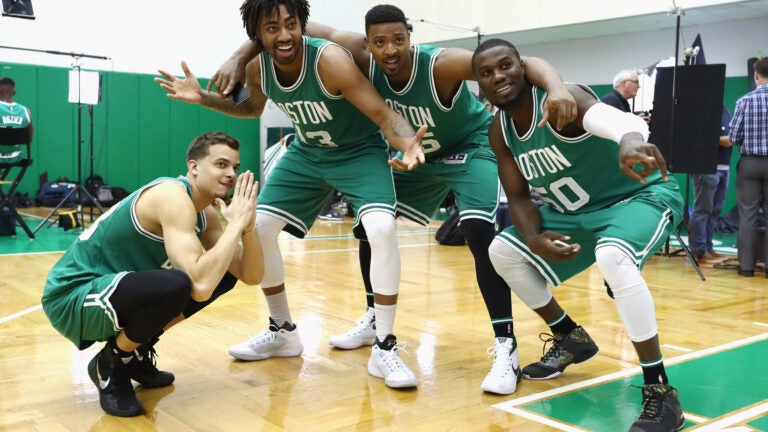
COMMENTARYWhen the Celtics elected to keep and use six of their own picks during the 2016 NBA Draft, Danny Ainge knew that he was creating the possibility of an overcrowded roster. Despite choosing to leave two of those picks (Ante Zizic, Guerschon Yabusele) overseas for the 2016-17 season, the Celtics still entered training camp in a conundrum, having 16 guaranteed contracts fighting for just 15 roster spots. Given the construction of the depth chart, the prevailing thought throughout the preseason has been that guards R.J. Hunter and James Young are the two players battling for the final spot on the roster. The Celtics have until Monday evening at 5 p.m. ET to figure out which of the two players they want to keep, unless they elect to open up another spot on the roster via trade, a move that could enable them to keep both. “It’s been tough for the last few months trying to figure out how it’s all going to work out,” Danny Ainge said Tuesday night at the Celtics Shamrock Foundation Gala. “We have a deadline coming up and we’re not looking forward to that.”Ainge’s hesitation to make a move comes for good reason. Both Hunter and Young have flashed impressive signs of their potential this preseason in stretches, making the proposition of losing either young player for little or no return in the next week tough to swallow.“It’s not my decision. Them boys is playing well,” Isaiah Thomas said of the battle earlier this week. “They’re making it tough on Danny Ainge and the organization. They’re playing at a high level and they keep it that way – not just in the games but in practice.”With deadline day looming, let’s take a closer at the case each player has made for the team’s final spot and try to determine who is more likely to stick. THE CASE FOR R.J. HUNTER
The 22-year-old started this competition with an edge over Young since he finished ahead of him on the depth chart during his rookie season in 2015-16. Hunter’s overall numbers weren’t impressive (2.7 ppg, 36.7 FG%, 30.2 3pt%) in that campaign, but he earned the trust of Brad Stevens early in the year with his all-around play. He fit well within the flow of the team’s offense with his ability to move off the ball, catch-and-shoot, and handle the rock within a pick-and-roll.
After a slow start to this year’s preseason, Hunter has show some progression with those skills over the past few weeks. His arsenal was on full display in Saturday’s win over the Knicks when he exploded for a team-high 17 points on 6-of-8 shooting in just 12 minutes of action.
Hunter’s outside shot during the preseason has remained inconsistent (27.8 percent from 3-point range), but he has looked steady inside the arc (44% FG), showcasing a reliable midrange game and additional confidence taking the ball to the rim. On a team that has lacked shot creators at time, Hunter could be valuable injury insurance if a backcourt player goes down.
Defensively, the former Georgia State star has lacked the strength and speed to stay with proven shooters at times, but he still demonstrates a solid game IQ. He knows the fundamentals well, likely the byproduct of being a coach’s son (his father Ron Hunter coached him at Georgia State). While he may never be a plus NBA defender, he’s still ahead of Young in that department, something that bodes well for him come decision time.
THE CASE FOR JAMES YOUNG
On draft night in 2014, Brad Stevens gleefully told the media that he had Young among his top-9 prospects when the Celtics managed to snag him at No. 17 overall. That perceived potential is likely the biggest thing Young has going for him as he enters his third NBA season. Unfortunately for him, the Celtics have failed to see much promise over his first two years in green.
The 6-foot-7 swingman failed to carve out a rotation spot for himself beyond more than a few games during those campaigns as he’s been shuttled regularly between Boston and the Maine Red Claws in the D-League for additional development. Young’s most promising trait out of college (outside shooting) has not translated, and he’s shot a mere 34 percent from the field and 25 percent from 3-point range in his NBA career. Those uninspiring numbers led Ainge to call him out directly this past summer when asked about the team’s crowded roster.
“Listen, you have to earn a roster spot,” Ainge said. “There are some exceptions, like James Young is an exception. He was drafted at 18-years-old, and we have to be patient with him, but now it’s time.”
Young has responded to that challenge this preseason with some encouraging consistency. While he has not had a standout performance like Hunter had against the Knicks, the 21-year-old has been one of the best outside shooters on the roster, hitting 6-of-14 attempts from beyond the arc. He’s also been more active in other phases of the game, showing notable increases his defensive rebounding and assist rates in the past few weeks.
Defensively, Young struggles to keep opposing wings in front of him and defend against cuts off the ball. Those weaknesses seem glaring but are issues that face many 21-year-olds at the NBA level. If he can turn the corner in those areas, his size and improved jump shot could certainly help a Celtics team that finished 27th in the league in 3-point shooting percentage last year.
THE VERDICT
The good news for Ainge is that both Young and Hunter have played well enough to make this choice a challenging decision for the team. The loser of the battle could potentially fetch some kind of a minor return for Boston via trade (i.e. a second round pick), a small consolation for having to cut bait on a first round pick this early in his career.
Ultimately the Celtics will make this decision not based on a handful of preseason games, but on the entire body of work they’ve seen from both players, as Brad Stevens explained on Monday:
“Everything’s got to be factored, I think,” he said. “But as part of that you factor improvement, right? So I think you factor more of the past in comparing to what you see now. You see a level of improvement. You see a commitment to getting better and growing. We’ve talked about it, that’s like the most important thing for our whole team, and 1 through 15. So that’s why this has become a hard decision, because everybody has gotten better. And that’s a good thing. That’s what you ultimately want. But these guys have put in a lot of work to get better. And so that’s what makes it tough. It’s going to be a tough call.”
While Hunter and Young have both made strides this fall, Hunter is the more-rounded commodity at this point. He earned the trust of the coaches last year, something Young has failed to do in two full seasons. Hunter is also the cheaper alternative moving forward, as he will make less than half ($1.25 million) in 2017-18 compared to what Young is owed. Ainge will have to make a decision on whether to pick up that team option by October 31, but for a team trying to maintain plenty of room under the salary cap for a max salary free agent next summer, the difference matters.
Barring the team fetching a significantly better trade return for Hunter over Young from an opposing trade, Hunter is the more deserving choice to make the roster.



To comment, please create a screen name in your profile
To comment, please verify your email address
Conversation
This discussion has ended. Please join elsewhere on Boston.com