
Is Russell Westbrook a viable trade option for the Celtics?
Weighing the pros and cons of any potential deal to bring the superstar to Boston.
COMMENTARY
The big fish in NBA free agency have found their homes, but that has not prevented the trade winds from swirling around the Celtics in the wake of Al Horford’s decision to sign a four-year deal with Boston last week.
Inking a 30-year-old player to that kind of a contract is a clear sign the Celtics are ready to take a step forward from last year’s 48-win campaign, and various member of the organization including co-owner Wyc Grousbeck have indicated the franchise isn’t done this offseason.
“Well, I feel the phones are definitely ringing,” Grousbeck said last week at Horford’s intro presser in Waltham. “Danny is definitely talking to people for sure, and has indicated that our work is not yet done.”
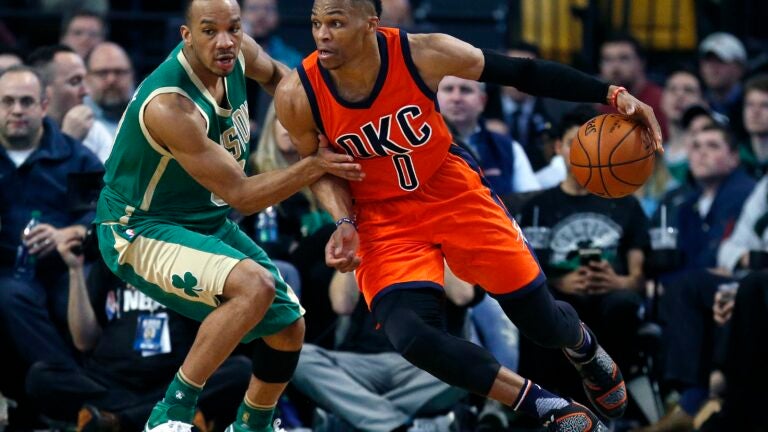
One name that has been floated in trade rumors following Kevin Durant’s departure from Oklahoma City is point guard Russell Westbrook. Howard Beck of Bleacher Report reported Wednesday that some league executives expect Thunder GM Sam Presti to move the athletic superstar ‘sooner rather than later’ and lists the Celtics as the most likely destination for the 27-year-old.
Just how realistic is a Westbrook-to-Boston scenario? Let’s examine the implications and potential roadblocks of a hypothetical swap.
Westbrook’s Contract
It’s important to start with the guard’s contractual situation, since that’s the reason Oklahoma City may place him on the trade block in the first place. The five-time All-Star is entering the final year of a five-year contract in which he’s set to earn $17.8 million for the 2016-17 season.
That kind of salary makes him a bargain in an NBA economic climate that has enabled players like Evan Turner to be handed long-term deals worth $17.5 million annually. The problem for the Celtics or any other team interested in trading for Westbrook is the fact his cheap deal runs out so quickly. He’s able to hit the open market as a free agent next summer when the salary cap is expected to rise to $102 million.
After watching Durant depart without compensation, the Thunder are clearly worried that they will not be able to retain Westbrook in free agency if they elect to move him this season. While the Celtics have a brighter future outlook than most franchises around the league, the gamble involved in dealing for a player on an expiring contract would be significant. Rumors have long swirled that the 6-foot-3 guard has eyes for Los Angeles, where he grew up and played collegiately.
A $102 million salary cap means plenty of suitors, including both LA franchises with enough cap space free to make a run at the athletic guard. That fact itself isn’t enough to prevent Ainge from talking deal with OKC, but it will affect just how many assets the Celtics are willing to give up in a hypothetical swap.
The one loophole that could help the Celtics solve this problem is to gauge Westbrook’s willingness to sign an extension before free agency. If Ainge creates enough room under the salary cap ($9 million roughly), he could raise Westbrook’s salary by that total for next season and offset the potential max earnings the point guard would sacrifice by adding an extra year or two to his deal based around this year’s $94 million cap.
It’s an option worth exploring if talks materialize, but there’s no guarantee Westbrook will want to sacrifice his right to become a free agent for the first time in his career.
On-Court Fit vs. Trade Compensation
The deepest part of the Celtics’ current roster is the backcourt, where the team has an All-Star point guard, an All-NBA defender and a couple of emerging young talents on rookie deals in Marcus Smart and Terry Rozier. That depth on its own should not preclude the Celtics from pursuing an MVP candidate in Westbrook.
The former No. 4 overall pick has averaged over 21 points per game for the past six seasons, is one of the best backcourt rebounders in the league, has posted 6.8 free throw attempts per game over his career and has consistently elevated his game over six postseason appearances.
With all of that said, he isn’t the perfect fit to address Boston’s needs on the roster right now. Westbrook’s unquestionably better than anyone on the roster, but Ainge does not exactly have a problem at point guard right now with Thomas, and it’s unclear if those two would be able to co-exist on the floor together with their size limitations.
Westbrook does plenty of things extremely well, but outside shooting is not one of them. He’s a career 30.2 percent shooter from 3-point range. When you account for the fact that the Celtics would likely have to deal away at least 1-2 of their dependable shooters in a package to acquire Westbrook, it’s unclear whether landing the eight-year veteran would make Boston a contender immediately.
When you factor in that reality and the inherent risks that Westbrook could leave town after just one season, the Celtics need to tread lightly when considering any trade scenario involving the superstar guard.
Without assurances he’s willing to sign an extension with Boston, the price (future Brooklyn Nets draft pick(s) + young core pieces) Ainge would presumably have to pay for Westbrook will likely be too extreme for the risks involved. The Celtics are better off finding a better roster and contractual fit more conducive to their rebuilding timetable.



To comment, please create a screen name in your profile
To comment, please verify your email address
Conversation
This discussion has ended. Please join elsewhere on Boston.com