
Comcast SportsNet’s ‘The ’86 Celtics’ does justice to its subject
Two-hour film premieres Wednesday night at 8 p.m.
COMMENTARY
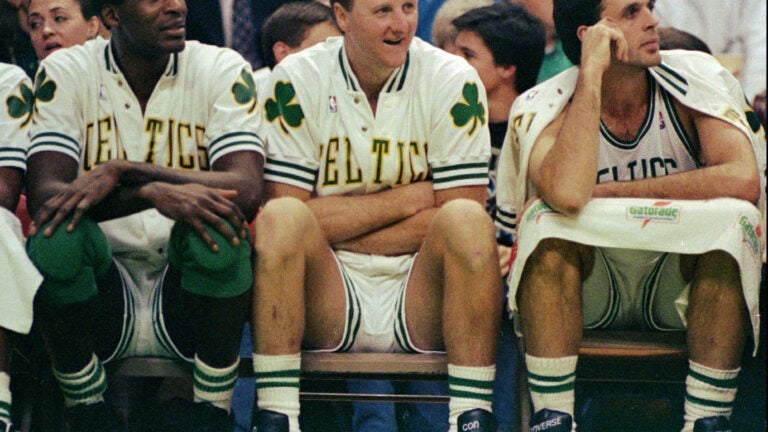
I’d devour a documentary on the 1985-86 Celtics even if it were told through, oh, I don’t know, the narrative of assistant coach Jimmy Rodgers, or spent an inordinate amount of time focusing on backup forward David Thirdkill’s garbage-time highlights, or introduced analytics claiming that Greg Kite was really the best reserve center on the roster.
I’d watch and probably even enjoy one that emphasized all the wrong things. But one that emphasizes all the right things about the team that in our neighborhoods is considered the greatest of all time? That’s a treat and a treasure.
With all that in mind, it’s a pleasure to report that Comcast SportsNet New England’s two-hour documentary, simply titled The ’86 Celtics – because no fancier selling point is required, right? – goes beyond emphasizing all the right things, though it certainly does that.
It does better: It reminds Celtics fans who are sure they remembers every meaningful detail from that cherished season of things they forgot, and unwraps a few new stories that are revealed like the perfect gift.
The film, which debuts on Wednesday at 8 p.m., was the product of a brainstorm nearly a year and a half ago between CSN special projects producer Torey Champagne and senior producer Jim Aberdale. From pitch to premier, it benefited from the contributions of numerous staffers.
It tells the story of those ’86 Celtics — winners of 67 regular-season games and the NBA title in a six-game defeat of the Houston Rockets — in full. Larry Bird, Kevin McHale, Robert Parish, and Bill Walton are among team members who are interviewed. To a man they are candid and nostalgic, just as a Celtics fan would hope they would be.
“They kind of all remember why they care about it each other,” said Champagne. “That team was so special because there were so many unique individuals able to get on same page and accomplish something so great. It doesn’t happen very often. They definitely realize that and appreciate that.”
That is especially evident in the anecdotes about the off-court connection among teammates – such as when Walton invited the entire roster to a Grateful Dead show in Worcester. Champagne said one of the toughest cuts from the doc – “we had enough for five hours,” was a tale about Bird and McHale sitting on a cooler in Atlanta after a game, having a couple of beers, talking about how well they were doing and how lucky they were to be playing together.
“That was the biggest challenge, cutting it down to the proper time,” said Aberdale. “There were quite a few times where we said, ‘I can’t believe we’ve got to cut this, but something has to go.’”
What remains is necessary and often extraordinary. There’s a segment about dealing with a young Michael Jordan – who dropped 63 points on the Celtics in Game 2 of their first-round playoff series – that is hilarious in how it captures the Celtics’ collective confidence. The Celtics veterans express respect for Jordan’s talent but still utterly dismiss the Bulls’ chances. “No one person is going to beat five people,” assures Dennis Johnson after Game 2. Adds Bird in the old footage: “I think we’re going to just keep taking the ball down low and see what happens.”
The back story on how the ’86 Celtics were formed is also told in concise but informative detail.
“Talking to other people along the way, we realized really quickly that the Celtics, because they had so much success in the mid-‘80s, things like the Kurt Rambis moment, it got confusing which season that was in. Was it ’84, was that ’85, or ’86? So the history was a little muddled as to what the lead-up was up to that ’86 season.
https://www.youtube.com/watch?v=UvIVjTlGKwc
“So it became very important to set the stage and show you two things: That the Celtics-Lakers rivalry was never more heated and apparent than it was leading up to ’86 because of what happened in ’84 and ’85. We wanted to recap that. A bigger thing is that there’s a younger generation of Celtics fans that would be watching the film and we knew we had to hit this home and really set the stage.”
Champagne, Aberdale and the CSN crew began the interview process with Walton, the effervescent, effusive center who enjoyed one last healthy season with the ’86 team.
“It was actually pretty funny. I texted with Bill and asked if we could do it, and he was like, ‘Of course!” said Champagne. “So we made the arrangements to go out there and meet him. When I showed up at his house, he was running late and was so kind that he called his gardener and asked his gardener to let me into his house.
“So for about 45 minutes, I was alone in Bill Walton’s house. I’m setting up the shot, and he just strolls in and says in that familiar voice, ‘Hey, Torey, how are ya?’ It was a two-hour conversation, and he was incredible. You don’t take those moments for granted when you’re able to sit down with a guy like that.
Champagne said the most pleasant surprise among the interviewees was the man who started ahead of Walton at center: Robert Parish, forever known as The Chief.
“We were really surprised with how open he was,” he said. “Everyone remembers him as the stoic Chief, but he was really candid. There was a lot of passion that came out of him when he was thinking back. We were really surprised with Robert’s interview. He was like, ‘I don’t really talk to a lot of people,’ but he was really forthcoming and animated, as you’ll see in the film. He was really excited to be traded from the Warriors to the Celtics. To hear him talk about how excited he was for that to happen and what it meant to his career, I’m sure that was well-known years ago, I think it was a little surprising to us to hear him talk about how meaningful it was playing alongside Kevin and Larry.”
Aberdale said it jumped out to him how revered coach K.C. Jones was among the players.
“You’d talk to one guy and then another and they’d all talk about how much respect they had for him. He was much more than an innocent bystander, so to speak. You read about it, and it’s like, ‘Ah, K.C. Jones, he was hands-off, he just let them play,’ but he was a tough S.O.B. in a lot of ways.”
Fans fortunate enough to have seen the ’86 Celtics in real time savor those days. Fans who only know of them through highlights and stories of an older generation are in for a revelation. So imagine how it must feel to have actually been a part of it. The doc captures that, too.
“When we were wrapping up with [reserve guard] Jerry Sichting, he got misty talking about just how important that time was for him,” said Champagne. “He even said that at one point when the season was over he wondered what he was going to do with the rest of his life, because nothing could be better than that.”



To comment, please create a screen name in your profile
To comment, please verify your email address
Conversation
This discussion has ended. Please join elsewhere on Boston.com