
Examining Kevin Durant’s free agency options
The 27-year-old star is set to become a free agent on July 1.
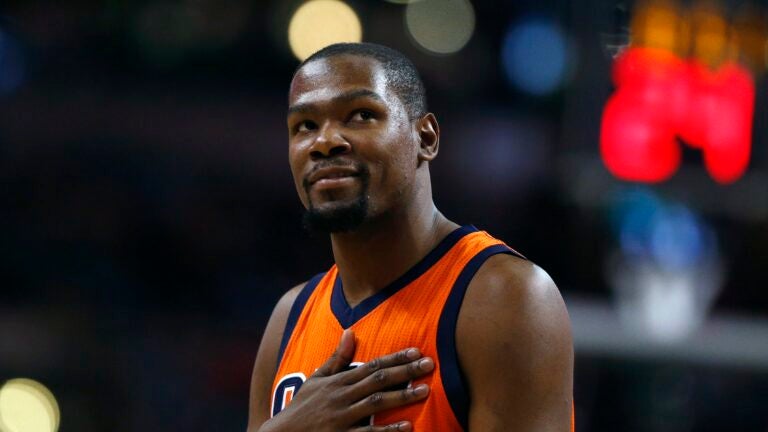
Kevin Durant and the Oklahoma City Thunder exceeded postseason expectations by taking the Golden State Warriors to a Game 7 in the Western Conference Finals, but ultimately the underdogs fell short in their quest to take down the team with the best regular season record ever.
With OKC’s season now officially over, the attention has quickly shifted to the top prize on the Thunder roster and 2016 free agent market: Durant. Celtics guard Isaiah Thomas wasted no time after Game 7 attempting to get the attention of the 27-year-old forward, and Marc Stein of ESPN.com is already reporting that at least eight teams (including the Celtics) are expected to pursue Durant this summer.
While the Thunder reportedly have the inside track on keeping the seven-time All-Star, it’s important to understand the varying contract options Durant has at his disposal this summer. Most free agents of Durant’s caliber value the security of a long-term deal when they hit the open market, but with a skyrocketing salary cap in place for the next two summers, that trend may change.
Let’s examine those possibilities and see why it could potentially be in his best interest to sign a short-term pact.
— Long-Term Deal With OKC
The NBA’s collective bargaining agreement gives any free agent like Durant the most financial incentive to re-sign with his own team. Not only can OKC offer one more year (five) than any other franchise, it can also offer raises of 7.5 percent annually for each year of the contract.
Durant has played nine seasons with the Thunder so the team has the ability to use Bird Rights to sign him to maximum contract (despite the fact that would put them over the salary cap). A player with nine years of service in the NBA is eligible for a maximum contract starting at (roughly) 30 percent of the salary cap, which is expected to rise to $92 million for the 2016-17 season.
2016-17: $25.9 million
2017-18: $27.8 million
2018-19: $29.9 million
2019-20: $32.1 million
2020-21: $34.5 million
Total contract: Five years, $150.2 million (Average annual value: $30.04 million)
This kind of a contract would give Durant tremendous security and keep him from having to deal with the consistent free agent speculation that signing a short-term contract would bring.
— Long-Term Deal With Non-OKC Team
There are a couple key differences here that limit the type of money suitors around the league can offer the 6-foot-9 star. First, the maximum length of any deal that can be offered to a player from another team is four years. The maximum raise per year that these franchises can offer in a contract is just 4.5 percent, a three percent reduction from the free agent’s original team.
Combined, those two factors significantly diminish the total value of a contract the Celtics or any other non-Thunder team could propose to Durant in July.
2016-17: $25.9 million
2017-18: $27.1 million
2018-19: $28.3 million
2019-20: $29.6 million
Total value: Four years, $110.9 million (Average annual value: $27.73 million)
It’s certainly possible that Durant wants a change of scenery this offseason, but fiscally any kind of a long-term deal with a new team in 2016 would cost him tens of millions of dollars. That type of difference makes it logical for the star forward to pursue a third option, whether or not he wants to leave Oklahoma City.
— Short-Term Deal
A two-year contract with a player option in the second year is the exact contract that LeBron James signed with the Cleveland Cavaliers last summer in order to maximize his earning power, and it’s the same model Durant is likely to follow this offseason. A pact with an opt-out after one season would allow the nine-year veteran to increase his salary in a couple of different ways.
To start, Durant will be eligible for a max contract worth approximately 35 percent of the salary cap in 2017 because he will have accumulated ten years of NBA service. He would also be able to apply that raise to a salary cap next summer that is expected to reach $110 million, thanks to skyrocketing NBA revenues. Those totals would leave him with a salary that could start over the $35 million mark annually for the 2017-18 season.
2016-17: $25.9 million (opt-out and sign new contract)
2017-18: $35.8 million
2018-19: $38.5 million
2019-20: $41.4 million
2020-21: $44.5 million
2021-22: $47.9 million (only his 2016-17 team could offer him fifth year)
Total value: Six years, $234 million (Average annual value: $39 million)
While a short-term deal would open Durant up to another year of constant speculation about his free agency status for next summer, the difference in earning potential should make that hassle worth the trouble.
Only a few players in the NBA right now can afford to take this kind of a risk, knowing their value is rock solid on the market in the future (even with the injury risk). At 27, Durant is one of those stars. Odds are any dreams of landing Durant won’t be officially put to an end for the Celtics, or any other team this summer.



To comment, please create a screen name in your profile
To comment, please verify your email address
Conversation
This discussion has ended. Please join elsewhere on Boston.com