
Revisiting the Celtics’ history of NBA Draft Lottery nightmares
The Celtics have not improved their standing in the NBA Draft Lottery in nearly 30 years.
COMMENTARY
Since the inception of the NBA’s draft lottery in 1985, the league has varied its selection allotment procedures on a number of occasions. One thing that has remained consistent over the ensuing three decades is Boston’s lack of luck in lottery proceedings.
The Celtics have been involved in the lottery process a mere 10 times over the past 30 years. In nine of those 10 lottery appearances, Boston has maintained its likeliest draft position based on regular-season win-loss records or fell to a lower position in the draft order due to teams jumping ahead of it via ping-pong balls or other factors.
How damaging has the Celtics’ string of bad fortune been over the lottery’s past three decades? Below is a deep look at the team’s history of lottery adversity ahead of another potentially transformative opportunity in 2016.
Breaking Even
Boston has maintained its likeliest draft position based on its regular-season record in 40 percent of lottery appearances. For a franchise that has not improved its draft position during the lottery in nearly 30 years, breaking even has essentially counted as a ‘win’ for Boston.
1994: No. 9 Eric Montross
The buildup: In the aftermath of the tragic death of Reggie Lewis and the retirement of Kevin McHale, the undermanned Celtics missed the playoffs for the first time since the 1979-80 season. Dee Brown led the 1993-1994 team by averaging just 15.5 points per game.
The odds: As the team with the ninth-worst record in the NBA during the 1993-1994 season at 32-50, the Celtics had a 1.5 percent chance at the No. 1 overall pick.
The outcome: Montross’ career peaked his rookie season when he averaged 10 points per game. He only lasted two seasons in green before the team dealt him to Dallas in June 1996.
1996: No. 6 Antoine Walker (via trade with Dallas)
The season: The immortal Dino Radja was the top scorer for the 1995-1996 squad, the very first of the M.L. Carr tanking era.
The odds: As the team with the ninth-worst record in the NBA during the 1995-1996 season at 33-49, the Celtics had a 3.04 percent chance at the No. 1 overall pick.
The trade: After landing the No. 9 pick, the Celtics’ front office managed to trade up to the No. 6 spot in the draft by moving Montross with their own lottery pick to the Mavericks a week before the draft. The Celtics also snagged Dallas’ 1997 first-round pick in the deal.
The outcome: Outside of Paul Pierce, Walker is arguably the best draft pick the Celtics have made in the lottery. At the very least, he was the best out of the selections the front office held onto for more than a season or two.
2000: No. 11 Jerome Moiso
The buildup: Pierce and Walker did the heavy lifting for Rick Pitino in his third year as coach, but a subpar supporting cast kept Boston in the late lottery for the third straight year.
The odds: With the 11th-worst record in the NBA at 35-47 during the 1999-2000 season, the Celtics had a 0.9 percent chance of securing the No. 1 overall pick.
The outcome: Moiso played just 15 games in Boston before being dealt away to the Philadelphia 76ers after his rookie season for Roshown McCloud and a 2003 first-round pick that would turn into Dhantay Jones. Moiso was out of the NBA by 2005.
2001: No. 10 Joe Johnson, No. 11 Kedrick Brown (via trade with Denver)
The season: Pitino resigned midway through the 2000-2001 season after a lackluster 12-22 start, but interim coach Jim O’Brien coached Boston to a .500 record over the final 48 games. Once again, Pierce and Walker led a lackluster supporting cast that featured the likes of Randy Brown, Milt Palacio and Bryant Stith.
The odds: Having finished the 2000-2001 season with the 10th-worst record in the NBA at 36-46 and holding the Nuggets’ first-round pick (thanks to a trade in 1999) following their finish with the 11th-worst record that season, the Celtics had a 1.8 percent chance at No. 1 overall pick.
The outcome: One of the more disastrous draft fallouts in team history. In order to advance a playoff push the following season, the Celtics dealt Johnson midway through the 2001-2002 campaign for Tony Delk and a rental in Rodney Rodgers. The Celtics got to the Eastern Conference finals with the pair, but Johnson turned into a perennial All-Star. Meanwhile, Brown never averaged more than 5.3 points in a season and was out of the league by 2005.
Lost Coin Flips
Boston’s bad lottery luck has not just come by virtue of ping-pong balls. The Celtics have held an identical record to another lottery-eligible team three times in their history with the ping-pong balls. In order to break such ties in the draft order, the NBA holds a random drawing before the lottery is held. Essentially, there is a coin-flip type event held to determine which team gets the higher spot in the draft order, if they fail to move up into the top-3 of the lottery via the ping-pong balls.
All three years Boston finished the season tied with another squad in the lottery, the Celtics lost their tiebreaker. Those three losses cost the team the No. 9 (1998), No. 6 (2006) and No. 4 (2014) spots respectively.
1998: No. 10 Paul Pierce
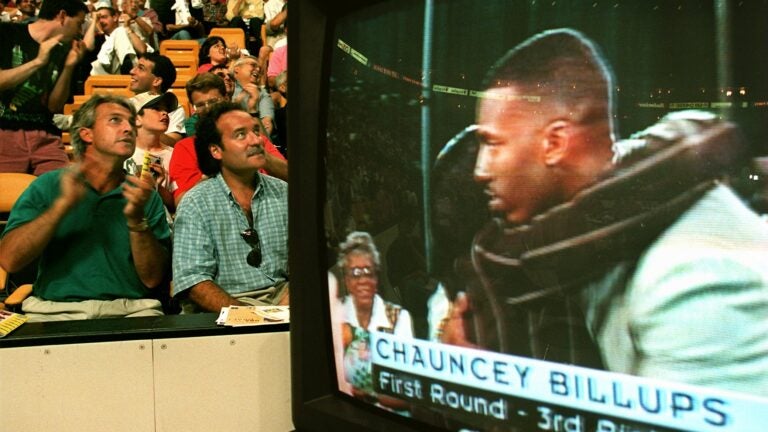
The season: The Celtics enjoyed a 21-win boost in Pitino’s first year as head coach, but still missed the postseason. Antoine Walker looked like a young star in the making during the 1997-1998 season. In an attempt to accelerate the rebuilding process, Pitino unwisely traded away 1997 draft pick Chauncey Billups to the Raptors for veteran point guard Kenny Anderson.
The odds: Tied for the ninth-worst record in the NBA during the 1997-1998 season at 36-46, the Celtics had a 2.01 percent chance at securing the No. 1 overall pick.
The outcome: At No. 10, Pierce remains one of the greatest late-lottery steals in NBA draft history. He averaged 21.8 points per game for the Celtics over 15 seasons. The No. 9 pick — which the Celtics ceded to the Milwaukee Bucks in a coin flip — landed Dirk Nowitzki in Dallas via a draft-day trade.
2006: No. 7 Randy Foye (traded to Minnesota)
The season: In 2006, Danny Ainge was in the middle of his first rebuild since taking over as Celtics president of basketball operations in 2003. Boston had made the playoffs for the past four seasons, but with no elite talent on the roster outside of Pierce, Ainge made several in-season trades (Ricky Davis, Mark Blount) to position his squad for the future.
The odds: With the sixth-worst record in the NBA during the 2005-2006 season at 33-49, the Celtics had a 15 percent chance at top-3 pick (tied for sixth-best odds).
The outcome: After winning in a coin flip with the Celtics, the Timberwolves selected Brandon Roy with the No. 6 pick. With the No. 7 pick, Ainge selected Randy Foye, and then moved him in draft-night trade for a package that included Sebastian Telfair and Theo Ratliff’s famous expiring contract. The Celtics were also able to dump Raef LaFrentz’s expensive deal in the three-team swap with the Timberwolves and Trail Blazers. The deal also included Roy going from Minnesota to Portland.
2014: No. 6 Marcus Smart
The season: After putting an official end to the franchise’s second Big Three era by dealing away Pierce and Kevin Garnett to the Brooklyn Nets in the summer of 2013, a mix of young and veteran role players tied Utah for the fourth-worst record in the league.
The odds: Tied for the fourth-worst record in the NBA for the 2013-2014 season at 25-57, the Celtics had a 33.4 percent chance at a top-3 pick.
The outcome: After winning a coin flip against the Celtics, the Jazz selected Dante Exum with the No. 5 selection. Since being picked at No. 6 by the Celtics, Smart has established himself as one of the best young defensive guards in the NBA. But his offensive game remains a work in progress: He’s shooting just 35.7 percent from the field over his first two seasons.
The Missed Stars
1997: No. 3 Chauncey Billups, No. 6 Ron Mercer (via Dallas)The season:
With a franchise building block in Tim Duncan expected to declare for the draft, the Celtics were in full tank mode for the 1996-97 season. Armed with the likes of Brett Szabo, Marty Conlon and Alton Lister, M.L. Carr’s team put together a franchise-worst 15-win season en route to having the best odds to land Duncan at No. 1.
The odds: Having finished the 1996-1997 season with the second-worst record in the NBA at 15-67 and also holding the Dallas Mavericks’ first-round pick following their sixth-worst record that season, the Celtics had a 36.3 percent shot at the No. 1 pick.
The outcome: Despite the worst team in the league (Vancouver Grizzlies) being ineligible for the top choice due to expansion rules, the Celtics were still leapfrogged by the San Antonio Spurs and Philadelphia 76ers for the top choice. Duncan went on to anchor a Spurs dynasty. Billups was traded 50 games into his rookie season for Kenny Anderson in a win-now move by Pitino. Mercer followed suit just two years into his career as Pitino sent him to the Denver Nuggets.
2007: No. 5 Jeff Green (traded to Seattle)
The season: With a hobbled Paul Pierce watching from the sidelines, the Celtics bottomed out during the 2006-07 season. The campaign gave Boston the inside track at landing either of the draft’s prized prospects: Kevin Durant or Greg Oden
The odds: With the second-worst record in the NBA during the 2006-2007 season at 24-58, the Celtics had a 55.8 percent chance at a top-3 pick.
The outcome: Boston’s nightmare scenario became a reality when three teams jumped the Celtics in the draft order. Boston fell to the No. 5 spot, despite having a slim 12.3 percent chance of stumbling that far. Even with the poor lottery luck, most know this offseason story had a happy ending for the franchise: Ainge dealt the No. 5 pick on draft night with Delonte West and Wally Sczerbiak for Ray Allen and a second-round pick. The move set the stage for the acquisition of Kevin Garnett in July 2007.
A Tragedy
1986: No. 2 Len Bias (via Seattle)The setup:
Fresh off the team’s third title win six seasons, the Celtics held a spot in the lottery thanks to a 1984 trade with the Seattle Supersonics. In 1986, all seven non-playoff teams got a spot in the lottery and had even odds for a shot at one of top three spots.
The odds: The Celtics had a 14.29 percent chance at each of the top three selections.
The outcome: Boston lucked into the No. 2 spot on lottery night, giving them the opportunity to pick Maryland star Len Bias. Two nights after the Celtics drafted him in June, Bias died of a cardiac arrhythmia related to cocaine use.


To comment, please create a screen name in your profile
To comment, please verify your email address
Conversation
This discussion has ended. Please join elsewhere on Boston.com