
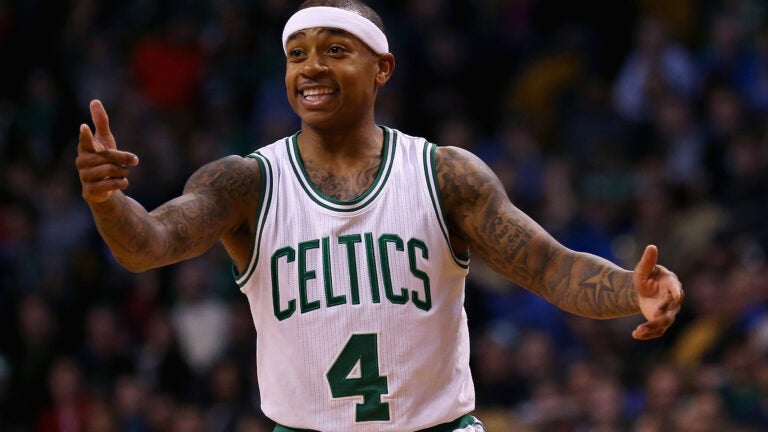
Will the Celtics give Isaiah Thomas a shot at starting next season?
COMMENTARY
The Celtics had plenty of things go right in the midst of an impressive 24-12 stretch to close out the regular season last year, and chief among them was the play of Isaiah Thomas.
The midseason acquisition from Phoenix led the Celtics in points (19) and assists (5.4) per game after joining the team on deadline day. The shifty Thomas ignited the team’s offense almost immediately with his play, helping catapult Boston into a postseason spot in the East.
The stellar production by Thomas came in a sixth-man role, but the 5’9’’ guard is jockeying for a promotion before he starts his first full season in green. On the surface, Thomas’ numbers provide a compelling case for consideration of a starting job in the team’s crowded backcourt. The 26-year-old spoke about his desire to join the top unit earlier this month while volunteering at a community event in Roslindale.
“I’m not warming up to [coming off the bench].’’ Thomas told Chris Forsberg of ESPNBoston, before quickly adding, “I’m a team player. At the end of the day, I’m going to do whatever it takes to win. I’m going to do whatever is best for the team. But like I keep saying — or as you guys keep asking — I do want to be a starter. I mean, who doesn’t? That’s one of my goals in my career — to be a full-time starter and be one of the best little guys to ever play the game. That’s a goal of mine, but at the end of the day, I’m a great teammate and that’s not going to mess with anything.’’
The team-first stance is an admirable one from Thomas, but the question still remains: Is it in the Celtics’ best interest to give their leading scorer a chance at running with the starting five?
Brad Stevens admitted last week that he’s still on the fence about the possibility.
“It’ll all figure itself out,’’ Stevens said at an ABCD charity fundraiser at the TD Garden. “If it’s best for our team for Isaiah to start, then Isaiah will start. If it’s best for our team for Isaiah to come off the bench, then one thing that he’s proven is that he’s an awfully good player coming off the bench.
“Hey, I get it. We all want to be out there when the ball is tipped. There’s not a person playing that doesn’t. But there are a lot of players that are out there when the ball is tipped that aren’t as effective as the guys who come in for them. You can also be really impactful off the bench. We’ll see.’’
Stevens has plenty of factors to consider before making a decision. In spite of the team’s second half resurgence last year, one of Boston’s liabilities for much of the season remained the production of the starting lineup. After Danny Ainge dealt away Rajon Rondo and Jeff Green, Stevens settled on a starting core of Marcus Smart, Avery Bradley, Evan Turner, Brandon Bass and Tyler Zeller. Jared Sullinger was the initial starting center of choice for Stevens, but Zeller replaced the 6-foot-9 forward when Sullinger suffered a foot injury in February.
As a team, Boston played some of its best basketball of the season with this starting five in place. However, Boston’s improved offense was primarily due to the play of Thomas and the second unit, not the performance of the starting unit. In fact, the first group scored just 95.1 points per 100 possessions, six points worse than the team’s season average.
The uneven mix of skillsets in that personnel group provided ample reason for the drop off. Outside of Bradley, there were no above-average 3-point shooters in the grouping, which allowed opposing defenses to pack the paint most nights.
Most opposing starting lineups also simply had more talent at their disposal than Boston, making a Celtics’ offense that lacked any efficient shot creators struggle to keep pace on the offensive end.
An overhaul in the starting unit is already expected to take place in the frontcourt, thanks to the offseason additions of David Lee and Amir Johnson. Both big men have proven to be consistent scorers in the past, much more so than Boston’s incumbent bigs. Lee’s finishing ability and Johnson’s three-point range should help Boston’s first team offense take a step forward. The return of a fit Jared Sullinger could help in this department as well, if he plays his way into a starting spot in training camp.
Still, none of these players should be considered a major difference maker from an offensive standpoint. Boston’s scoring issues will likely remain intact if the trio of Smart, Bradley and Turner hold onto their starting gigs. Jae Crowder could be a candidate to take over the small forward spot in place of Turner, but his three-point shooting ability (31.6 percent over his career) is just as big of a question mark as Turner’s, leaving him unable to solve the group’s spacing issues.
Ainge surely wants to give Smart a chance to show that he can handle a bigger role in the team’s offense during his second season after handing him point guard duties during summer league in July. Despite a pair of impressive outings in Salt Lake City and Las Vegas, Smart’s shooting woes (35 percent from field) remained in place against the inferior competition.
There’s no way to know for sure right now whether Smart can capably run an NBA offense, but giving him the reins at point to start this year will be the easiest way to find out. Whether that’s the best decision for the team’s win-loss record remains to be seen.
Unlike Smart, Thomas has proven he can produce consistently against top-tier competition, averaging 15.3 points per game while starting 154 games with the Sacramento Kings during the first three seasons of his career. With that kind of track record, it’s clear that the main obstacle to handing Thomas the gig is his defensive limitations.
“You need guys who play offense and defense,’’ Ainge candidly said about Thomas at his end-of-season press conference. “At his size, defense is sometimes a challenge and puts our team where we have to cover up for some of his mistakes.’’
The question that Stevens will have to tackle next month is whether those defensive mistakes would outweigh the offensive gains Thomas could bring to the starting five. He’ll have a full training camp to evaluate that conundrum and decide whether it’s worth tinkering with a formula that worked so well last year: Thomas captaining the second unit. With added scoring depth in place amongst the reserves, the time may prove to be right to at least experiment with the switch.
Photos: The Greatest Celtics of all time
[bdc-gallery id=”118766″]




To comment, please create a screen name in your profile
To comment, please verify your email address
Conversation
This discussion has ended. Please join elsewhere on Boston.com