
Draft night is a lesson in patience for the Celtics
COMMENTARY
For the Celtics, the ‘war room’ on draft night might be more aptly named the ‘cordial discussion room’.
“We’re very loose and there’s a lot of joking in between [picks],’’ Celts director of player personnel Austin Ainge said by phone over the weekend, discussing the atmosphere in Boston’s war room during the NBA Draft. “Really because we’ve been together late nights usually for 7 to 10 days leading up to it, all in one room, and it’s just kind of a continuation.
“We’ve had the debates [over players] so many times,’’ he continued. “They don’t get heated because all the heated discussions have happened. We’re pretty calm, everyone makes their point heard, and whatever the final decision is we then get on board and join that group. Whatever decision’s made we all have to be together on it and move forward.’’
The Celtics have four picks in Thursday’s draft; two in the first-round at Nos. 16 and 28, and two in the second-round at Nos. 33 and 45. They’ve worked out more than 50 players, though Ainge estimates only 6 to 8 were worthy of that No. 16 choice and he unsurprisingly was not willing to reveal his favorites. Rumors have swirled for weeks the team is interested in dealing some of its vault of assets in order to trade up into the lottery (top 14), perhaps even into a top-10 position with other rebuilding franchises like the Knicks (No. 4), Kings (No. 6), Pistons (No. 8), and Hornets (No. 9) all potentially dangling their selections.
At this point, just days away from the big night, Ainge revealed his club has spoken with every team in the lottery and “probably every team in the league’’ in the interest of keeping its options open with regard to trading up or even out of the draft if a bona fide star, namely a DeMarcus Cousins, becomes available. Dealing for future picks is an option as well.
Ainge declared the C’s will be active and admitted it’s not their goal to have four rookies on next year’s roster – the club could draft American or European players and stash them overseas to build upon their development – but said there’s no preconceived notion of how draft night will unfold, and it’s important to be ready for anything.
“Draft day and the few days leading up to the draft are all pretty similar,’’ Ainge said. “Everyone’s at the office very late, everyone is calling around the league, discussing many, many trades, many possibilities, we’re asking our friends on other teams what they’re hearing, what’s going to happen. It’s just a lot of phone calls, a lot of text messages, and then in between all of that, it’s a lot of discussion on hypotheticals.
“If these three guys are available, who are we taking? If this pick is up to trade, what would we trade it for on this team? And on this team? We try to be prepared for every possible scenario because when the draft starts, it comes fast,’’ he noted. “Someone might slide in the draft; we’re sitting there at 16 and some team is in love with a player, and they want to trade down, and we have to be ready. All those scenarios could happen.’’
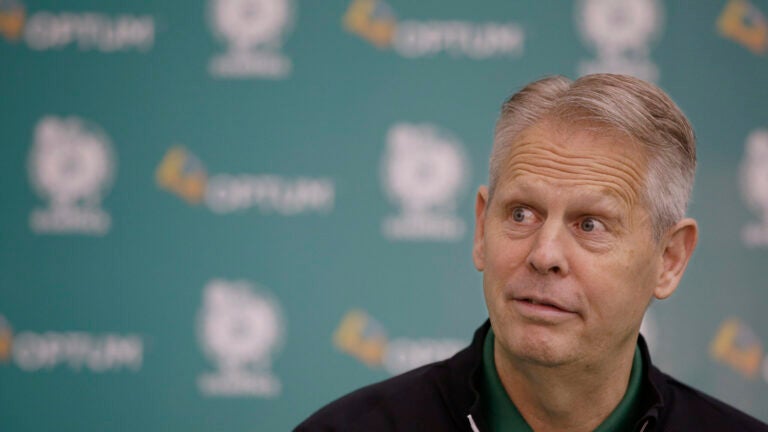
Occasionally, the team’s president of basketball operations Danny Ainge, coach Brad Stevens, director of player personnel (and Danny’s son) Austin Ainge, and other individuals in the room will revisit one of those theoretical scenarios if the reality meets the ticking clock but, as mentioned, any passionate or strong-willed debates are in the past and everyone’s opinions have already been heard and considered. This is about reaffirming the consensus.
“There are some years when we have a guy who’s a clear winner at a certain pick, whether that’s second-round, first-round, whatever, where if that guy’s there we’re all really excited about him,’’ said Ainge. “Then there are other years where we’re really having trouble distinguishing between the three or the four or the eight, however many it is, or two. Sometimes there are years when the clock starts and you go, boy, you don’t have a great answer and you hash it out again.’’
Ultimately, Ainge said, the Celtics hope to use nights like the NBA Draft as a springboard to quickly becoming a contender again, just as they did in 2007 when the No. 5 pick (Jeff Green) was sent to Seattle for Ray Allen, which helped pave the wave for Kevin Garnett’s acquisition. It’s imperative, however, to keep the big picture in mind.
“We all want star players and high level talent; that’s what wins in the NBA and it’s a little easier to get at the top of the draft. If that opportunity presented itself we’d be interested, but it depends on the price,’’ Ainge warned. “You can’t trade the whole farm for one pick, and if you miss on it you’re in trouble. We have to be cautious. It’s all about the right price. Whether that’s for a current NBA player or moving to the top of the draft, we have to get value.
“We have a lot of assets, we feel, if teams want to get off from a veteran player and rebuild through the draft, we have a good package of picks to offer them. We will stay opportunistic.’’
Part of being on the ready, of course, is being reachable. Ainge said there’s one fear that exists in the war room that’s as significant as any other: Bad cell service.
“There’s been some times when text messages didn’t go through,’’ Ainge said, his voice heightening as if he was reliving a bad dream, “and we go back and check, and it didn’t send, and we’re freaking out that [a team] didn’t get the trade proposal.’’
Thursday’s NBA Draft will be filled with plenty of challenges, stresses, and worries, even amid what Ainge promises to be a calm atmosphere. Whether Trader Danny’s cell phone bullets are loaded with enough bars hopefully won’t be one of them.





To comment, please create a screen name in your profile
To comment, please verify your email address
Conversation
This discussion has ended. Please join elsewhere on Boston.com