
Has the NBA Left Rajon Rondo Behind?
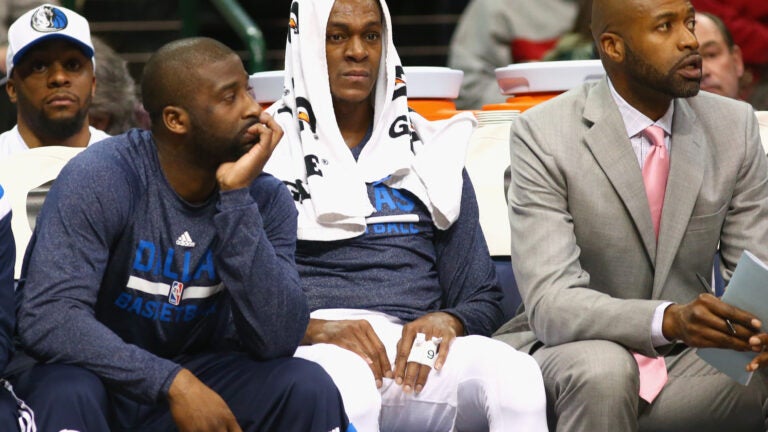
It hasn’t been a good week for Rajon Rondo. And with the Sloan Sports Analytics Conference in town this past weekend, it’s probably fortunate that the former Celtic is now a Dallas Maverick. As far away as Dallas is from the MIT campus, Rondo might be even more distant from the style and direction analytics is leading the NBA.
You don’t need advanced stats to see that things aren’t going well for Rondo and the Mavs. After getting into a shouting match with head coach Rick Carlisle — reportedly for ignoring a play call — the point guard was benched for the final 20 minutes of the Mavs’ win against the Toronto Raptors. The argument continued after the game in the locker room and Rondo was eventually suspended for Wednesday trip (and loss) to Atlanta.
He returned to the lineup Saturday, putting up 8 points, 7 rebounds, 6 assists, 4 turnovers and a team-worst -22 in plus-minus as the Mavericks lost 104-94 against the usually hapless Brooklyn Nets.
Though the Mavs are still fifth in the West, since acquiring Rondo their offense has declined notably. A month into the season, Dallas was scoring at a blistering league-record pace of 115.2 points per 100 possessions. According to Grantland’s Zach Lowe, the team’s offense lived off lots of corner threes, rapid ball movement and highly efficient shots in the paint. At the time of Lowe’s writing, the Mavs were “shooting 68.2 percent in the restricted area on an above average number of attempts.’’
In Rondo’s first 21 games with the Mavs, their points per 100 possessions dropped to 106.0. With Rondo in the lineup, the offense scored more than 10 points less per 100 possessions than it did with Jameer Nelson.
The Mavs’ offense never needed Rondo. They already had a great pick-and-roll, slash-and-kick spacing offense and Rondo’s skillset overlaps with the one ball-dominant guard, Monta Ellis, they started.
According to the NBA’s player tracking statistics, during Nelson’s 23 games at point guard, he averaged 4.0 minutes of possession a game. In the 26 games Rondo has played for the Mavs, his ball possession has bumped up to 5.1 (the same 1.1 minute difference as between Kobe Bryant and Dennis Schroder).
ESPN Dallas’s Tim MacMahon wrote that because Rondo is notoriously weak from outside (for a point guard, at least), his “shooting woes allow defenses to dare him to beat them from the perimeter, screwing up the spacing for everybody else.’’
This is as an existential problem for Rondo as it is a tactical problem for the Mavs. NBA teams are increasingly emphasizing the “three and key’’ offense, triggered by advanced stats showing three-pointers — particularly corner threes — and close-range shots to be the most efficient.
The Spurs just won the title on the strategy of maximizing their corner three opportunities and eliminating the same shot for opponents. Likewise, the Atlanta Hawks are currently leading the East running a similar motion offense dependant on creating layups and open shots. It’s no coincidence Hawks coach Mike Budenholzer used to be an assistant to Spurs coach Gregg Popovich.
In January, Kirk Goldsberry wrote an article titled “The Future of Basketball is Here, and It Looks a Lot Like James Harden.’’ He wrote about how Houston’s general manager Daryl Morey (an NBA nerd apostle who also co-chairs the Sloan conference) wants Harden running an offense explicitly designed to get close shots, corner threes and free throws.
Harden led the league in assisted three-pointers and assisted corner three-pointers, as well produced (made plus assisted) three-pointers. The Rockets currently score more than 34 percent of their points from threes. They also avoid taking inefficient shots, scoring less than six percent of points from mid-range two-pointers. Harden also gets to the line 9.5 times a game and shoots just under 87 percent.
It’s an offense explicitly based off shot efficiency analytics that has turned Harden into a top MVP candidate.
Meanwhile, if the Rockets represent the future, Rondo represents the past. He avoids the free throw line like it’s a disease, and for him it actually might be. He’s shooting 28 percent from the stripe with the Mavs. Twenty-eight percent. Only 15 percent of his points come from threes, while nearly a quarter came from mid-range jumpers.
The only team with a higher mid-range rate are the New York Knicks and the only other teams with a rate more than 20 percent are the Wizards, Hornets, Lakers, Pacers and Timberwolves. I’ll wait if you want to look up their records.
It should then be no surprise that Carlisle didn’t necessarily want to hand over play-calling duties to mid-range happy Rondo. To paraphrase Goldsberry, the stats say it’s better to be even slightly inefficient from an efficient area, than to be efficient from an inefficient area.
As McMahon wrote after the Brooklyn loss, “the Mavs’ biggest issue is figuring out how to make the square peg that is Rondo fit into the round hole that is the point guard’s role in Carlisle’s system.’’
However,in 2015, that round hole might not just be the Mavericks. For Rondo, the mismatch might be with the future of the NBA.




To comment, please create a screen name in your profile
To comment, please verify your email address
Conversation
This discussion has ended. Please join elsewhere on Boston.com