
Sign up for the Today newsletter
Get everything you need to know to start your day, delivered right to your inbox every morning.

COMMENTARY
The Boston Bruins have money to burn this offseason. And plenty of leaks to plug on a depth chart floundering with far too much flotsam in place.
Even after taking care of in-house matters like crafting a long-term contract extension for Morgan Geekie, the Bruins should have plenty of capital remaining from their $28.8 million in projected cap space (per PuckPedia) to inject talent into their listless lineup this summer.
Boston could remedy its impotent offense and sub-standard power play (15.2 percent) by opening their checkbook for a dynamic winger on the unrestricted free-agent market like Mitch Marner, Brock Boeser, or Nikolaj Ehlers.
Don Sweeney and the Bruins could take advantage of a cap-strapped team looking to shed payroll in order to accommodate future contracts, with a power forward like Dallas’ Mason Marchment (owed $4.5 million in 2025-26) standing as an intriguing trade target.
But what about the other avenue used to acquire talent in the NHL offseason — one that is rarely utilized, given the stigma that comes with snatching young talent off another team’s roster.
Utilizing offer sheets and targeting restricted free agents is an exercise rooted more in theory than practical application across the NHL.
But, after the St. Louis Blues snagged two impact players from a cap-crunched Oilers team last offseason, targeting RFAs might hold even more appeal for teams this summer.
And let’s face it. Every avenue has to be on the table for Boston to help course-correct a lackluster roster.
In most circumstances, the process involved in trying to sign a restricted free agent away from another team’s roster is simply not worth the hassle, especially if the team that currently holds his rights is adamant about retaining him.
Sure, there’s also the risk of other GMs leaving you at the lunch table during league meetings if you become the team that poaches away young talent. But more importantly, any team fixated on signing RFAs has to be willing to spend a lot of money, and give up significant assets in return.
Not only would a team need to essentially pay over market value to both entice the RFA and preclude his original team from matching that same contract, a team that successfully signs away an RFA also has to give his original team draft picks as compensation.
This offseason’s offer sheet compensation tiers were reported earlier this week, ranging from no draft compensation if a team signs an RFA to an average annual value of $1,544,424 or below … or a whopping four first-round picks if they sign an RFA to average AAV at $11,700,192 or above.
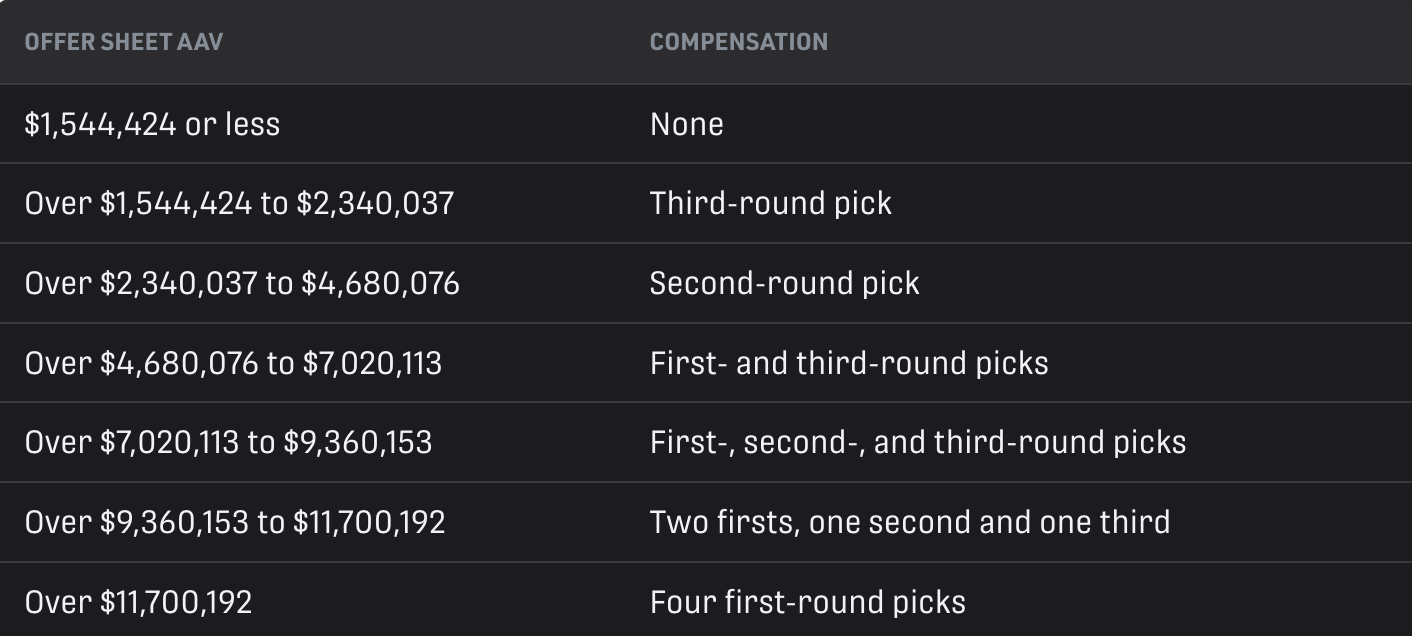
There are seven different tiers based on AAV that will determine draft payouts, with a potential middle-six option making between $2.34 – $4.68 million per year costing a second-round pick. Meanwhile, a first-line talent earning over $7,020,113 will cost his new team a first, second, and third-round pick.
As such, the steep price to pay (both in contract terms and draft picks) — coupled with the potential for the RFA’s original team to move heaven and earth to match that offer sheet and keep their player in place — often makes it an exercise not worth following through on for most teams.
But did the St. Louis Blues’ plundering of the Oilers last offseason change some of that sentiment regarding offer sheets?
The Blues took advantage of the Oilers by offer sheeting two of their youngest players in Philip Broberg and Dylan Holloway, with Edmonton ultimately opting not to match those offer sheets, given their fiscal situation.
St. Louis signed Broberg for a total of $9.16 million (two years, $4.58 AAV) and Holloway for $4.58 million (two years, $2.290 million AAV), with the Blues giving up a second and third-round pick as compensation to the Oilers.
It stood as a risk for both teams. The Oilers gave up two younger players, but avoided more cost-cutting measures on a win-now roster. Meanwhile, the Blues are acquiring two promising, albeit unproven, assets in exchange for both draft capital and solid pay raises.
So far, the Blues have benefited tremendously from the gamble, with both Broberg and Holloway developing into key fixtures in 2024-25.
Holloway — whose previous career high in scoring with Edmonton was six goals and nine points in 2023-24 — broke through with 26 goals and 63 points in his first year with St. Louis. Broberg, who appeared in 12 games with Edmonton in 2023-24, averaged 20:30 of ice time and recorded 29 points in 68 games with the Blues.
In some respects, the Bruins should be following a similar approach as the Blues when it comes to using offer sheets to target high-upside players who could thrive in elevated roles moving forward.
The most appealing target for the Bruins on the RFA front would be Toronto Maple Leafs forward Matthew Knies. The 22-year-old forward is seemingly cut from a different cloth as his Toronto teammates, showcasing a nose for the net and playing a physical, power-forward game that translates well to the postseason.
Boston adding a player of Knies’ caliber — he’s fresh off of scoring 29 goals in his second full NHL season — would be a welcome sight for a Bruins team short on young, high-end talent.
But, the task of stealing Knies from Toronto would come at a steep price, and offer a slim chance of success.
To get Toronto to really balk at their offer sheet and decide to not match it, the Bruins would likely have to offer a sizable contract worth at least $9 million per year to put the screws to their Original Six rival.
But Toronto does have $26.8 million in cap space this summer to work with, especially with both Mitch Marner and John Tavares’ contracts coming off the books. While one would assume that Toronto will want to retain at least one of those players, the Leafs could also place a premium on signing a younger player like Knies for the long haul.
And even if Toronto does relent and doesn’t match the offer sheet set down by the Bruins, Boston would be paying Knies top dollar — and giving up at least a first, second, and third-round pick (all of which must be Boston’s own picks) — to bring the winger aboard.
Perhaps Knies — a potential 30-goal stalwart who can ride shotgun with David Pastrnak — is worth such a cost.
But if the Bruins really wanted to make the most of this RFA market, they should take a page out of St. Louis’ book and find the next breakout player (or two), rather than a young stalwart who has already arrived like Knies.
A team with far less cap space to work with like the Rangers ($8.42 million) might be a more appealing club to target — especially when it comes to a forward like Will Cuylle.
Cuylle won’t require the same payout as Knies, but if the Bruins could set down an offer sheet around $4.67 million per annual (costing a second-round pick), could it get the Blueshirts to blink?
Cuylle, 23, is exactly the type of forward that already thrives in today’s NHL — and has plenty of room to grow.
The 6-foot-3 left winger is already a strong skater who hits like a freight train (301 hits, fourth in NHL this season). But he is also coming off a season where he scored 20 goals and posted 45 points (with only two of those tallies on the power play).
At his current level, Cuylle would already be a one-man wrecking crew on Boston’s middle-six grouping. But could he be the next Knies and end up being a legitimate 25-30-goal threat? Either result would be welcomed on a team like the Bruins.
Cuylle is the exact type of young player (on the type of team dreading an offer sheet in New York) that the Bruins should be honing in on this offseason.
As flashy as established RFAs like Knies or Evan Bouchard might be, the Bruins should have no shortage of other targets who could conceivably thrive with more reps in Boston.
Instead of shelling out a hefty contract for a pugnacious forward like Sam Bennett, could Boston try to offer sheet a netfront menace like Columbus’ Dmitri Voronkov (23 goals) — especially if Columbus is bracing to pay other top talents like Adam Fantilli, Cole Sillinger, and Kirill Marchenko in the years ahead?
A shot-first winger like Florida’s Mackie Samoskevich or Nashville’s Luke Evangelista could develop into 20-goal talents in short order as well.
The Bruins are not a single player or two away from re-asserting themselves as legitimate contenders moving forward.
But if they do their homework, there are several underrated players on the RFA market who they should prioritize as they look to build up a new core of young talent.

Get everything you need to know to start your day, delivered right to your inbox every morning.



To comment, please create a screen name in your profile
To comment, please verify your email address
Conversation
This discussion has ended. Please join elsewhere on Boston.com