
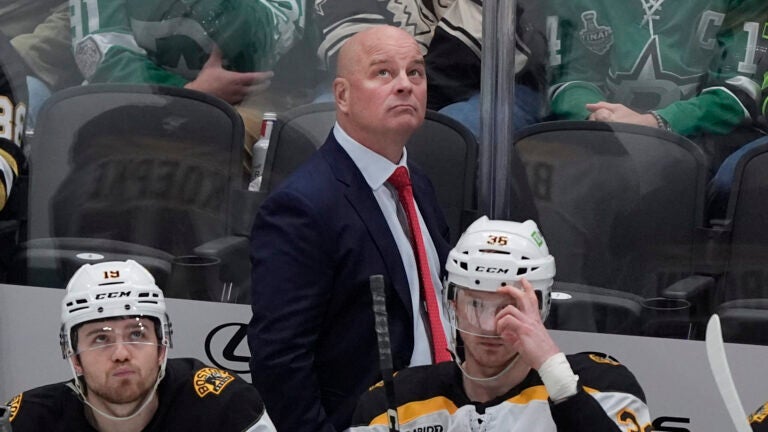
Jim Montgomery is feeling the heat. But there’s plenty of blame to go around for the Bruins’ dreadful start.
Poor roster construction and multiple players regressing have hindered the Bruins so far in 2024-25.
COMMENTARY
Jim Montgomery could only shrug his shoulders on Thursday after yet another lopsided loss for the Bruins.
“It’s been frustrating all year that we haven’t been able to string like, three to four consistent games where we feel like our habits and details are consistently there,” Montgomery acknowledged after Boston left the ice in Dallas after a 7-2 defeat.
Much like his team’s repeated flaws amid an underwhelming 8-8-2 start, Montgomery’s postgame musings have repeated themselves into the same predictable script: Short on answers, and plenty of bewilderment over how a seemingly stout Bruins roster could erode across so many areas in record time.
At this point, Montgomery has already scrolled through his list of tried-and-true coaching maneuvers in hopes of giving his team a spark.
Boston’s lines have been put in a blender countless times over. He chewed out captain Brad Marchand on the bench in October before later benching David Pastrnak for the third period of a game against Seattle just a few weeks later.
The results have done little to change the fortunes of a Bruins team that has still yet to win three games in a row — routinely following up any sort of “get right” result with a one-sided loss or extended slide.
Montgomery is in an unenviable spot less than two months into a new season — seemingly unable to right the ship for a win-now roster and further hindered by the lack of clarity regarding his future with Boston.
Even though Montgomery has said all the right things about coaching in the final year of his contract in 2024-25, putting a team’s head coach through a “lame duck” campaign doesn’t exactly signal heaps of confidence from Boston’s top brass.
There’s no question at this point that Montgomery is feeling the heat — especially in a sport where head coaches are already given an extremely short shelf life.
And make no mistake, some of the Bruins’ woes in 2024-25 can be correlated to Boston’s coaching staff.
Much like last year’s playoff run where sluggish starts and lapses in execution (remember the approximately 350 too-many-men penalties assessed to Boston?) plagued the Bruins, Boston has spent far too many periods this fall disinterested and lacking urgency.
The Bruins have taken their foot off the gas across multiple third periods — culminating in a miserable 20-minute stretch against Ottawa last week where Boston didn’t land a single shot on goal against Linus Ullmark.
Boston’s special-teams units have also completely splintered, with Boston currently dead last in the NHL on the power play (11.4 percent) and 26th on the penalty kill (74.3 percent).
If the Bruins continue to tread water — or downright flounder — Don Sweeney and Boston’s front office could opt for a change behind the bench in hopes of a midseason spark.
It’s a familiar strategy in hockey, one that the Bruins benefitted from in 2017 when Bruce Cassidy led Boston back to the postseason after moving on from Claude Julien.
But make no mistake. However culpable Montgomery might be for Boston’s ongoing malaise, there’s no guarantee that a coaching change alone will be enough to fix this underachieving roster.
And there’s a whole lot more blame to go around for this team’s current predicament beyond just their head coach.
While injuries across the blue line (especially Hampus Lindholm) have hindered Boston as of late, there are valid concerns about the current constitution of this roster and just how conducive this team’s identity is to sustainable success on the ice.
After failing to solve Florida’s frantic forecheck for the second straight postseason, Boston’s top brass signaled ahead of the summer that the Bruins were looking to adopt a similar identity moving forward.
“Obviously, this game is fast and we’re not as fast as we’d like to be … There’s areas where we still need to improve, and we’re going to address that this offseason for sure,” Cam Neely noted in May. “But yeah, maybe a little faster and we’d like to see a little bit more 50/50 puck battle wins. That’s an area where you have to want the puck more than the other team.”
“I have to be able to find some players that can come in and provide secondary scoring for us and key opportune times,” Sweeney added.
The Bruins did flex their fiscal muscles by signing the top free-agent pivot on the market in Elias Lindholm. But Boston saw its secondary scoring wane by letting forwards like Jake DeBrusk, Danton Heinen, and James van Riemsdyk depart in free agency.
Rather than add another scoring winger like Tyler Toffoli or Anthony Duclair, the Bruins instead beefed up their lineup — signing defenseman Nikita Zadorov to a six-year, $30 million contract while bringing in big-bodied skaters like Max Jones and Riley Tufte.
The case can certainly be made that a bigger and meaner Bruins squad was better equipped for the grind of the playoffs.
But Boston’s emphasis on snarl over speed and scoring has backfired — creating a low-event product that’s labored when it comes to generating quality scoring chances.
All things considered, it really shouldn’t come as a surprise that a trio of Cole Koepke, Mark Kastelic, and Johnny Beecher were the lone forward trio fueling Boston’s offense out of the gate. What they lacked in skill, they made up for in puck pressure, speed, and a knack for banging home pucks near the crease.
It’s far from flashy, but it’s winning hockey. And it’s a trait that’s hard to come by across the rest of Boston’s roster — at least at the moment.
And while free-agent pickups like Lindholm (nine points in 18 games) and Zadorov (a league-leading 16 penalties in 18 games) have done little to move the needle, Boston’s returning cast has also done little to build off the promise unearthed from last year’s playoff run.
Expecting several career years from Boston’s forwards to serve as the norm moving forward has backfired for all parties in 2024-25.
After scoring a career-best 25 goals and 60 points last year, Charlie Coyle has just four points across 18 games. Pavel Zacha is on pace for 32 points in 2024-25 after recording 59 last season.
Morgan Geekie has gone from 17 goals as a breakout player in 2023-24 to just one tally over 13 games. Trent Frederic’s primary helper on Coyle’s goal Thursday marked his first point since Oct. 26.
Boston’s leadership core of Brad Marchand, David Pastrnak, and Charlie McAvoy have the ability to take over games — as evidenced by Tuesday’s comeback win over the Blues. But much like the rest of the team, those performances have been hard to replicate across this turbulent stretch.
Add in a newly anointed franchise goalie in Jeremy Swayman who ranks 48th out of 55 qualified goalies (five games played) in goals saved above expected (-4.6), and just about every area of Boston’s depth chart has been dragged down by underwhelming and underperforming play.
Of course, a GM can’t fire a slew of players — nor are in-season trades involving player-for-player swaps all that common these days.
If the Bruins continue to struggle, firing Montgomery stands as the next course of action for an increasingly desperate team.
It’s a brutal scenario for all parties, especially for a coach who — even with his flaws behind the bench — has had little to work with so far this fall.
But for Boston’s management staff and players, such a move also pushes another uncomfortable scenario to the forefront.
That if these woes continue after a coaching swap, that the rest of this personnel will need to confront more hard truths.
Namely, looking at themselves in the mirror for the next responsible party.





To comment, please create a screen name in your profile
To comment, please verify your email address
Conversation
This discussion has ended. Please join elsewhere on Boston.com