
Newsletter Signup
Stay up to date on all the latest news from Boston.com
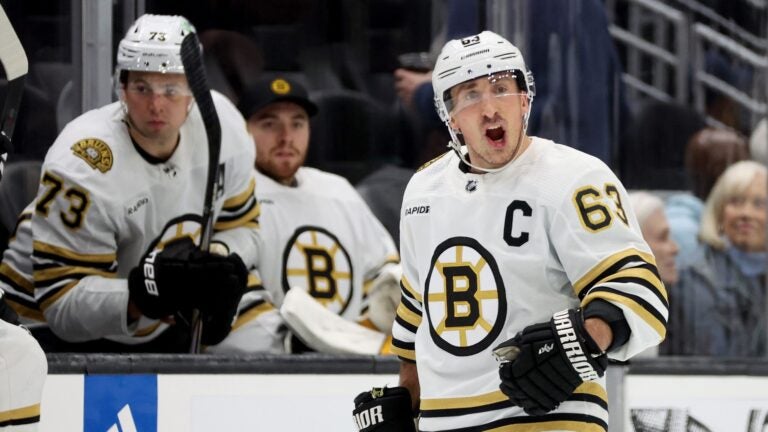
The Bruins’ unchallenged reign atop the Eastern Conference has come to an end.
Even though Boston and Florida are tied in the standings with 82 points, the Panthers hold the edge with 32 regulation wins over the Bruins’ 26.
Some regression was to be expected for a Bruins roster that opened the year with a sterling 14-1-3 record. But since returning from the All-Star break, Jim Montgomery’s squad has flatlined during critical situations — allowing Florida to catch up in the Atlantic Division.
Since returning from the All-Star break, the Bruins are just 3-3-5. Boston has now trudged through six straight overtime games, with their last regulation win coming all the way back on Feb. 8 against Vancouver. In total, Boston has posted just two regulation wins in the past month.
So what has hampered a Bruins team that went 9-2-3 in January? It’s been more than just one overarching issue, and most of these flaws have been present all season long.
Boston’s most concerning trend in 2023-24 has sprouted up again in February, leading to frustrating results during the dog days of the regular season — and potentially devastating consequences come April.
Of the six straight OT games that the Bruins have slogged through during this recent skid, four have come from games where Boston has held a third-period lead. In total, the Bruins are now 25-1-8 this year when leading after two periods.
Those nine losses under favorable odds currently lead the NHL, while their .735 win percentage ranks 28th overall in the league. The only teams with a worse mark while holding a two-period lead? The Islanders (.720), Blackhawks (.642), Sharks (.615), and Blue Jackets (.611). Not exactly the company you want to be in.
The Bruins held a third-period lead in three of their four games out west during this most recent road trip. A 2-0 edge in Vancouver after 40 minutes eventually devolved into a 3-2 overtime loss. A 2-1 advantage in Seattle on Monday night eventually resulted in a 4-3 shootout defeat.
The lone two-point showing on the road trip in Edmonton? It still featured Boston coughing up a 4-2 lead in the third period before Charlie McAvoy bailed the team out in overtime.
“Vancouver had a little bit push, we don’t feel Seattle had so much of a push,” Montgomery said Wednesday of Boston’s late-game miscues. “It was more of our lack of poise of the puck, and game management that allowed them to get the opportunities to get back in the game.”
Some of the issues that have hindered the Bruins in the third period will be dissected further below. But a prevailing sense of tentativeness and severe lapses in execution — especially in terms of breaking the puck out and limiting D-zone time — have been hallmarks of Boston’s late-game woes.
“Most times, we have situations where we think we know where our outs are and how we’ve got to win those battles. And people got to get to those areas quicker,” Montgomery said of Boston’s struggles moving the puck. “Because if you looked at the first 40 minutes of our game in Seattle, we were winning those sort of races, and we had a lot of opportunities to build a lead.
“We didn’t. But how connected we were, how fast we were playing? Gave us opportunities, odd-man rushes and stuff that, we didn’t finish them.”
The 2022-23 Bruins team was a juggernaut all season long, only to have their miracle run ended in April after coughing up a late third-period lead during a 6-on-5 situation. So far, this revamped roster has done little to offer up hope that a similar fate won’t befall them this spring.
Some of Boston’s late-game issues have also been magnified by the team’s inability to manufacture additional breathing room on the scoreboard.
Montgomery’s tenure in Boston has seen the Bruins make strides in terms of generating quality chances at 5v5 play. But for years now, the Bruins have tilted the ice in their favor thanks to strong special teams play — be it a stingy penalty kill or a potent power play.
But since the All-Star break, a man advantage featuring proven playmakers like David Pastrnak, Brad Marchand, and Charlie McAvoy hasn’t made much of a dent.
Over their last 11 games, the Bruins have only converted on 11.4% (4-for-35) of their power-play opportunities — while only negating 72.4% (21-of-29) of opposing power plays.
Boston has the personnel to do damage during 5-on-4 situations, but the results haven’t presented themselves as of late.
“We felt when it comes to the power play it’s just making sure we’re converging at the net,” Montgomery said. “If we’re converging at the net and we’re having a shot-first attitude, we think it works itself out. And the last power play we had, the only one we had in Seattle, we were converging at the net, we ended up scoring. Took us probably four conversions at the net before we scored.”
Perhaps the most surprising development this season has been Boston’s struggles with clearing the netfront and preventing Grade-A chances from being generated in front of Linus Ullmark and Jeremy Swayman.
Even though the Bruins currently sit fourth in the NHL in goals against per game (2.70), Boston ranks 22nd in the league in high-danger scoring chances allowed per 60 minutes at even-strength play (11.71).
Boston has relinquished at least 10 high-danger scoring chances at even strength in three of its last four games.
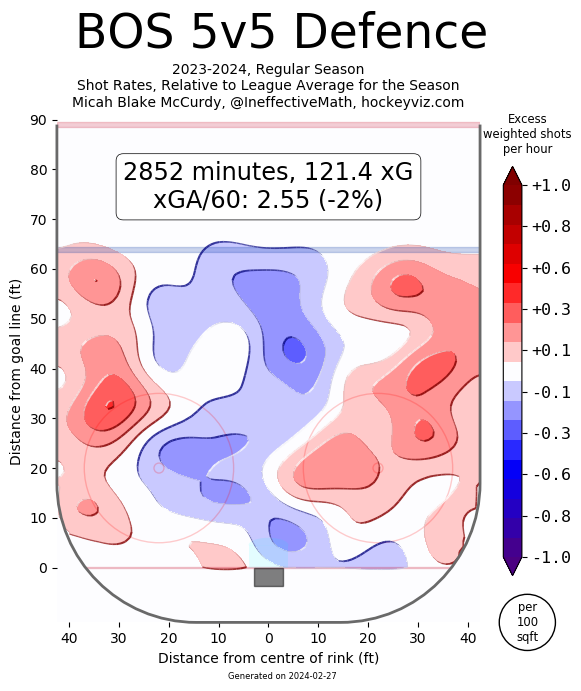
The Bruins have been bailed out throughout this season, with both Ullmark and Swayman in place to turn aside quality looks. But Boston’s propensity for letting teams uncork shots from the slot and other high-danger areas might be taking a toll on its 1-2 punch in net.
For the first time in a long time, both Ullmark and Swayman have looked rather mortal between the pipes.
In his last six games, Swayman is sporting just a .904 save percentage. Ullmark? A .903 save percentage. Of course, Ullmark will likely want to burn the tape on Monday after firing a puck right into Seattle forward Jordan Eberle’s chest en route to the easiest goal of his career.
But Swayman has also been knocked at times for relinquishing untimely goals at critical stages of games during this recent lull.
Even though Boston left Edmonton with a 6-5 overtime win last week, Swayman had a third period to forget — letting a puck fired in on a point shot from Cody Ceci trickle near the crease before Mattias Janmark jammed it home. It’s a stop that needs to be made, especially against a high-powered offensive team like the Oilers.
Ullmark and Swayman have been far from net negatives during this current stretch. Rather, they’ve regressed to league-average production. But on this roster, league-average goaltending won’t be nearly good enough.
All things considered, the Bruins have been able to replicate some of the top-six production lost when Patrice Bergeron and David Krejci retired last summer — with Charlie Coyle and Pavel Zacha on pace for a combined 45 goals and 116 points this season.
But Boston has struggled all season long when it comes to accounting for the absence of Bergeron and his ability to win face-offs during critical stretches of games — especially in the third period.
In total, the Bruins rank 18th in the NHL this season in faceoff percentage at 49.6%. Last season, they were second overall at 54.5%.
Zacha (54.0%) and Coyle (52.2%) have actually been solid in this department this season, although both of Vancouver’s third-period tallies on Saturday were generated off of faceoff losses from Zacha.
But elsewhere, the Bruins have had few answers at the dot, especially with Johnny Beecher (53.9%) down in Providence.
Trent Frederic (46.2%) hasn’t been the answer when shifted to center, nor has Morgan Geekie (43.3%). Even though Jesper Boqvist has generated more offense on the fourth line, the 4C is only winning 42.5% of his faceoffs.
Considering Boston’s issues with possessing the puck in the third period, calling up Beecher or targeting a faceoff specialist at the deadline might be a necessity by next week.
Of course, it hasn’t helped that several key cogs across the Bruins’ depth chart have been mired in extended slumps.
When Boston has several forwards rolling, Montgomery has the luxury of calling on an impact line regardless of what trio hopes over the boards.
But during scoring lulls, this team often becomes far too top-heavy and dependent on names like Pastrnak. And even when Pastrnak does deliver (two goals, three points vs. Seattle), it may not be enough if other players aren’t pulling their weight.
Brad Marchand only has just one goal in his last nine games, while Jake DeBrusk only posted one tally and two points in his last 13 games. Pavel Zacha hasn’t lit the lamp since Feb. 8, while Morgan Geekie has just one goal in his last nine games.
More players need to pull on the rope if this Bruins team wants to right the ship.

Stay up to date on all the latest news from Boston.com





To comment, please create a screen name in your profile
To comment, please verify your email address
Conversation
This discussion has ended. Please join elsewhere on Boston.com