
Ranking the top needs for the Bruins at the NHL trade deadline
The Bruins could use some heft in their lineup, be it on the blue line or the bottom-six grouping.
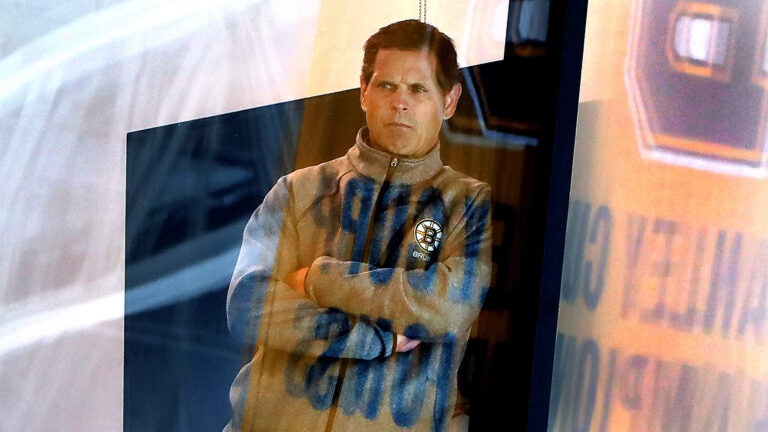
The NHL trade deadline is less than a month away.
And even though the Bruins currently sit atop the Eastern Conference with a 32-11-10 record, Jim Montgomery’s club could use an upgrade or two before the March 8 deadline.
It’s a midseason endeavor easier said than done for Don Sweeney and Boston’s front office.
Years of putting Boston’s chips on the table in win-now moves have depleted the team’s cupboard of draft picks. Sweeney and Co. won’t be on the clock until the fourth round of the 2024 NHL Draft.
And with an expected cap crunch sapping Boston of any semblance of fiscal flexibility ($61,558 in available cap space, per CapFriendly), the Bruins don’t necessarily have the means to add impact talent, not without shipping out NHLers (and their contracts) in the process.
Still, several areas of Boston’s roster could use an upgrade ahead of another grueling postseason push.
Let’s rank Boston’s top needs ahead of the trade deadline.
4. An impact center
What a difference a few months make.
Had we posed this question in September, this would have been the top need — and it wouldn’t have been particularly close.
Yes, it hasn’t been perfect with both Patrice Bergeron and David Krejci hanging up their skates last summer.
But Boston’s current 1-2 punch of Charlie Coyle and Pavel Zacha have been more than capable this season as play-driving options in the top six.
This fourth-ranked spot does not mean that Boston won’t make calls for pivots like Elias Lindholm in free agency.
Even though the Canucks relinquished several valuable assets to pluck Lindholm out of Calgary last month, Boston might have been in the mix for his services, per Sportsnet’s Elliotte Friedman.
But given Boston’s limited draft capital and meager cap space, this deadline doesn’t seem like the proper time for the Bruins to be players for a C like Adam Henrique.
Don’t expect Boston to be engineering any blockbusters come March.
3. A middle-six scorer on the wing
The Bruins might not have to tinker with talent down the middle this season. But another proven scorer on the wing might stand as some necessary insurance for an uneven B’s depth chart.
When his lines are rolling, Montgomery’s team has the means to splinter D-zone structure with just about any trio that hops over the boards.
David Pastrnak and Brad Marchand are proven commodities as far as their offensive contributions.
But after that? The Bruins have some impact wingers, but several are saddled with question marks regarding their stop-and-start production.
Jake DeBrusk has all the tools to be an impact, 30-goal scorer in the NHL. But his submissions on the scoresheet are about as easy to predict as a mid-February Nor’easter.
After a post-Christmas surge (eight goals, 14 points in 14 games), DeBrusk has now gone six straight games without a point.
Trent Frederic is in the midst of a breakout season, but has zero points in four games since the All-Star break. Morgan Geekie has just one goal and zero helpers in his last seven games.
Much like Boston’s 2019 procurement of Marcus Johansson, a steady, two-way winger can go a long way toward stabilizing a critical area of the lineup.
Options like Anthony Duclair or Jason Zucker could be appealing for Boston, although the cap gymnastics will remain an issue as far as taking on those contracts.
2. A tone-setter on the fourth line
No, the Bruins don’t necessarily need a brawler.
A flurry of right hooks isn’t usually the recipe needed to punch one’s way into another best-of-seven series.
But in an NHL that’s largely embraced skill over snarl, the Bruins are still in need of a fourth-line stalwart capable of landing welts on the forecheck, shifting momentum with a bone-crunching hit, and perhaps most importantly — dragging his teammates into the fight.
An impactful checking-line unit has been a hallmark of successful Bruins teams over the past 15 years. Beyond the famous “Merlot Line,” Boston relied on dependable two-way forwards like Sean Kuraly, Chris Wagner, Noel Acciari, and Joakim Nordstrom during its last run to a Stanley Cup Final in 2019.
The Bruins have found some promise on the fourth line, especially among younger skaters like Johnny Beecher and Jakub Lauko. But a checking unit filled with green skaters has largely been unable to consistently impact games and forge an identity at such a critical area of the lineup.
In total, Montgomery has rolled out seven different fourth-line trios this season who have logged at least 15 minutes of 5v5 ice time together. Only one has logged over 50 minutes together — a grouping of Oskar Steen, Beecher and Lauko (75:01).
The Bruins added Milan Lucic this past offseason as one of their bargain-bin pickups — with the veteran winger not only expected to serve as a physical deterrent, but as an emotional conduit capable of getting his teammates to follow his lead in the fracas found in the postseason.
Of course, that offseason vision dissipated in short order this winter. And while Lucic remains in the NHL Players’ Assistance Program, his days donning a spoked-B are likely at an end.
Thankfully, there are several potential options that the Bruins could turn to before the deadline in search of a big body, a veteran leader, or a two-way asset further down the lineup.
Even though the Bruins might not need an outright goon, the team could use someone capable of adding some heft to the lineup.
He’s currently sidelined for at least a month due to back surgery, but Wild power forward Pat Maroon is a proven winner (three Stanley Cups) capable of doing damage both with his fists and on the scoresheet (16 points in 49 games). Jordan Greenway (6-foot-6, 231 pounds) could also be an appealing option.
Minnesota’s Brandon Duhaime has all the makings of a bottom-six menace come the postseason given his wheels and knack for hitting anything that moves whenever he hops over the boards (470 hits in 183 career games).
And if Boston is looking for a steady 4C, there’s a lot to like about what 33-year-old Nic Dowd could offer Boston as a two-way option down the middle.
After several instances this year where the Bruins have either labored against a bruising opponent or have not put forth the proper response after a late hit or post-whistle tussle, Boston could use some new blood on the fourth line — especially one that can get the opposition’s blood boiling in record time.
1. A physical third-pairing blueliner
Much like Boston’s search for a top-six center, any scenario where Boston deals for a proven top-pairing stalwart like Noah Hanifin or Chris Tanev seems unlikely given the costs involved.
(Now, Hanifin in free agency? That’s another story.)
But for all of the talk of Boston’s strengths being rooted in its goaltending and D-zone play, the latter has left something to be desired.
Even though the Bruins rank third in the league in goals against per game (2.57), that might be more of a byproduct of the play between the pipes. After all, the Bruins rank 17th overall in the NHL in high-danger shot attempts allowed during even-strength play (per Natural Stat Trick), while their PK has been rendered mortal since the holiday break (75.7 percent success rate).
If the Bruins want to grind their way through the postseason, they need another steady, no-frills option on their blue line capable of eating up pucks, clearing bodies out of Grade-A ice, and logging taxing shifts on the PK.
Be it a viable top-four option like Minnesota’s Jacob Middleton, a puck magnet like Philadelphia’s Nick Seeler (a league-best 155 blocked shots) or a bruiser like Anaheim’s Ilya Lyubushkin, Boston needs another steady D-man further down its lineup.
If you’re looking for inspiration regarding the proper constitution of a Cup-contending D corps, look no further than the 2022-23 Vegas Golden Knights.
As we researched last June, the Golden Knights had only one starter on defense who was under 6-foot-2. And Alec Martinez (6-foot-1, 210 pounds) is far from a liability.
While Cup-winning rosters are filled with high-end talent and skill, a beefy defense has been a recurring trend with teams like the 2020-21 Tampa Bay Lightning and 2019 St. Louis Blues. During the 2023 Stanley Cup Final, the Golden Knights blocked 123 shots from Florida over the five-game series. Of that total, 71 of those blocks came courtesy of a defenseman.
If the Bruins plan on going deep this spring, they’re going to need more help in their own zone.



To comment, please create a screen name in your profile
To comment, please verify your email address
Conversation
This discussion has ended. Please join elsewhere on Boston.com