
With Patrice Bergeron and David Krejci retired, what could the Bruins’ opening-night lineup look like?
The Bruins will need multiple internal candidates to step up following both Bergeron and Krejci's retirement.
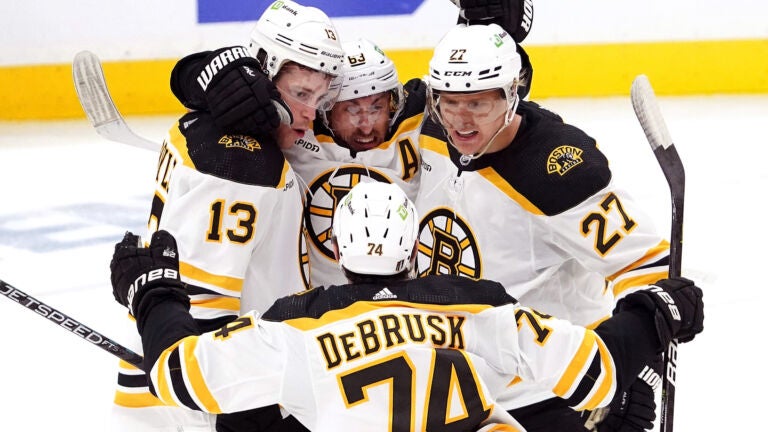
A painful off-season was always going to be on the horizon for the Bruins.
Be it a looming cap crunch, a barren cupboard of prospects following a series of win-now moves, or both Patrice Bergeron and David Krejci’s unsustainable defiance of Father Time, the bill was going to come due for Boston this summer.
Ideally, those concerns were going to be assuaged by the sight of Bergeron hoisting the Stanley Cup in June.
Instead, Boston’s shocking first-round exit against Florida accelerated the timeline of Boston’s massive exodus of talent.
And while the departures of key cogs like Taylor Hall and Tyler Bertuzzi will sap away some of Boston’s scoring depth, the retirement of both Bergeron and Krejci will usher in a sea change not felt within the Original Six franchise in over two decades.
For Don Sweeney and the Bruins, any hope of contention will likely need to fall on the shoulders of a stingy defense, poised goaltending tandem and a need of multiple internal candidates to step up at the forward position.
So with both Bergeron and Krejci now out of the equation, what could the 2023-24 Bruins look like in early October?
Let’s take a way-too-early look at Boston’s projected lineup:
FORWARDS
Brad Marchand — Charlie Coyle — Trent Frederic
We’re going for a slightly unconventional grouping here for Boston’s “top” line.
There’s no way for the Bruins to replicate Bergeron’s two-way mastery and top-line production.
But if Boston is looking to carve out a new top-six unit capable of negating top opponents and doing damage by way of a relentless puck-possession game, handing the keys to Charlie Coyle makes plenty of sense.
Even though the 31-year-old center is best suited in his regular role as Boston’s 3C, he held his own when slotted next to Marchand for an extended stretch of Boston’s first-round series against Florida.
When he’s on his game, Coyle is a physical force who can exhaust opposing skaters by playing keep-away from the puck. His greatest strides last season came on the defensive side of the puck, with Coyle earning a heavy share of D-zone starts in order to lighten both Bergeron and Krejci’s workload.
The offensive ceiling of this unit will be lessened with Coyle (one 50-point season on his resume) driving play down the middle. But a full season next to an offensive conduit in Marchand should only help Coyle unlock more scoring touch.
The addition of Frederic might confuse some, considering that Jake DeBrusk formed an effective partnership with Marchand over the last two seasons.
But if Frederic plays to his strengths, the 25-year-old forward should be stapled to Coyle’s hip in all 5v5 situations moving forward.
He might be a natural center (a 43.9% career showing at the dot raises some concerns), but Frederic did plenty of dirty work at RW for Coyle and Hall on the third line last season.
During the 649:43 of 5v5 ice time where Coyle and Frederic skated together, the Bruins outscored teams, 35-18, and held a 154-116 edge in high-danger scoring chances.
As for the 420:24 of 5v5 reps when Coyle skated without Frederic?
Boston only outscored opponents, 16-14, and saw opponents hold a 94-75 advantage in high-danger scoring chances.
Whatever the case may be, Coyle was at his best when he had Frederic on his right.
And even if Frederic may not have the ceiling of a DeBrusk, he could be a useful asset if Jim Montgomery opts to turn this top line into a cycling, puck-possession group that can eat up minutes and keep opposing stars at bay.
Jake DeBrusk — Pavel Zacha — David Pastrnak
Another positive domino effect of a Frederic promotion next to Coyle involves pushing Jake DeBrusk back to his natural position at left wing — and slotting him onto Boston’s top scoring line next to Pavel Zacha and David Pastrnak.
If Marchand-Coyle-Frederic are slated to serve as Boston’s 200-foot line, DeBrusk-Zacha-Pastrnak could be the Bruins’ offensive conduit — earning a lion’s share of the O-zone starts now up for grabs with Krejci and Bergeron out of the picture.
Zacha, 26, has been viewed as a natural successor for a top-six role even before both Bergeron and Krejci opted to hang up their skates. The 6-foot-4 forward had a breakout year in his first season with Boston, posting 57 points (21 goals, 36 assists) in 82 games while regularly slotting in for Krejci as the Bruins’ 2C.
Much like Coyle taking over for Bergeron, Zacha doesn’t have the same poise and passing capabilities as Krejci. But last season showed that he’s far from just a passenger in a featured role. And a full season spent next to a 60-goal scorer in Pastrnak should only further elevate Zacha’s play.
With Krejci — not necessarily the most fleet-footed skater — no longer driving play in the middle, don’t be surprised if Montgomery and Boston’s coaching staff pushes this line to play with plenty of pace next season.
Such a change in strategy would benefit another speedster in DeBrusk, who was on pace for his first 30-goal season in 2022-23 before missing six weeks due to a broken leg.
James van Riemsdyk – Morgan Geekie – Jakub Lauko
Morgan Geekie might be the most intriguing addition that Don Sweeney made during his bargain-bin shopping spree this summer.
A big-bodied center (6-foot-3, 200 pounds) with strong returns at the faceoff dot (51.1 career FO%), Geekie posted 28 points in 69 games with the Seattle Kraken last season — averaging just 10:27 of ice time per contest.
In total, there were 593 NHL skaters who logged at least 500 minutes of 5v5 ice time last season. According to Natural Stat Trick, Geekie’s 2.47 5v5 points per 60 minutes of play ranked 31st in the league — ahead of names like Clayton Keller (2.46), Jack Eichel (2.45), Leon Draisaitl (2.41), Alex Ovechkin (2.31), and Matty Beniers (2.21).
That’s not to say that Geekie is poised for a 65-point season if his reps bump up to 15:00 minutes per game, but there’s room to grow here.
James van Riemsdyk (15.41 individual expected goals in 2022-23) will look to get some more puck luck in Boston, although the 34-year-old winger might be better suited in a bottom-six role, rather than on a speedy line anchored by Zacha and Pastrnak.
The 3RW vacancy could be a landing spot for any younger player in the Bruins organization who pops during camp, especially one with a higher offensive upside like Fabian Lysell or Georgii Merkulov.
But for now, we’ll go with Jakub Lauko, who warrants a promotion after posting seven points and drawing 11 penalties in just 23 games (8:52 ATOI) last season. So long as his motor keeps going, Lauko should routinely make impact plays next season.
Milan Lucic – Patrick Brown – A.J. Greer
Beyond Lucic — who should be penciled in at 4LW throughout this upcoming season — there should be plenty of fluidity when it comes to Boston’s checking unit in 2023-24.
Providence regulars like Johnny Beecher, Marc McLaughlin and Oskar Steen will try to land starting spots out of camp, and will likely be given plenty of run during preseason action. Free-agent pickup Jesper Boqvist will also be in the mix as well.
But if Boston is looking to add some thump to their fourth line, we’ll opt for this trio.
Brown, a 31-year-old veteran and former captain at Boston College, is a likely replacement for Tomas Nosek given his strong faceoff numbers (56.1 career FO%). He also averaged 14.4 hits per 60 minutes of play last season — ranking 28th out of the 717 NHLers with at least 200 minutes of ice time last season.
Greer could be challenged at 4RW by younger players with more offensive upside, but the BU product regularly added energy and some bite into the lineup whenever he was called upon last season.
DEFENSE
Matt Grzelcyk — Charlie McAvoy
As polarizing as a player like Grzelcyk might be, keeping these former Terriers together offers the highest upside for Boston over the span of an 82-game regular season.
Logging heavy minutes next to a do-it-all force like McAvoy will aid Grzelcyk.
But McAvoy was also at his best when he had a transition ace like Grzelcyk as a regular partner. In the 604:05 of 5v5 ice time that McAvoy and Grzelcyk logged together in 2022-23, Boston outscored teams, 36-15, and held a 327-270 edge in shots on goal.
Hampus Lindholm — Brandon Carlo
Keeping Grzelcyk with McAvoy also allows Montgomery to anchor two different D pairs with franchise blueliners in McAvoy and Lindholm — ensuring that Boston has a top-flight presence on the ice for the majority of a 60-minute contest.
Despite suffering a steep drop in play in the postseason due to a broken foot, Lindholm played like a top Norris contender in 2022-23, and also meshed well next to the steady, stay-at-home Carlo.
Expect this duo to keep earning daunting matchups in 2023-24 and beyond.
Derek Forbort — Kevin Shattenkirk
Forbort might be a divisive player due to his results at 5v5 play, but he’s still a valuable asset on the penalty kill and a magnet for blocked shots. Mason Lohrei will likely be a focus for many Bruins fans during camp, but Boston’s blue-chip prospect likely needs more seasoning down in the AHL ranks first.
Boston will miss Connor Clifton’s physicality, but the veteran Shattenkirk should perform well in a lesser role than the top-four assignments he was regularly assigned on a dreadful Ducks team.
GOALTENDING
Linus Ullmark
Jeremy Swayman
If it ain’t broke …
It remains to be seen how exactly the reps will be allocated over the span of an 82-game season.
But with Boston’s strengths rooted in its defensive fortitude, expect both Ullmark and Swayman to continue their effective rotation between the pipes.
The next step, of course, is keeping that rotation intact if Boston punches its ticket to the postseason once again.



To comment, please create a screen name in your profile
To comment, please verify your email address
Conversation
This discussion has ended. Please join elsewhere on Boston.com