
A bargain-bin bridge, building from the net out & a future spending spree? Mapping out Bruins’ future plans
"We know we’re a competitive group and we want to remain a competitive group and with an eye towards the future."
COMMENTARY
A salary-cap headache was all but inevitable for the Bruins this summer.
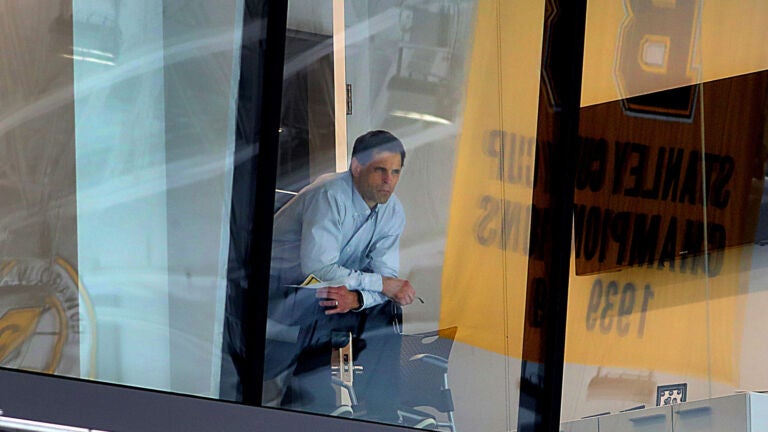
The sight of his name etched into the Stanley Cup would have alleviated some of Don Sweeney’s pain.
Such wasn’t the case for a record-setting Bruins squad in 2022-23.
Despite Sweeney’s efforts to put an already impressive roster over the top, Boston’s campaign for the ages came to a crashing halt in late April after just seven games.
Since Carter Verhaeghe snapped a puck past Jeremy Swayman and into Boston’s net on April 30, little has gone right for the Original Six franchise.
Entering Saturday afternoon, the Bruins had $13.6 million in available cap space to sign seven forwards, re-sign a goalie and orchestrate other roster tweaks.
Dmitry Orlov and Connor Clifton have already signed new contracts elsewhere. Tyler Bertuzzi, once thought of as a potential cog in Boston’s revamped, post-Bergeron core, is not expected to return.
An unforgiving, cap-crunched marketplace that saw the Blackhawks leverage Boston into dumping Taylor Hall’s contract for two fringe defensemen prevented Sweeney from making other cost-cutting measures.
It remains to be seen if either Patrice Bergeron or David Krejci will return for Boston’s centennial season.
And with Boston’s next first-round selection not available until 2025, Sweeney doesn’t have the option of fully dismantling his roster in search of a franchise-saving prospect in the draft.
The only option available for Sweeney is to trudge ahead with the current core in place.
And with little in terms of fiscal flexibility, the Bruins opted to get crafty in search of greater returns in 2024.
By the time the dust settled on Saturday’s “spending spree”, the Bruins announced nine different signings. Four additions that will likely stick on the NHL roster — Milan Lucic, James van Riemsdyk, Morgan Geekie, and Kevin Shattenkirk — account for a total cap hit of $5.05 million.
They’re far from flashy signings. But each should slot into an expected vacancy on the depth chart.
Lucic’s heft and veteran leadership will be welcomed on a revamped checking unit. Shattenkirk will likely replace Clifton on Boston’s third D pair, while James van Riemsdyk will be tasked with replacing Bertuzzi’s netfront presence on the power play.
Geekie, a 6-foot-3 forward who generates off the forecheck, could slot in as Boston’s fourth-line center. If Bergeron and Krejci don’t return, Geekie might be pressed into 3C duties.
It’s an uncomfortable spot for Sweeney and the Bruins to be in, with Boston going from on-paper juggernauts to bargain-bin shopping like the 2002 Oakland A’s.
But there’s a method to the madness for Boston’s “Moneyball” offseason thus far.
“You have a lot of if, ands, or buts, but with the congestion of the marketplace as it relates to the cap and where we were,” Sweeney said Saturday afternoon. “I think we did a lot of the things that we set out to do in addressing the depth overall of our club. …We have plenty of opportunity for younger kids to come in and take their place if they earn it, but we’ve also complemented the group with players we felt we needed to fill some holes and address some needs.”
Boston is holding out hope that its low-cost additions will be able to carry out their expected duties across the lineup. But given the short-term contracts involved, Boston will have few qualms if internal options supplant their free-agent pickups, be it in training camp or over the course of 82 games.
Van Riemsdyk might open the year in Boston’s top six, but a push from either Fabian Lysell or Georgii Merkulov will be welcomed. Jakub Lauko, Marc McLaughlin, and Johnny Beecher will be fighting for reps on the fourth line.
Within the span of just the 2023-24 season, the Bruins are giving themselves some options — and for the first time in a long time, the opportunity for younger players to make their mark.
Sweeney’s decision to not dole out a bevy of long-term contracts offers up hope that Boston will be able to orchestrate a more expansive retool in 2024-25.
As of Saturday night, Boston is projected to have $30.8 million in cap space next offseason, per CapFriendly. A long-awaited surge in the league’s salary cap could add another $5+ million in spending power, with another $5 million on the way in 2025-26.
With key cogs like David Pastrnak, Charlie McAvoy, Hampus Lindholm, Pavel Zacha, Linus Ullmark, and Jeremy Swayman (pending his upcoming RFA pay bump) already locked up by then, Boston has plenty of capital to target top options on the free agent market and build atop an already strong foundation.
Boston might be able to swing for the fences for a Noah Hanifin next summer to join an already stout blue line. Free-agent centers next summer include Elias Lindholm and Sebastian Aho.
More fiscal flexibility might give the Bruins the luxury to absorb a larger contract like Tomas Hertl’s in the coming years, while the emergence of a prospect like Lysell, Mason Lohrei, or Merkulov can give Boston a strong building block — or some much-needed trade capital.
As you can see, the possibilities to add to an already solid core in 2024 are bountiful, unlike the harsh realities of this cap-crunched summer.
Of course, the Bruins can’t just stay transfixed on the promise that the summer of 2024 provides.
Boston can’t wave the white flag this upcoming season, not with their draft cupboard barren and players like Pastrnak and McAvoy in the middle of their prime.
The return of Patrice Bergeron still looms large as a domino that needs to fall for this club as a steadying (and cheap), top-six stalwart.
But with the tandem of Ullmark and Swayman expected back in net, coupled with a D corps still anchored by Charlie McAvoy and Lindholm, the backbone of Boston’s success in 2022-23 is still in place.
“Our defense and our goaltending are pretty much what we had last year … That was a pretty good d-corps last year, so we feel pretty good about that, and the goaltending was excellent during the regular season,” Sweeney said. “We all fell short in the playoffs. So, our depth at the front was where we tried to address most of the needs, and again, with an eye towards allowing some of the younger guys to see if they can come in and take their jobs.”
The depth up front is not the same, unfortunately. A former Hart Trophy winner in Taylor Hall isn’t pushing play on the third line.
A lot can go wrong if a player like van Riemsdyk doesn’t deliver in the top six, and youngsters like Lysell or Merkulov aren’t ready for the opportunity.
But the Bruins still have the framework of a competitive roster in place for the 2023-24 season, one that should still have the personnel in place to remain in the playoff picture and even surprise many — especially if Bergeron returns.
And given the dour outlook that this cap crunch offered up for most of the last few months, Sweeney will accept such a reality.
Especially with the promise of next summer now fixated on the horizon.
“I think I was pretty honest that we weren’t going to be the same team,” Sweeney said. “We had an incredible amount of depth and we felt that we put together a good team, but we fell woefully short in the playoffs with what our goals were. We know we’re a competitive group and we want to remain a competitive group and with an eye towards the future. We didn’t really encumber ourselves too badly from a standpoint of contracts. … As we pointed out, we feel good about the competitiveness of our group.
“We have to stay healthy, and our top guys have to stay healthy to have the amount of success that we would like to have. It’s going to be a dog fight regardless with how you feel about your team today, injuries can play a part in that, and the growth of other teams is going to play a part in that.”




To comment, please create a screen name in your profile
To comment, please verify your email address
Conversation
This discussion has ended. Please join elsewhere on Boston.com