
Newsletter Signup
Stay up to date on all the latest news from Boston.com
COMMENTARY
It’s a testament to both the parity and the unpredictability of hockey that the Presidents’ Trophy — doled out annually to the team with the most regular-season points — is often regarded as a curse, not a blessing.
First-round upsets and implosions by juggernaut rosters are commonplace in the Stanley Cup Playoffs, as Bruins fans can, unfortunately, attest to this spring.
But even with various Cup runs routinely derailed off an unfortunate bounce of the puck or a split-second gaffe, the arbitrary nature of hockey hasn’t halted GMs from adhering to a copycat mindset when it comes to roster building.
While few teams might boast a Cale Makar on the blue line or an Andrei Vasilevskiy between the pipes, there are a number of roster-construction trends that have sprouted up over the last few championship clubs in the NHL ranks.
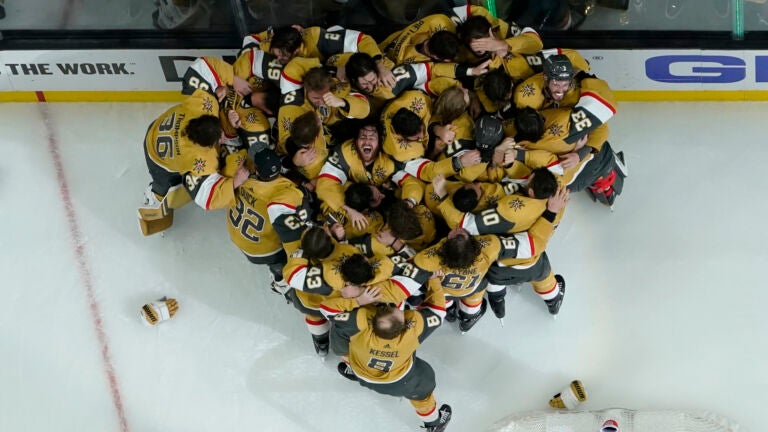
The 2022-23 Bruins do have some similarities with the newly crowned Golden Knights.
Both featured plenty of depth both up front and on the back end — a necessity during the war of attrition that is playoff hockey.
Both have plenty of familiarity with Bruce Cassidy as their bench boss.
But looking beyond the coaching staff, what other lessons can the Bruins glean from Vegas’ run to a championship?
The keys to success during the Stanley Cup Playoffs tend to shift over time.
But if there’s been one overarching theme that plenty of Cup contenders have adhered to, it’s a lot of heft on the blue line.
Let’s take a look at the last couple of Stanley Cup champions and see if you can notice a specific trend as far as their starting D corps for a majority of the playoffs.
2022-23 Vegas Golden Knights
Alex Pietrangelo: 6-foot-3, 215 pounds
Shea Theodore: 6-foot-2, 197 pounds
Alec Martinez: 6-foot-1, 210 pounds
Brayden McNabb: 6-foot-4, 215 pounds
Nicolas Hague: 6-foot-6, 230 pounds
Zach Whitecloud: 6-foot-2, 207 pounds
2021-22 Colorado Avalanche
Devon Toews – 6-foot-1, 191 pounds
Cale Makar – 5-foot-11, 187 pounds
Bowen Byram – 6-foot-1, 190 pounds
Josh Manson – 6-foot-3, 218 pounds
Erik Johnson – 6-foot-4, 225 pounds
Jack Johnson – 6-foot-1, 227 pounds
2020-21 Tampa Bay Lightning
Victor Hedman: 6-foot-7, 244 pounds
Ryan McDonagh: 6-foot-1, 215 pounds
Mikhail Sergachev: 6-foot-3, 215 pounds
Erik Cernak: 6-foot-4, 224 pounds
Jan Rutta: 6-foot-3, 204 pounds
David Savard: 6-foot-1, 235 pounds
2019-20 Tampa Bay Lightning
Victor Hedman: 6-foot-7, 244 pounds
Ryan McDonagh: 6-foot-1, 215 pounds
Mikhail Sergachev: 6-foot-3, 215 pounds
Erik Cernak: 6-foot-4, 224 pounds
Kevin Shattenkirk – 6-foot-0, 206 pounds
Zach Bogosian – 6-foot-3, 221 pounds
2018-19 St. Louis Blues
Alex Pietrangelo – 6-foot-3, 215 pounds
Colton Parayko – 6-foot-6, 230 pounds
Jay Bouwmeester – 6-foot-4, 206 pounds
Carl Gunnarsson – 6-foot-2, 198 pounds
Joel Edmundson – 6-foot-4, 215 pounds
Vince Dunn – 6-foot-0, 203 pounds
Notice any similarities here?
The Golden Knights trudged their way through the 2023 playoff bracket thanks to a suffocating defensive system, including a stout D corps that made life miserable for opponents in Grade-A ice.
Teams might rely heavily on a red-hot goalie to carry them through critical junctures, but the task becomes much easier when you’ve got a pair of big bodies in front of you who are more than capable of blocking shots and keeping skaters to the outside.
During the Stanley Cup Final, the Golden Knights blocked 123 shots from Florida over the five-game series. Of that total, 71 of those blocks came courtesy of a defenseman.
Some of Boston’s best playoff runs over the past decade have usually come to a grinding halt (2019 Blues, 2020 Lightning) due to an opposing defense that can dole out plenty of punishment and defend interior ice on just about every shift.
The 2023 Golden Knights are just the latest squad to execute with a similar roster build-out.
Of course, some additional context needs to be added when it comes to how Cup-clinching clubs are retooling their D corps.
If Boston wants an overhaul, that doesn’t mean that it has to go out and just add big bruisers like Luke Schenn and Radko Gudas and then call it a day.
Yes, Vegas and all of the teams mentioned above are linked in terms of their imposing stature on defense.
But crisp transition play from the back end and a bevy of shots from the blue line are often foundational pieces of championship rosters as well.
The Golden Knights’ defense might be hefty, but they were also skilled down the other end of the ice. The Bruins were generally cut from the same cloth when it came to puck play and offensive talent, until their breakout completely unraveled against Florida’s forechecking pressure.
The 2022 Avs were similar, and that’s looking beyond the on-ice cheat code that is Cale Makar.
Of the 213 NHL defensemen who logged at least 500 minutes of 5v5 ice time in 2021-22, the Avs had five in the top 85 in terms of shots on goal per 60 minutes of play.
Erik Johnson (6.85 shots per 60 minutes – 15th overall)
Cale Makar (6.76 shots per 60 minutes – 17th overall)
Devon Toews (5.99 shots per 60 minutes – 37th overall)
Bowen Byram (5.09 shots per 60 minutes – 67th overall)
Josh Manson (4.77 shots per 60 minutes – 85th overall)
Adding a bunch of big bodies to your blue line certainly helps in the postseason.
But in order to thrive in today’s NHL, you also need a D corps capable of jumpstarting your offense by way of shots from up high in the offensive zone.
The best offense in today’s NHL is usually the most versatile one. A team can’t rely solely on the cycle game or chances off the rush in order to consistently win in the spring. Having a slew of blueliners capable of jumping into the play and peppering shots off low-to-high plays needs to be part of the equation.
While many Cup contenders are beefing up their blue lines, the opposite is happening up front.
Fleet-footed power forwards like Tom Wilson are still coveted in today’s game, but gone are the days where teams are loading up their forward corps with a number of 200-pound bruisers.
In the modern NHL, speed kills. And the Golden Knights are just the latest roster that made life miserable for opponents by wreaking havoc in transition and on the forecheck.
Even though the 2022-23 Bruins had an explosive offense, they didn’t necessarily have burners up front beyond Jake DeBrusk and Taylor Hall.
Contrast that with the Golden Knights, who had straight-line speedsters like William Carrier, Keegan Kolesar, and William Karlsson in the bottom-six grouping and the 5-foot-9 Jonathan Marchessault doing damage on the top line.
The Panthers also had gifted skaters like Anthony Duclair and Sam Bennett do damage on the rush and on the forecheck. The Carolina Hurricanes’ frantic forecheck doomed Boston last season, and has been a hallmark of Rod Brind’amour’s system for years now.
But more than just turning the ice into a track meet (a rather unsustainable offensive strategy), speed creates both opportunity and versatility for your offense.
On the rush, having players capable of putting opponents on their heels can lead to Grade-A looks in transition or can prompt a panicked hook or trip from a defender. But having a number of gifted skaters on your roster also allows you to augment your offensive approach on the fly.
The Golden Knights, much like the Bruins, did most of their damage during the regular season on the rush. Oftentimes, those chances tend to dry up in the playoffs when interior ice is locked down and teams ratchet up their pressure against your breakout.
The Golden Knights had the speed in place to tweak their attack by ramping up their own forechecking pressure, using their straight-line acceleration to force turnovers and create havoc in their opponent’s end of the ice.
The Bruins simply didn’t have the horsepower available to follow a similar formula.
Whether it be incorporating youngsters with closing speed like Jakub Lauko and Johnny Beecher into the bottom six or adding more skill via trades, the Bruins need to inject more pace into their forward grouping in 2023-24.
If the Bruins continue to roll out a goalie tandem of Linus Ullmark and Jeremy Swayman next season, they’ll boast arguably the best 1-2 punch in the entire league.
It’ll also likely cost them somewhere between $8-9 million, given that Swayman is due for a nice pay raise as a restricted free agent.
And while that combined cap hit is still below what some netminders like Sergei Bobrovsky ($10 million cap hit) and Andrei Vasilevsky ($9.5 million) are costing on the books, Vegas’ run with the personnel they had in net offers validity to the belief that such a hefty investment isn’t needed at the position.
It might sound crazy given the importance of goaltending in any Cup run, but the Golden Knights’ run offers proof that play in net might ultimately be a crapshoot.
After a proven star in Vasilevskiy anchored two Cup titles for the Lightning in 2020 and 2021, the last two Cup-winning goalies have been Colorado’s Darcy Keumper and Vegas’ Adin Hill.
Hill, who started the year as Vegas’ third-string goalie and entered the postseason as Laurent Brossoit’s backup, casually went out and posted two shutouts and a .932 save percentage in 16 games during this playoff run.
Keumper finished his 2022 playoff run in Colorado with a .902 save percentage over 16 games. Even Jordan Binnington has largely fallen back to Earth after his improbable run with the Blues in 2019.
If the Bruins do need to trade one of Ullmark/Swayman this offseason in search of cap relief/assets, they might find solace in the fact that the best goalie on paper (at least in October) has rarely been the one leading his team to a title in June.

Stay up to date on all the latest news from Boston.com




To comment, please create a screen name in your profile
To comment, please verify your email address
Conversation
This discussion has ended. Please join elsewhere on Boston.com