
In a changing Canada, Don Cherry’s firing is front-page news and a Rorschach test
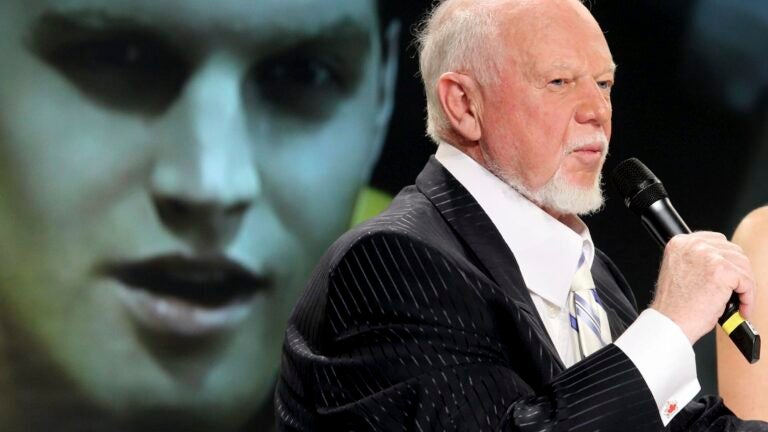
MISSISSAUGA, Ontario – Outside the Paramount Fine Foods Center, a hockey arena in this ethnically diverse suburb of Toronto, a storm was dumping snow and causing chaos Monday night. Inside, parents of kids playing the country’s national sport discussed a very different storm: The one that led Rogers Sportsnet to oust longtime hockey commentator Don Cherry after on-air remarks that were widely perceived to be anti-immigrant.
“I don’t think they had a choice, unfortunately,” said Gary Camilleri, before the Mississauga Senators minor midget AAA team that he coaches took to the ice. “The public cries, and they have to answer.”
Cherry was fired Monday afternoon, ending a more than 40-year broadcasting career that made him a singular figure in Canada – in hockey, and beyond. Saturday night, on his “Coach’s Corner” segment, which runs during the first intermission of the popular “Hockey Night in Canada” program, the 85-year-old referred to Canadian immigrants as “you people” and claimed that few people in Mississauga and downtown Toronto wear a poppy to honor military personnel in the run-up to Remembrance Day, the country’s equivalent to Memorial Day.
The firing made front-page headlines on Tuesday, from Winnipeg to Montreal. Tabloid Le Monde splashed “Bon débarras” across its cover, or “Good riddance” in French.
“He was iconic,” said Ken Hitchcock, a Canadian who coached in the NHL for more than 20 years. “I know in Canada we’re a country of immigrants and that’s what we are. And that’s where society’s at now, [not] just in hockey but in every aspect of life. There’s a real sensitivity toward that stuff that there wasn’t 20 or 30 years ago, but there sure is now.”
After Washington Capitals practice on Tuesday, forward Tom Wilson, who grew up watching Cherry, said, “I think hockey is changing, the world is changing. It is the end of the era of ‘Coach’s Corner’ for sure. It probably won’t ever be the same without him.”
Indeed, it is difficult to overstate Cherry’s cultural relevance in Canada, and in his chosen sport. The former NHL coach and player became a far bigger figure after his transition to broadcasting. He wore garish suits on TV and was a bombastic celebrity in a country that has few of them. In a national survey in 2004, Cherry was voted the seventh-greatest Canadian, edging out Wayne Gretzky and Alexander Graham Bell. He was dubbed the Prime Minister of Saturday Night. Fans at NHL games in Canada would leave their seats during intermissions to crowd around televisions in the concourse to hear Cherry’s takes.
Longtime Sports Illustrated hockey writer Michael Farber recalled once talking to a player in the Montreal Canadiens’ locker room who asked if he had heard what Cherry had said during a game. “I said how are they watching him, were they recording him somehow?” Farber said in an interview. “Turns out they were watching Cherry on TV during intermission.”
In recent years, though, Cherry had become a touchpoint in a changing Canada, as his commentary on Saturday nights grew more pointed, and more political. Those who believe in climate change were “cuckaloos.” Opponents of fighting in the game were “turncoats.” Quebec nationalists were “a bunch of whiners,” and the Canadian government’s decision not to enter the Iraq War meant “we’re just riding on [the U.S.’s] coattails.”
“He was a Rorschach test,” Farber said. “People thought he was incredibly out of touch, that hockey had evolved and he hadn’t. Other people thought he understood old-time hockey better than anyone, that he stood for old-time hockey values but also what they embraced as Canadian values.”
In the immediate aftermath of Cherry’s dismissal, a backlash was already fomenting on talk radio and online, with #IStandWithDonCherry, #BoycottSportsnet and #DonCherryWasRight trending on Twitter. And yet the Canadian Broadcast Standards Council, the agency responsible for handling listener and viewer complaints, said it received so many complaints about Saturday’s broadcast that its “technical processing capacities” were exceeded.
“Sports bring people together – it unites us, not divides us,” Sportsnet President Bart Yabsley said in a statement Monday. “Following further discussions with Don Cherry after Saturday night’s broadcast, it has been decided it is the right time for him to immediately step down. During the broadcast, he made divisive remarks that do not represent our values or what we stand for.”
Kristi Allain, a sociology professor at St. Thomas University in New Brunswick, spent three years watching and analyzing “Coach’s Corner” segments for research that informed her dissertation on gender and Canadian identity in men’s hockey. She said that “no one should be surprised” by Cherry’s comments and that he has presented a “consistent message” about his concerns over changes in Canadian society and hockey more specifically.
“The fact that he has stayed on the air means that he’s not speaking to nobody,” Allain said, noting that he has rarely faced blowback from sponsors or had trouble finding publishers for his books or videos. “It’s not that he didn’t change with the times. It speaks to deeper troubles in a largely fragmented Canadian population.”
Cherry’s dismissal comes in the same year that Canada recorded its largest influx of immigrants since World War I. The country’s changing makeup is, inevitably, altering its sports culture. While hockey remains Canada’s most popular sport, a study from the Solutions Research Group in 2014 found that newcomers to Canada are more likely to enroll their children in sports such as soccer and basketball, which have lower barriers to entry.
“I think the older I got the more difficult it became to watch him,” said Sunaya Sapurji, the managing editor of The Athletic Toronto. “And if you want to grow the sport – the NHL has a ‘Hockey is For Everyone’ campaign – here was a guy who wasn’t on the same page as that and to people who didn’t look like him.
Cherry’s ouster also caps a year in which questions around race and immigration have been thrust into the national spotlight here, prompting sometimes uncomfortable conversations and reflection.
In June, the Toronto Raptors defeated the Golden State Warriors to capture their first NBA title. They did so with a roster made up of players from several countries – one that commentators noted appeared to reflect the diversity of its fan base in multicultural Toronto, where more than half of the population identifies as minority. The night before the team’s championship parade, the province of Quebec passed a controversial law banning public-sector employees from wearing religious symbols such as hijabs, turbans or yarmulkes on the job. The legislation, the first of its kind in North America, has drawn criticism across Canada and among rights advocates worldwide.
Later in the summer, 19-year-old Bianca Andreescu became the first Canadian to win a Grand Slam title when she beat Serena Williams at the U.S. Open. At a rally for Andreescu in her native Mississauga, Prime Minister Justin Trudeau specifically thanked her parents, immigrants from Romania, for “choosing Canada.” That same week, in the middle of a federal election campaign, Trudeau apologized repeatedly after several photos and video surfaced of him wearing brownface and blackface as a younger man.
Cherry’s ties to Mississauga run deep. He lives here and once owned and managed the Mississauga IceDogs (now the Niagara IceDogs), the city’s Ontario Hockey League franchise. The Paramount Fine Foods Center is located on Rose Cherry Place, named for the broadcaster’s late wife.
Kofi Kwajah, whose son was playing Monday night, said he watched Cherry’s unscripted jeremiad live. “At first, I was shocked when I heard it,” he said. He added, “All in all, the guy is good for hockey.” Bruno Cristini, a real estate broker chatting with other hockey moms and dads, said Cherry has been given “a bit of a long leash,” and that he would like to hear Cherry apologize, saying he was “a little bit shocked” by his remarks.
“I love when he talks about hockey,” Cristini said, “and I prefer that he stick to hockey.”
– – –
Strauss reported from Washington. The Washington Post’s Isabelle Khurshudyan and Samantha Pell contributed to this report.





To comment, please create a screen name in your profile
To comment, please verify your email address
Conversation
This discussion has ended. Please join elsewhere on Boston.com