NBC’s Patrick Sharp knows what it’s like to face Bruins in Stanley Cup Final
"In 2013, Boston played as good a hockey game as you can play."
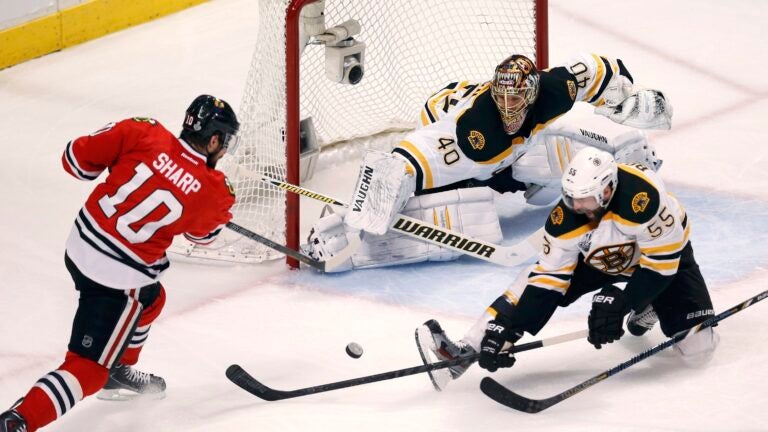
One of the most fulfilling moments of Patrick Sharp’s 15-year NHL career also qualifies as one of the most painful of this generation for Bruins fans.
The brief synopsis, as if you want the reminder: In Game 6 of the 2013 Stanley Cup Final, the Bruins led, 2-1, with less than two minutes remaining and were on the verge of forcing a seventh game.
There would not be one. Bryan Bickell tied it for the Blackhawks with 1:16 left, and Dave Bolland scored 17 seconds later to give the Blackhawks the stunning lead. Fifty-nine seconds later, the Cup was theirs.
Graciously, Sharp, a member of that Blackhawks team who retired after last season and now comes across as a natural as an analyst for NBC’s NHL coverage, doesn’t emphasize his joy at Boston’s expense when he thinks back on what playing against the Bruins meant to him.
“I do have some good memories of Boston, and winning the Cup is one of them, but most of my memories from that building are remembering the tough teams we had to play and knowing I was going to have to keep my head up against them,’’ he said.
Of course, Sharp’s graciousness and clear respect for the Bruins organization — particularly players he faced in that series, including Zdeno Chara, Patrice Bergeron, and Tuukka Rask — doesn’t mean he’s unwilling to talk about one of happiest plot twists of a career in which he played on three Stanley Cup champions as a Blackhawk.
“Hey, in 2013, Boston played as good a hockey game as you can play,’’ said Sharp. “They outplayed us for 58 minutes of that game, and we were able to steal one from them in 17 seconds and get out of there with the Cup.
“I remember after [Bickell] scored, I’m [on the bench] thinking, ‘Overtime, Game 6, somebody is going to be the guy to win the Stanley Cup, I want to be that guy.’ That’s what I was thinking about, staring into space, and by the time I put my eyes back to the ice, Bolland scores 17 seconds after we tied it, and all we’re thinking is, ‘Oh man, let’s get out of town, let’s get this over and get the hell out of town.’ It was chaos.’’
Six years after that series, Rask is questing to win his first Cup as a starter and fully emerge from the shadow of 2011 goaltending star Tim Thomas. Sharp said he’s always been bewildered by any skepticism of what Rask is capable of achieving.
“I always thought he was a top goaltender in the league,’’ said Sharp. “I was always shocked at the size of Tuukka, he’s way bigger than he looks on television. For whatever reason he’s had to earn his stripes locally and across the league. I’ve heard people say this is the best he’s ever played. Well, I’ve seen this before. I’ve seen him be locked in like this, be calm and matter-of-fact in interviews. I’ve always liked Tuukka and had a lot of respect for him. I hope he’s earned the respect of everybody watching, because he has it from his peers.’’
The Bruins and Blues have engaged in an especially physical Stanley Cup Final, and attrition may be a significant factor in the outcome. And that comes as the finale of a playoff structure in which the Cup finalists have already played three previous series over two months. It’s the toughest postseason grind in professional sports, and Sharp acknowledged that it takes a toll, even into the next season.
“In the moment, right now, it’s just another day,’’ said Sharp. “Yeah, the level and the intensity has jumped up, but it didn’t just jump from Game 40 in the regular season to the Stanley Cup Final. It’s a gradual build-up. When you get to the playoffs, Game 1 of the first round is your biggest game of the season, until you get to Game 2, and the next game, and then the next round. You just keep that progression going until you get to the Final.’’
Sharp, whose Blackhawks teams won three Cups and lost in two conference finals from 2009-15, said the challenges of the postseason can carry over to the next season.
“When it gets to September and October the next year, when you’re playing preseason games again, it’s a real mental grind, and you think, ‘Wow, we were playing the highest level hockey we could play just a couple of months ago, both teams, and we were beating each other up.’ It weighs on you mentally for a while. That physical toll comes later.’’
Sharp said he believes all of the extra hockey — the postseason plus international tournaments — took years off the end of his career.
“It’s a lot of hockey crammed into a short period of time,’’ he said. “I didn’t realize it in 2010 or ’13 or ’15, I was just — I mean, ’15 had started to take a toll, but when you’re in the moment and you feel like your team is good enough to win, you just do it, and you pay the price later on.
“I’m 37 years old right now and I’ve taken a full year off hockey. The broadcasting chair feels pretty good. I’m pretty sure that I could come back and play physically, but it’s the mental grind and the mental punishment that you take. My last two years in the league, the playoff games beat me up pretty good. So many great players and great teams haven’t had those opportunities. So no, zero regrets at all. I’m sure the players who ultimately win this series will feel the same way.’’