Former Bruins enforcer Nick Boynton details the personal demons he’s fought since retirement
"In so many ways, my life after hockey has been a living hell."
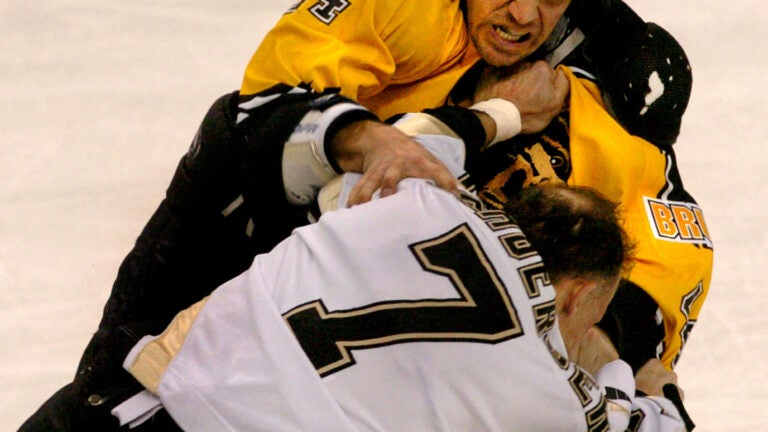
In the second period of a 4-1 game between Boston and Florida in 2008, Milan Lucic slammed one of the Panthers into the boards. Nick Boynton, a former Bruin then playing with the Panthers, immediately charged over and challenged the towering forward.
The pair circled each other, gripping jerseys, before Lucic unleashed two overhand rights. Boynton stayed on his feet and replied with a combination of his own, but a series of left hooks from Lucic sent him to the penalty box with his face split open.
The scrap was in keeping with Boynton’s approach: pick fights with bigger guys. Win, and you’re a hero. Lose, and you’re still the underdog who punched up. In hindsight, Boynton writes in The Player’s Tribune on Wednesday, that was an ill-fated plan. The defenseman, who made his name as an enforcer throughout an 11-year NHL career, paid the price for all those punches.
“In so many ways, my life after hockey has been a living hell,” Boynton said.
In the piece, he details his struggle with different personal demons — depression, anxiety, substance abuse, “and just… pain.” Boynton is far from the only ex-NHLer fighting battles long after they last dropped the gloves. He names several players who lost their lives before their time and notes he often wonders if he’ll be next.

Boston Bruins defenseman Nick Boynton lets loose with shot while skating at Ristuccia Memorial Arena in 2005.
For Boynton, one persistent thought kept breaking through the darkness — dying without speaking up, dying in silence, would be a waste. He decided to tell his story in the hopes that it might help someone else.
“My life, I’m telling you right now, will not end up being a waste,” he said.
The Bruins selected Boynton with the 21st overall pick in the 1999 NHL Draft. He played in 299 games for Boston, tallying 22 goals and 84 points in six years and earning an All-Star nod in 2004. He also had numerous concussions, which led to dangerous self-medication, rehab trips, and eventually a psychologist who helped address the root problems.
If he could do it over again, Boynton would have retired at age 26 or 27, even before the Stanley Cup he won with the Chicago Blackhawks in 2010.
“They can scratch my name off that cup, and I’d hand my ring back in right now if I could go back and make it so that I wouldn’t have had to experience all this pain and sorrow and anger and sadness,” he said.
Today, Boynton is an advocate for dealing with head trauma and the ramifications caused by a violent, physical sport. He’s working with Daniel Carcillo, another former Blackhawk who’s criticized the NHL for their handling of the issues and pledged to donate his brain to the study of traumatic brain injuries.
“Let’s start addressing the problem,” Boynton said. “Let’s look closely at the brain — and how our sport as we currently play it might be harmful to the brain — and begin making things right.”
“Enough is f— enough already.”