
Fresh off another Cup win, Mark Recchi says he could still skate a shift
Recchi played for 7 different teams and won the Stanley Cup 3 times as a player
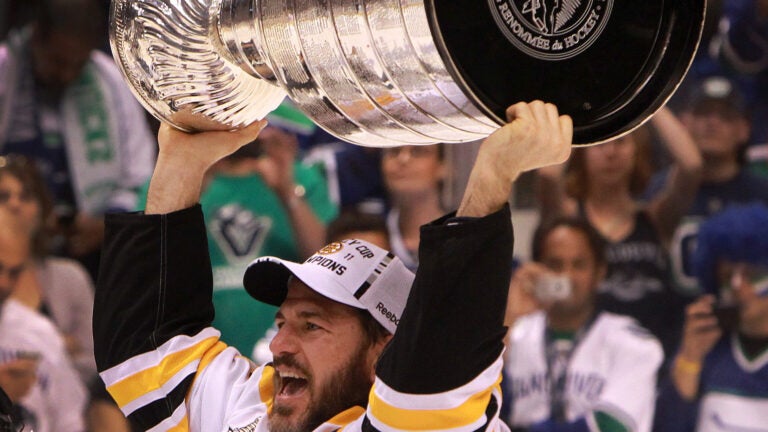
Mark Recchi is running out of room for Stanley Cup tattoos.
The former Bruins assistant captain wrapped up his 22-year playing career in 2011, announcing his retirement soon after the B’s brought the Stanley Cup home to Boston for the first time in 39 years. The Cup win wrapped up a career which included 1,652 games played (4th all time behind some guys named Howe, Messier, and Francis) , 577 goals, 956 assists, and 3 Stanley Cup wins.
Five years later, Recchi is back in a familiar place, Pittsburgh, where he won his first Cup and started his career. For the past two seasons, he’s served as the Penguins’ player development coach. Last month, the Penguins won another Cup thanks in large part to phenomenal rookie performances by guys Recchi helped develop. That win should alleviate at least part of the sting Recchi must have felt to be passed over for the Hockey Hall of Fame last week. We caught up with Recchi before the Hall announcement.
How was the 2011 Cup win different than your previous two?
Well you really appreciate them as you go along, I’d say that’s the biggest thing. I mean, I was fortunate to win period. In my opinion it’s the hardest sport to win, and I’m very fortunate to have a few of them. In ‘91 you win, before that I won the World Juniors. I won the Turner Cup in the minors in my first year as a pro, and then two years later I won the Stanley Cup — and I thought, ‘Oh sh**, this is easy, I just keep winning.’ And then all of the sudden, bam, you don’t win for a while. I was fortunate to win the ‘97 world championship with Canada, then 2006 comes around and you finally get another opportunity, and you really really appreciate it at that point, that’s the biggest thing. And with each one, you get an appreciation of how hard it really is, and what it takes to get there.
I’ve heard you’re a big wine connoisseur and collector, same with Mario Lemieux. Was there any particular bottle you brought out for this Cup win or the 2011 win?
I still have a couple bottles, hopefully I get it this year, I do have a bottle of Chateau Petrus, an older wine, older French wine, and I would like to drink it, but the problem is once you open it you have to finish it–I don’t know if I could do that by myself [laughs]. I gotta find a bunch of people that like that wine, that’s something I would like to do definitely.
It’s a mature taste, a veteran taste. And during the 2011 Stanley Cup run, you became the oldest player at age 43, to score in a Stanley Cup Final. You had a 22-year career, played less than 60 games twice, almost always above 40 points each season. Is there anything in particular you could say led you to have such a long and productive career?
Well obviously I was lucky to stay away from those injuries, but a big part of that was conditioning. I was always in shape, I always took care of myself, and I kinda look back, and especially with the resources these young guys have, and everything they have – and I can only imagine what I could’ve done if I had what they have now. The trainers and the special people that test you for things, nutrition. But conditioning was a big part of it for me. Randy Hillier told me when I was like 26 or 27, he says if you start taking care of yourself now, like really taking care of how you eat how you do everything, you’ll get to play longer. He said he started doing it when he was like 30 when he really started to do it, and he said he wasn’t able to catch up on the time he missed. I took that to heart and paid attention to it, and I was fortunate to keep playing until I was older.
Do you think you could throw on a pair of skates and skate a shift if you wanted to?
Yeah, I’m back to it now – six months ago I’d say not a chance, but I’m finally back in shape now. I could play one shift, I can’t say more than that. Throw me on the power play and put me in front of the net, I think I’d be okay [laughs] As long as Bergie and Krejci are throwing the puck around, I think I’ll be okay.
Do you do a rec league or anything along those lines?
I don’t, the last time I put my equipment on was the Alumni game in Boston [at the Winter Classic] – I shouldn’t say that actually, I played in the WHL alumni game in Kamloops, but those were the last two times. I skated a ton with Wilkes Barre, when they were going through the playoff run down in Wilkes Barre, I skated all the time at the end of the day, I would skate with the players, and do that, I love doing it. If you’re gonna make them skate, might as well skate with them. I’m not gonna go sit on the boards.
What is your day to day role as the player development coach?
My day-to-day is to help these guys get to that point, that’s what Bill Guerin and Jason Botterill, that’s our goal, and the coaching staff in Wilkes Barre is to get these guys to the next level, and finding a way to help them get there is the most important thing for us. Figuring a way out, getting to know the kids, getting to know what they are, what makes them tick. These guys deserve all the credit though, they wanted it, every one of them. You got Kuhnackl, Wilson, Rust, Sheary, Murray, Pouliot, but you got these guys, and first of all they’re great kids, and they get it, they want to be players, and when you have that attitude, it sure makes it easy to develop these guys and to work with them. Y’know if these guys weren’t up [in the NHL], we would’ve won one in Wilkes Barre [laughs]. And I think ultimately that’s what the goal is to have these guys come up and help you. We’ve got another crew coming up, another crew of kids coming up, and they might be this year they might be next year, or two years from now, but we have a great group of kids similar to this coming up, and this is what your organization thrives on, it has to do it. My role is to just kinda get them there. And once you get them there, you help them you guide them, mentally, physically, whatever, you do whatever you need to help them get there.
And speaking to the youth, and speed that the Penguins won with, it’s kind of a very different style of hockey than the Bruins 4th line back in 2011, a kind of heavier hockey – how crucial was the role that line played, and do you think hockey still has a place for that style of play?
Actually it wasn’t much different, you think about the 4th line in 2011, it was Campbell, Thornton, Paille – that was a heck of a 4th line. Paille could skate, Campbell could fly, Thornton was obviously a presence – he could play. Those guys are important, when they played 10 minutes or more, we were very successful. I think there was a stat, when this line played more than 10 minutes per game, every one of them, we won, like 90 percent of the time. It shows you how important they were to the team. And that’s the same with the Penguins now, when you have Kuhnhackl, Cullen, and Fehr, Cullen who’s a great veteran, Fehr who’s obviously a great veteran as well, and and you have a young kid like Kuhnhackl who will do whatever it takes, it creates a dynamic that’s a piece of your puzzle that helps your team win, and coaching could put them out at any time and feel comfortable, that’s the most important thing, you build that trust, you earn it, you throw them out whenever, whenever you throw ‘em out you throw ‘em out. That line played against top lines. And back in 2011, there was no problems playing those guys against top lines. It didn’t matter, you start the faceoff here, no big deal. And that’s important to a team.
Do you have any special plans for your day with the Cup? It is your fourth time, after all.
Not really, I’ll have it in Pittsburgh, I’ll have it where I live, and just have my kids, and my friends. I brought it back to Kamloops two of the times that I won it, and I was very fortunate to bring it back there, had a party in Boston in 2011 before training camp started, so I just want to have something real special with just friends and just really hang out with it, and enjoy it again, like you said it just gets better every time. Who knows when this will happen again, hopefully soon, but you just never know.
I think with the tear you’re having, you’re set for three or four more —
I only have room for one or two more tattoos.




To comment, please create a screen name in your profile
To comment, please verify your email address
Conversation
This discussion has ended. Please join elsewhere on Boston.com