
NHL won’t let warm temperatures rain on its Winter Classic game
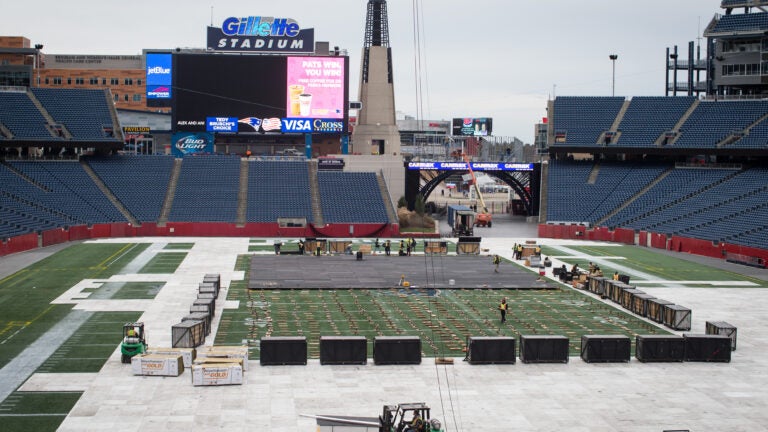
With 60-degree or warmer weather expected for Christmas Eve lasting into Christmas Day, Boston isn’t experiencing ideal outdoor hockey weather this December.
This is leaving many wondering how the ice rink will be affected if toasty temperatures—or worse, rain—persist when the Bruins face off against the Montreal Canadiens at 1 p.m. on New Year’s Day at Gillette Stadium in the NHL’s annual outdoor Winter Classic.
Dan Craig, the NHL’s senior director of facilities operations whose worked seven Winter Classics, told BostonBruins.com in a video that warm temperatures won’t be an issue for his crew.
“Not at all,’’ said Craig, who also oversaw an NHL game at Dodger Stadium in Los Angeles in 2014.
Rain, however, could be an issue.
“If we get a heavy rain, then there will be a concern. Light rain? Not a problem at all,’’ Craig said.
[fragment number=0]
NHL spokesman Jamey Horan told Boston.com on Tuesday that the facilities operations team is “ready to adjust to whatever the weather conditions are.’’
“If rain is too heavy or it’s dangerous for the safety of the players or the fans during game day, the league and the player’s association will make a decision, whether that’s a delay or something else,’’ he said.
Decisions won’t be made until the day of, Horan said. And if it does rain on game day, it wouldn’t be the first time for the Winter Classic.
“In Pittsburgh, we had heavy rain so they used the Zambonis to vacuum water off the rink,’’ Horan said. “They took over 6,000 gallons of water off the rink in the course of a couple hours.’’
The rink being built at Gillette Stadium is “one of its kind in the world,’’ according to Horan, because of the sophisticated system it uses to keep the ice frozen.
The 53-foot, 300-ton capacity refrigeration unit removes heat from the ice’s surface and stabilizes the temperature, according to an NHL statement.
“It’s refrigeration 101,’’ Horan said. “A lot of people think it freezes by pushing cold, but the system actually removes heat from the ice.’’
To remove the heat, the unit pumps up to 3,000 gallons of the coolant glycol into aluminum trays that are custom-made and configured to the field of each stadium. A series of hoses from the unit to the field moves the anti-freeze, which is chilled in the trays to 22 degrees Fahrenheit.
After the refrigeration is in place, the rink boards are installed and the ice is built two inches thick to help withstand the elements, according to the NHL.
Though warmer weather isn’t an issue for game day, the sun can cause problems for the addition of lines and logos, which will be added to the ice on December 27.
“[Craig’s team] will cover the ice during the day with reflective blankets that repel sunlight, and then work on the ice when it’s cloudy or when the sun is not directly on the ice,’’ Horan said.
As for dreaming of a white Winter Classic?
“We’re just hoping for a great sheet of ice to give the best game to players and entertain fans,’’ Horan said. “There has been snow in the past, and it doesn’t make-or-break game, but a little snow definitely does add to the game experience.’’
Gallery: Gillette Stadium is being transformed into an ice rink
[bdc-gallery id=”137495″]




To comment, please create a screen name in your profile
To comment, please verify your email address
Conversation
This discussion has ended. Please join elsewhere on Boston.com