
Who’s in better shape: the Celtics or Bruins?
COMMENTARY
Free agency begins at midnight Wednesday in both the NBA and NHL, just days after what were widely considered to be disappointing drafts for both the Celtics and Bruins.
Both Garden habitants are, at their core, in the same position: on paper, and likely in reality, neither is close to contending for a championship. Each franchise, though, has its own advantages and disadvantages as compared to the other.
So, a simple question with a complex answer:
Who’s in better shape, the Celtics or Bruins?
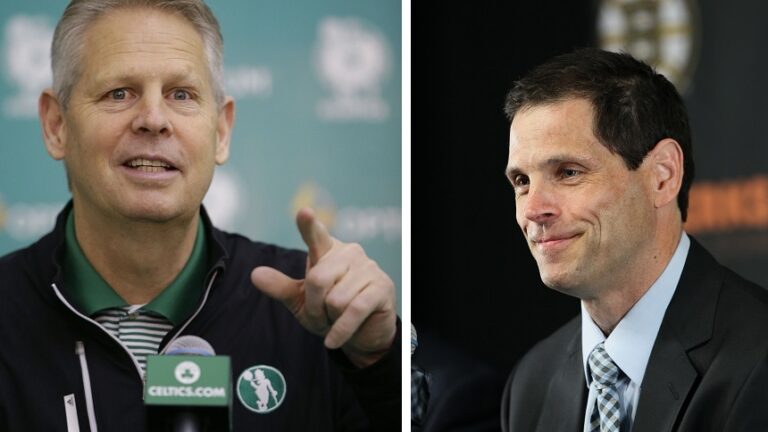
Most would lean toward the Green for the combination of ownership (Wyc Grousbeck, et al), top decision-making executive (president of basketball operations Danny Ainge), and head coach (promising youngster Brad Stevens) over the Stanley Cup-winning trio of Jeremy Jacobs, president Cam Neely (and, by extension, new general manager Don Sweeney), and veteran coach Claude Julien.
Conversely, it’d be impossible not to tap a stick in the direction of the B’s with regard to talent on the roster.
Even after dealing core players Milan Lucic and Dougie Hamilton for inferior returns, the Black and Gold still possess three-time Selke Trophy winner Patrice Bergeron (age 29), oft-injured but potent performer David Krejci (also 29), skilled agitator Brad Marchand (27), aging, game-changing defensemen Zdeno Chara (38) and Dennis Seidenberg (33) and, of course, former Vezina Trophy winner Tukka Rask (28). Even if future trades involving Chara or Seidenberg are somewhere on the horizon, there’s an indisputable group of talent worth building around going forward.
On the hardwood, the C’s have a number of nice pieces, but no All-Star caliber players. Marcus Smart, just 21, could reach that status. Perhaps 19-year-old swingman James Young might one day, too. Isaiah Thomas, 26, is a good scorer and the guard has a knack for injecting life into a stagnant offense, but he’s not likely to be part of a trifecta of stars good enough to carry a club to a title. No player on the existing roster is untouchable, not one is a clear building block for the future, and none would net the return in a deal some from the Bruins might fetch.
Short of trades, how do you build for the future? As we know, there are but two paths: the draft and free agency.
Both local fan-bases remain frustrated their teams stockpiled picks, attempted to trade up in last week’s drafts, and were unable to complete their respective goals.
The Celtics had no intention to select Terry Rozier at No. 16, not because they don’t like the strong-willed Louisville guard but rather due to their desire to move into the top 10 on Thursday. It didn’t happen. The C’s reportedly dangled as many as six draft picks, including up to four in the first-round, for the No. 9 choice and the Hornets rejected the offer out of some burning desire to add Wisconsin’s Frank Kaminsky, which is simply beyond comprehension. That somber reality introduced a question we can’t help but now consider: are Ainge’s treasure-chest of future picks – as many at 16 over the next three drafts – not worth as much as we all believed they were, especially if those Nets selections over the next few drafts don’t land in the lottery? Rozier and No. 28 pick R.J. Hunter might very well be nice role players, but odds are they won’t be men who shape the future of the franchise.
Then you have the Bruins, who wound up with three straight picks at Nos. 13, 14, and 15 and, to a chorus of boos, added defenseman Jakub Zboril and forwards Jake DeBrusk and Zachary Senyshyn. Unlike Rozier and Hunter, these three teenagers have at least the promise of shaping a future Blackhawks-like mold in Boston with young, inexpensive talents who develop within the system and grow into stars for years to come. It’s that latter part that stings; it will likely be years before we learn if Zboril, DeBrusk, or Senyshyn are Hamilton, Krejci, and Lucic or Matt Lashoff, Zach Hamill, and Jordan Caron, or some combination of the two.
Success in drafting, in many ways, comes down to luck. Short of regularly picking in the top five, the right player has to fall at the right time. The scouting department has to nail its selection. The kid has to stay healthy. And, naturally, he has to produce under the pressure of playing in a fan and media crazed market.
Free agency is different, and it’s two-fold. It involves having the money and being able to lure the top prizes.
The Celtics have been preparing for this moment for years; for the first time in decades they have the money to sign not one but two max-level free agents. There’s actually a chance to light those fireworks that have been so busy collecting dust in Grousbeck’s office. The problem, as you’ve heard thousands of times, is they’ve never been able to ink a player of that ilk. Now, they have the financial flexibility to add a LeMarcus Aldridge, Marc Gasol, Kevin Love, Draymond Green, or DeAndre Jordan – but they won’t. Those players don’t want to come to Boston. Superstar talents in the NBA tend to re-sign with their own clubs, seek the warm-weather climates, the states with no income taxes, places with great nightlife or endorsement opportunities, or those where they can team other with their fellow top-tier pals to chase rings. The C’s have no such supporting cast.
Boston may have a record 17 championships, but it will never be Los Angeles or New York, and perhaps not Miami, Dallas, Houston, San Antonio, or Chicago either. As long as LeBron James can promise his friends around the Association a chance to win, our beloved Celts don’t even have the attraction of Cleveland.
Story continues after gallery.
Potential Celtics free agent targets
[bdc-gallery id=”464712″]
It’s different for the Bruins. In the NHL, it means something to play for an Original Six organization. Generally-speaking, players prefer colder-weather climates like Boston, Chicago, Minnesota, Detroit, New York, Pittsburgh, Montreal, and Toronto. Historically, the B’s haven’t had much trouble signing free agents when they’ve had the finances to do so. However, as has been the case all too often in recent years, Boston is fiscally flummoxed; a situation created by former GM Peter Chiarelli’s questionable spending on certain players. Sweeney, you’d think, wants to climb out of that hole with the salary cap rising to $71.4 million, but the future savings created by dealing Hamilton, Lucic, and Carl Soderberg were lessened after an overpay to retain Adam McQuaid (four years, $11 million), a favorite but also a third-pairing defenseman. At the moment, the Bruins have 16 players under contract for next season, and just $7.8 million available to sign seven more (three forwards, three blue-liners, and a goalie). That number will increase by $4 million once Mar Savard’s cap hit is transferred to long-term injured reserve, but still leaves the team tight against the cap. Brett Connolly and Ryan Spooner have received qualifying offers and are in line for raises, and newly-acquired netminder Martin Jones, also a restricted free agent, will receive a new deal as well. Clearly, there’s no room for standout additions to the roster this summer, pending additional changes to the current group.
To recap: one team has some brilliant minds and plenty of cap space but virtually no attraction to free agents or existing players to build around, and the other has leaders with a spotty recent track-record, a solid veteran core, and an almost non-existent ability to supplant it financially.
Therefore, the bottom line: which team is closer to contention?
While noting a world of factors can change in the coming weeks between free agency and trades, it’s still the Bruins. They have some stars and proven playoff performers, and a hot goaltender and solid defense can carry a team a long way in the NHL. The Celtics, in order to truly compete in today’s NBA, need at least two All-Stars. They have none. Chemistry can only carry a team so far on the hardwood, as we watched last season.
It’s hard to say if either the C’s (roughly 75 guards on the roster, at present) or B’s (McQuaid and Zac Rinaldo instead of the kids??) have a specific plan for the seasons that lie ahead, but no clear path is apparent. Trader Danny and Donnie the Dealer, as they’ve come to be known, still have their work cut out for them.
For now, though, even with people calling for Sweeney’s head after only about six weeks on the job, his is the organization to envy between the two.


To comment, please create a screen name in your profile
To comment, please verify your email address
Conversation
This discussion has ended. Please join elsewhere on Boston.com