
Bruins could take a lesson from Blackhawks’ new dynasty
How did the Blackhawks do it?
COMMENTARY
You probably saw this bit of nostalgia floating around social media on Monday…
[fragment number=0]
Seems like a million years ago, doesn’t it? Just considering the active roster from that night’s 4-0 Game 7 shutout in Vancouver will give you pause.
[fragment number=1]
Yes, the Bruins have undergone changes over the last four years – the most defining, perhaps, coming after Claude Julien recently failed to guide his 96-point club to the postseason for the first time in eight seasons. The coach kept his job while his boss, general manager Peter Chiarelli, lost his.
But more alterations appear to be in store for a franchise ready to implement new GM Don Sweeney’s vision, a franchise desperately in need of a new identity, not to mention some massaging of the salary cap.
Story continues after gallery:
Boston Bruins head coaches through the years
[bdc-gallery id=”318212″]
The Blackhawks are professional sports’ latest dynasty after winning their third Stanley Cup championship in six seasons with a 2-0 Game 6 win over the Tampa Bay Lightning Monday night.
Since coach Joel Quenneville took charge of the bench four games into the 2008-09 season, his clubs have always been in the mix. Seven years, all ending in the playoffs. Three Cup titles. Two additional trips to the Western Conference finals. A .650 regular season points percentage and a .624 playoff winning percentage.
No, the Hawks aren’t Bill Russell’s Celtics (11 championships from 1957 through 1969), Tom Brady’s Patriots (three rings from 2001 through 2004) or those legendary Yankees that won 10 World Series between 1947 and 1962.
But Chicago is in extraordinary company after dispatching Tampa two short years after disappointing Boston.
So, how did the Blackhawks do it? How have they remained among the elite while well-coached and reasonably balanced clubs like the Bruins have dropped off or failed to find similar consistency?
Well, going a ridiculous 43-14 in Games 4 thru 7 of the last seven postseasons obviously helps, but being built to get that far and responding as necessary is another animal.
Simple to theorize, tougher in practice: Locking up a relatively small, but gifted core, with an emphasis on successful drafting and development to balance out the rest of the roster with a supporting cast of low-priced, high-round budding stars and role players.
This season, the Blackhawks had seven players with cap hits of at least $5.2 million, including forwards Jonathan Toews ($6.3M) and Patrick Kane ($6.3M), defensemen Brent Seabrook ($5.8M) and Conn Smythe-winner Duncan Keith ($5.51M), and goalie Corey Crawford ($6M). With the exception of Seabrook, an unrestricted free agent after next season, each of those instrumental performers is under contract for the next two to four years.
But that’s only half the battle. Toews, Kane, Seabrook and Crawford, like some of the others, have all been in the organization since this run of dominance began. All four are homegrown first or second-round picks who have matured through Chicago’s system both economically and in stature.
Rookie center Teuvo Teravainen, a 20-year-old taken 18th overall in 2012, chipped in 10 points in 18 postseason games after an abbreviated regular season. Brandon Saad, now a 22-year-old two-time champ picked 43rd in 2011, scored eight goals in the playoffs and put himself in position to cash in handsomely this summer.
Neither player made $1 million this season; both are likely to be prominent contributors for years to come.
From there, sage veteran Brad Richards ($2M), feisty forward Andrew Shaw ($1.5M), shot-blocking menace Marcus Kruger ($1.4M) and body-checking winger Andrew Desjardins ($750K) represented a group of high-upside role players capable of filling pivotal roles for short dollars.
In an ideal world, this is how you find success in the salary cap era, and GM Stan Bowman’s Blackhawks are doing it like no hockey franchise has ever accomplished before. The last team to win three Cups in six years was Detroit (1997, 1998, 2002), before the cap was installed prior to 2005-06.
That forward thinking, which has forced the Hawks to rebuild their roster multiple times since their Cup win in 2010 (See: Dustin Byfuglien, Andrew Ladd, Brian Campbell and others), has lacked around the Bruins in recent years.
Handing out hefty long-term contracts to Vezina Trophy winner Tuukka Rask (eight years, $56M), two-time Selke winner Patrice Bergeron (eight years, $52M), and elite-when-healthy pivot David Krejci (six years, $43.5M) were necessary evils of a salary cap reality. As noted with Chicago, it was imperative Boston identified and secured its top young stars for the foreseeable future.
But, as we all know, Chiarelli was widely criticized for falling too in love with his own players. He was unwilling to move on from the likes of Chris Kelly and all too eager to part with phenom Tyler Seguin for pennies on the dollar. Along the way, he handed too much money to bit parts like Gregory Campbell. And, more recently, the former GM’s botched attempt to properly structure the cap contributed to the forced trade of a top-pairing defenseman in Johnny Boychuk and a failure to allocate enough funds to keep high-scoring, top-line forward Jarome Iginla.
So, again, why did Chiarelli overpay or show and inability to move on from certain pieces? In large part, poor drafting.
Picking Tyler Seguin at No. 2 in 2010 was a “can’t miss’’ decision. Dougie Hamilton, taken ninth overall in 2011, was a hit as well and appears in line for a big payday in the coming months. His final first-rounder in Boston, David Pastrnak (24th overall), has shown in limited action as a teenage rookie he can play.
The 2006 draft that brought Phil Kessel, Milan Lucic and Brad Marchand to Boston featured interim GM Jeff Gorton as the brains of the operation. In Chiarelli’s first three drafts on the job, Boston opted for forwards Zach Hamill (8th), Joe Colborne (16th) and Jordan Caron (25th) in the 2007 through 2009 first rounds, none of whom were ever worthy of top billing in the Hub. In Colborne’s defense, he may have been eventually, but he was traded in 2011 before he had time to make an impact.
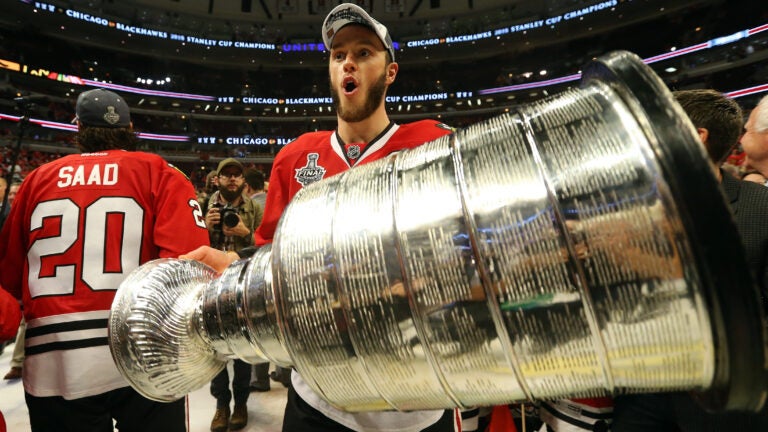
Bowman’s tenure in Chicago has been much more successful, which is why we’re likely to see more of the following before long.
[fragment number=2]
Hopefully a similar scene in Boston isn’t too far away, but Don Sweeney has a lot of work to do. If he’s searching for inspiration, Chicago wouldn’t be a bad place to look.



To comment, please create a screen name in your profile
To comment, please verify your email address
Conversation
This discussion has ended. Please join elsewhere on Boston.com