

Address Newsletter
Our weekly digest on buying, selling, and design, with expert advice and insider neighborhood knowledge.
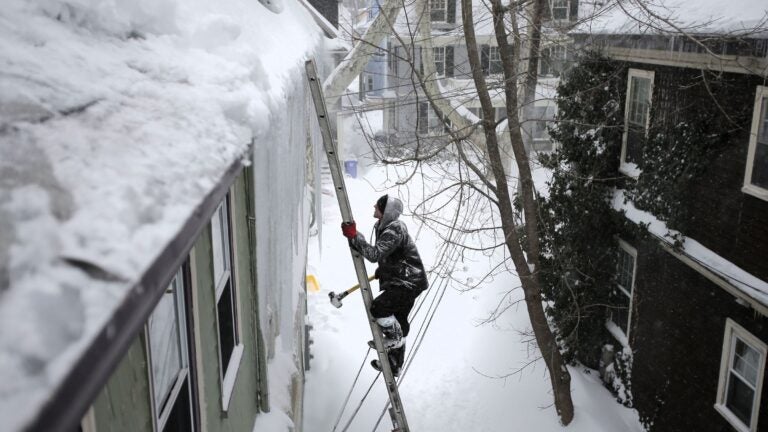
Should homeowners be checking for deep snow loads, loose shingles, and ice dams — worrying that the cold and snow of this season is causing irreparable damage to the roof over their heads?
The answer is yes and no. While ice dams can, in fact, create issues on older pitched roofs, winter itself is no worse than other natural events, such as wind storms or heavy rains. The reassuring fact is that roofs are tougher than you might think, experts say.
“Snow on the roof is not a problem in itself,” said Anthony Corrao Jr., president of Precision Roofing Services of New England, located in Essex. “In fact, it acts as an insulator that protects the shingles. And, even when it’s deep, the snow’s weight is less than what the roof is designed to bear; the average roof is built to carry loads of 65 pounds per square foot. Even flat roofs, which seem more vulnerable to snow loads than pitched ones, are pretty tough. In fact, residential flat roofing is stronger than commercial roofs.”
He said that some of the worst damage to roofs is caused by wind shears.
“When heavy winds change direction, they can tear shingles off and loosen the ridge caps.” He added that older roof shingles were designed to withstand winds of 80 miles per hour. “Now, they’re made to handle 130 mile-per-hour winds.”
Bruce Irving, Cambridge-based renovation consultant and Realtor, and former producer of “This Old House,” agreed.
“Snow itself is usually not damaging to roofs; its weight is the biggest concern, and building codes usually ensure modern roofs can carry it. Even three-deckers from the early 20th century, with their flat roofs, have proven able to handle New England’s snows.”
Water seepage, the problem that produces ice dams, can be addressed with better technology.
“Fifty percent of roofs right now are forming ice dams,” Corrao said. “In the end, most people get ice dams, but now building codes require that roofs be installed with an ice and water shield.”
“The best defense against water seepage is to block seams and holes against infiltration, which is what self-adhering rubberized asphalt products like Ice and Water Shield do,” Irving explained. “Essentially a sticky roll-out product applied to the roof’s edges, valleys, and other seamed areas, before the shingles go on, it blocks water from getting through the sheathing. It even self-seals around roofing nails when the shingles are applied.”
But even improved new products are never perfect, Corrao pointed out.
“There is a 30 percent failure rate,” he said. “But we have found that, 90 percent of the time, the problem is workmanship, not the product.
“If you do get leaking in the house, then try to get the snow off the roof. But you don’t want to damage the shingles, especially if you are trying to cut into ice dams.”
“During the last tough ice-dam season — 2015’s “Snowmaggedon” — people tried all sorts of approaches to breach ice dam humps: hacking through them, lobbing big salt discs onto them, even laying pantyhose legs loaded with salt across them, all with dubious results,” Irving said. “There is some evidence that heating tapes and wires along the eaves can help, but they, too, are not always effective. Snow rakes can be helpful. But roof access can be a challenge, and dangerous. And whatever you do, don’t take a snowblower up there, as seen in a disastrous video currently making the internet rounds. It’s so stupid that it’s probably AI-generated.”
Corrao said, “If the roof is relatively new, people don’t have to waste their money or to put themselves in danger removing ice dams.”
The average roof life, he said, is 25 years.
“If you find missing shingles,” says Corrao, “Call and get a roof repair. But, generally, one or two shingles coming off does not cause leaks.”
If you do need a new roof, he recommends that you install it in late winter or early spring.
“The new shingles and the ice and water shield stick to each other, and summer heat helps with that.”
Precision Roofing Services of New England, Essex

Our weekly digest on buying, selling, and design, with expert advice and insider neighborhood knowledge.





To comment, please create a screen name in your profile
To comment, please verify your email address
Conversation
This discussion has ended. Please join elsewhere on Boston.com