

Address Newsletter
Our weekly digest on buying, selling, and design, with expert advice and insider neighborhood knowledge.
In historic districts governed by preservation-based guidelines, exterior home renovation are a precise negotiation, as modifications down to the paint color may be subject to historic standards. But interiors are rarely, if ever, governed in such ways for residential homes, so what’s inside may be surprising.


In Providence, Rhode Island, a home with roots in the abolitionist movement has entered the market featuring an exterior reflecting its 1854 build, but an interior time-warped to 1988. The home at 98 Congdon Street in College Hill will see its next chapter written by a buyer interested in taking on both of the home’s aesthetic dimensions.
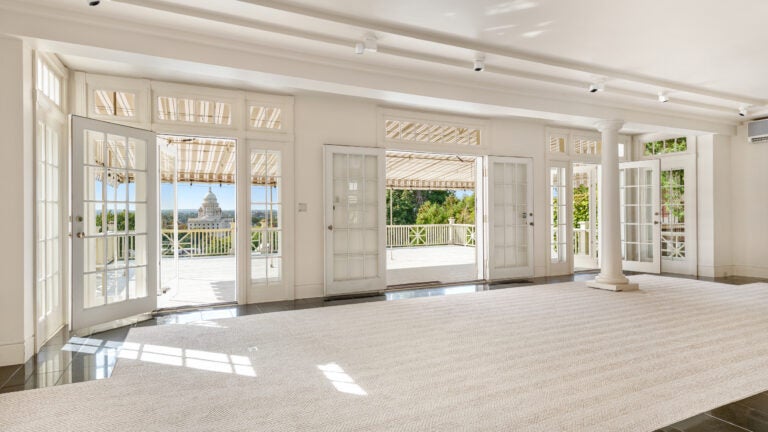
In 1988, former owner Marilyn Ardente purchased the house, completing a gut renovation down to the studs that opened walls and invited vast washes of sunlight inside — and the State House, which can be viewed from every room. For those (multi) million-dollar views, the asking price is just over $2.4 million.

Before it donned leopard print and marble, the Emma J. Smith house, as it’s known to the Providence Preservation Society, was built in the Italianate style, featuring mid-19th century elements seen in architecture of that era: bracketed cornices, molded window caps, and other elements of the time. According to research by the society, the land was first purchased by two schoolteachers for $2,335, and later sold to the Channing family in 1863. Former owner William Channing — an accomplished inventor who patented a portable electro-magnetic telegraph and is credited as one of the pioneers of inventing the telephone — collaborated with Lewis Hayden, Boston’s Underground Railroad leader at the time as well as several other abolitionist groups.
The house at 98 Congdon Street is one of about 1,600 Providence-based homes for which a Gowdey File exists — a detailed home history associated with historic plaque-holders in the city — as well as additional research detailed by the Society. The society has detailed the home’s ownership history through 1959. In 1988, Marilyn added her influence.

“It’s very modern and sleek,” said Christina Ardente, an agent with Residential Properties, based in Barrington. “I think somebody could move right in — but it’s also dated.”
The 4,658 square-foot home has three bedrooms, five bathrooms and a separate in-law apartment, the listing states.
Ardente, who is co-representing the property with her sister-in-law, Lisa Ardente, of Compass, is especially familiar with the space. Marilyn Ardente, who died last spring, was her mother-in-law.
“It was where my daughter took her first steps,” said Lisa Ardente, recalling decades of family celebrations at the house. She said that Marilyn would regularly host dinner parties, hiring local culinary and music students to cook and perform, and the family found the home an ideal base for watching New Year’s Eve fireworks.
“They basically did a gut renovation, but anything exterior had to be really carefully monitored and approved,” said Lisa Ardente. “It has original windows that have all been pulled out and literally stripped, reglazed, de-leaded and put back on,” she said, noting the all-new clapboard restoration as well. “Extensive work was done to make it a new, historic house.”


Inside, the spacious open plan recalls Miami more than the Colonial New England era: marble, mirror, and leopard print carpet leads to upstairs suites, glass bricks gleam surrounding a jetted tub with views of downtown, and a working elevator connects the floors. Outside, a four-car garage addition hoists a large terrace for entertaining.
The home is located in both a national historic district zone, as well as the local College Hill Historic District, so potential buyers will need to observe related guidelines, said Providence Preservation Society Executive Director Marisa Brown. The College Hill Historic District was submitted for nomination to the Department of the Interior’s National Register of Historic Places in 1959, according to records.
Generally speaking, acquiring a historic home joins a potential buyer to the past lives of those who lived there prior, she said.

“Hopefully … you’re interested in this history of this particular house, and all of the people who made lives within it,” said Brown.
Providence saw a wave of interest in historic preservation following 1960s-era urban renewal, she said, as neighbors became concerned with the demolition of historic structures. Today, while demolition happens less frequently (and is now off-limits inside historic districts), she said, those who live in the zones seem to be increasingly interested in preservation efforts, and are unbothered by their specific guidelines.

“We’re getting more and more calls from communities who are feeling like they’re more interested in the protection than in the drawbacks,” she said.
Lisa Ardente said the sisters-in-law chose not to stage the home for its sale.
“I really thought it was important that a potential buyer … see the bones of the place and the light that comes in,” said Lisa Ardente. “Much of College Hill… because it’s very densely populated, and the houses are so close together, some of the houses can be dark. And this is not; it is sun-filled.”
To have experienced a home firsthand and then represent it isn’t the everyday experience of most real estate agents, and Christina and Lisa are embracing it.
“It’s bittersweet, actually, but it’s also joyful in that it’s time for the next generation to enjoy it,” said Lisa Ardente.
Our weekly digest on buying, selling, and design, with expert advice and insider neighborhood knowledge.





To comment, please create a screen name in your profile
To comment, please verify your email address
Conversation
This discussion has ended. Please join elsewhere on Boston.com