
Artist thought his gardening days were over, but the call was irresistible
John Funt, the son of Allen Funt, host of the 1960s hit TV show "Candid Camera," swore he had worked gardening out of his system.
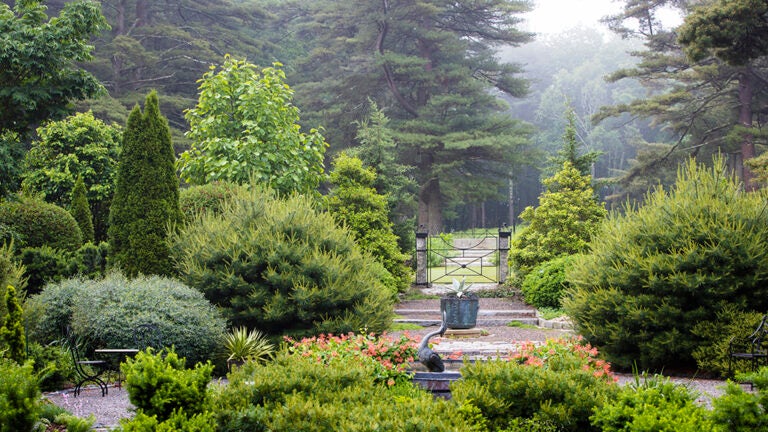
John Funt swore he had worked gardening out of his system. No more manic designing of landscapes for him, no more trawling nurseries for collectible plants. Nope. When he and his husband, Rick Childs, bought High Meadow in 2007, they planned to sit back and admire the massive sculptural white pines that came with the 55-acre Norfolk, Connecticut, property.
“The pines are the spirit of the place,” Funt proclaimed. “They are the legacy of this landscape.” No further input necessary.
Nobody who knew him believed him. After all, previous properties boasted legendary landscapes. The son of Allen Funt, host of 1960s hit television show Candid Camera, John Funt is a visual person who cut his teeth orchestrating special events for New York’s Metropolitan Museum of Art, followed by a 10-year stint designing for Tiffany & Co.

He and Childs moved to idyllic Litchfield County, where the scenery sparked his creativity — to paint, and their previous garden in Goshen, Connecticut, became his muse. That property was an encyclopedic tribute to conifers, with which Childs, an emergency room physician, is infatuated. When they moved to High Meadow, they envisioned field days confined to admiring the meadow and its white pines.
Close to a year went by before Funt decided that “the ruins” — the remains of an 1895 house that burned down before the main 1917 Colonial Revival house was built — needed work. With a little manicuring, the surviving stone porch and balustrades could become a hauntingly romantic destination and a lookout to view the church steeple in nearby Norfolk center.
All that was needed, he reasoned, were some mosses and astilbes to set the stage. But then it struck Funt that the terrace was crying out for framing. Surely it would be improved by a little horticultural frill to offset the stonework. And so it went. By the time he and Childs had expanded the plantings to double the size of the 100-square-foot garden behind the house, Funt had ceased excusing his lust to design.

The massive sculptural white pines are a hard act to match, but Funt’s artistic sensibilities served him as he mapped out the proper dimensions to balance the garden against the natural landscape. Vistas are broad, pathways are more than double the normal width, and shrubs and trees make grand and meaningful gestures. Funt threw himself into procuring just the right plants — with an emphasis on conifers. Most important, he planned for the long haul.
“The scale is big here,” Funt says. “Shrubs that I planted nearly 10 years ago are finally becoming the anchors I envisioned.”
Even though the garden is now twice the size of the original plot, continuity erases any sense of a timeline.
“The goal is one composition,” says Funt. “I see it as one unified scene.” As does anyone who visits.
Funt and Childs designed the space personally and thoughtfully. For visitors who don’t know conifers intimately, it reads as a glorious opus. Garden insiders will recognize rarities placed to showcase their virtues without ostentation. Only a few perennials, peonies being a favorite, are planted in grand sweeps to compete against the shrubby and arboreal players.
Even the tiny black violet, Viola cornuta ‘Bowles Black’, which Funt says “has become something of a signature,” is a generous colony that balances the abundant shrubbery. As for his approach, beyond a love for formality, grand gestures, and an affection for blushes of subtle color delivered by copper, burgundy, and chartreuse-leaved shrubs, Funt humbly says that he got most of the mistakes worked out in previous landscapes.

“I was so impetuous and never listened to advice,” he says. “Here, I’m in no rush. It’s very much like painting.”
That it has been a thoughtful process is obvious, as when one of the massive white pines was included within the cultivated habitat to unify the framing meadow with the formal landscape. The meadow’s mown paths allow Funt and Childs access to commune with their winged visitors.
A buffer zone lets woodland creatures venture within the stewarded landscape. Funt’s morning walks are as carefully scheduled into the day as his outdoor maintenance, carefully balanced against his painting, which is buoyed by moments in the garden.
“Amazingly,” he says, “I do my best painting in summer.”
As for his change of heart, Funt says, “I could get spiritual about this, but I won’t — except to say that I hope our affection for this property is evident in what we created. It took a few years to get comfortable with this land,” he adds, “but when you find a place that you truly love, it can only get better.”
See more photos of the property:




To comment, please create a screen name in your profile
To comment, please verify your email address
Conversation
This discussion has ended. Please join elsewhere on Boston.com