
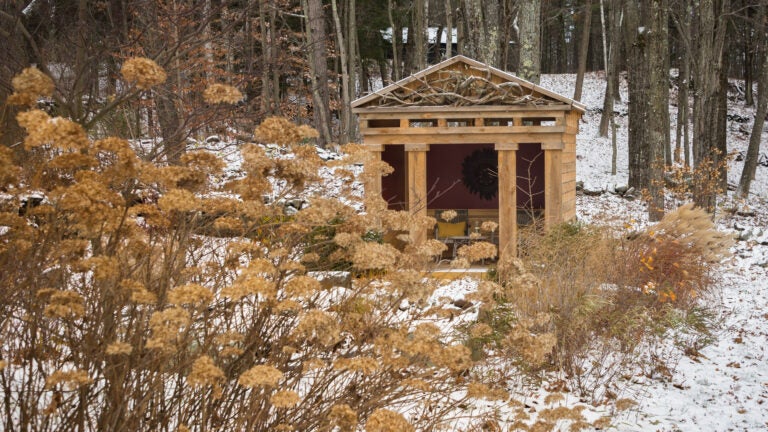
This garden in southern New Hampshire was designed to shine, even in winter
In 1999, Joseph Valentine and his wife, Paula Hunter, bought Juniper Hill Farm, a 30-acre property in New Hampshire’s Monadnock Region.
In 1999, Joseph Valentine and his wife, Paula Hunter, bought Juniper Hill Farm, a 30-acre property in New Hampshire’s Monadnock Region. Their goal was to renovate its 1789 saltbox-style house for weekend getaways.
“This project was the right size for us to manage ourselves at our own pace,” says Valentine, a retired psychologist, accomplished woodworker, and professional photographer. He and Hunter, a computer executive, spent four years restoring the 3,300-square-foot house, retaining its 18th-century charm and adding modern conveniences. Once finished, they decided to make it their full-time residence.
Then they turned to the landscape. “There was nothing here except a lawn with some ancient lilacs,” says Hunter. “There were no inherent focal points. Nothing was elevated.”
“We had never gardened on this scale,” says Valentine. “We started with the front entry garden. Neither of us had any design training, and we needed help. We heard Vermont-based garden designer Gordon Hayward speak during a garden tour and asked him for guidance.”
“I suggested they distinguish the courtyard garden from the dining patio with a pea stone path and hedges to create separate but connected areas,” says Hayward, whose home and business, Hayward Gardens, is in Westminster West, Vermont.

Valentine crafted a picket fence to surround the spaces and provide a sense of intimacy. Hayward says he “also advised hiding the gleaming turquoise pool in the backyard behind a hedge.”
As Valentine learned from Hayward the importance of layering with hedges and fences, the garden, which now spans 2 acres with 12 themed “garden rooms,” began to take shape.
“We wanted a garden with year-round interest,” says Valentine, “one to sustain us during the long winter. We visited gardens here and abroad to gather ideas for plantings, outbuildings, and accents. For instance, the pool pavilion was inspired by twin buildings at Hidcote in Gloucestershire [England]. I copied our frog pool temple from one in Prince Charles’s gardens at Highgrove.” Hardscape rather than plants came first. “It’s like building a house. Just as furniture and artwork come after construction, plantings should wait until the architectural elements, or ‘foundation,’ is in place,” says Valentine, who installed granite fence posts topped with stone orbs and added brightly painted enclosures, arbors, follies, and handmade planters that engage the eye, particularly when the garden is dormant.

Behind a protective fence, taxus, arborvitaes, and 150 boxwoods in 12 varieties, cut into fanciful shapes, lend structure and calming greenery year-round. In the lilac garden, varieties open at different times to extend the show. A hedge of ‘Miss Kim’ wears a stunning purple coat in spring and perfumes the air. Come fall, the leaves turn deep burgundy. The pink-tinged blossoms on 15 crab apple trees explode in the spring. Later, their crimson berries shimmer against the snow and feed the birds. Two Stewartia pseudocamellia flank the pergola over the terrace with creamy white summer flowers and striking red leaves in autumn. Grasses including miscanthus, pennisetum, and calamagrostis sway in warm weather breezes, turn softer shades in late summer, and sport jaunty seed heads in the cold-weather landscape. Spiky, actaea in the Zen and Faun gardens are fragrant in summer and add visual impact in winter. An espaliered pear tree grows on the woodshed while espaliered apple trees line the Meadow garden’s split-rail fence and potager. Beautiful in bloom, later heavy with fruit, their artfully arranged branches make a statement bare against the cold.
The gardens push the growing envelope, including plants not recommended beyond Zone 6 such as Clerodendrum trichotomum, whose leaves smells like peanut butter, and Salix babylonica ‘Crispa,’ whose foliage resembles a ram’s horn.
“I have a touch of the ‘frugal Yankee’ in me,” says Hunter. “Before the temperatures dip, I move 25 to 30 of our 100 container plantings indoors. We heel in our potted Japanese maples (many 10 years old) and some shrubs into our vegetable beds, root-prune, and replant them in the spring, too. It’s very satisfying to watch them leaf out and begin the cycle again.”
Their “country formal” garden fits its rural setting and is a natural extension of their house. “Everything has been carefully planned and delights us every day, especially,” says Valentine with a smile, “when we’re under a blanket of snow.”
See more photos of the garden:




To comment, please create a screen name in your profile
To comment, please verify your email address
Conversation
This discussion has ended. Please join elsewhere on Boston.com