
See how designer renovated her 1918 Dedham bungalow
Interior designer Liz McCabe lived for several years in the home before fully renovating the first floor. Design New England tours.
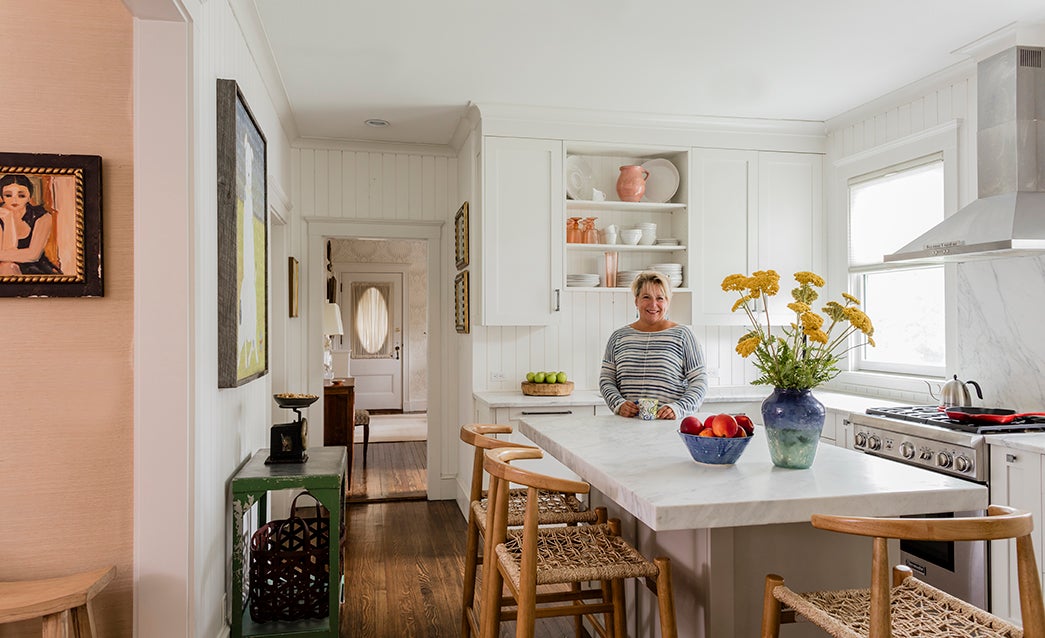
Interior designer Liz McCabe grew up in a small Connecticut town looking at her mom’s house and garden magazines and fantasizing about one day living in a house with an old barn on the property and plenty of room for kids and pets. Whether by destiny or design, McCabe today lives in a 1918 bungalow in Dedham, Massachusetts — complete with an old barn-style garage — sharing the house with her two sons, Oliver, 21, and Ben, 17, and one black cat with attitude named Wrangler.

“I walked in the front door of this house when Oliver was just 3 months old, and I immediately knew it was the house,” says McCabe, who loved the gracious entry, 10-foot-high ceilings, and architectural details that included a coffered dining room ceiling and generous mouldings. With three bedrooms, a full basement, front and back porches, and hardwood floors, the 1,700-square-foot house was precisely the home for which she and her then-husband (now ex-) were searching.
Best, the house needed just some cosmetic touches. “There were a lot of dark gumwood surfaces, so I painted things white to lighten up the feeling, and then just got on with life,” says McCabe, referring to the demands of raising two sons and running a design business.

As an interior designer, McCabe emphasizes her clients’ lifestyle and personal collections when transforming their interiors. In her own home, she is surrounded by her own collected treasures — from animal paintings by artist Richard Murray to an antique desk inherited from an aunt to a vintage flaxseed mill the shape of a crude surfboard that simply caught her eye. “I love looking at a house from the inside out and creating interiors that really reflect how a person lives,” says McCabe.
Although she had pored over those house and garden magazines while growing up, McCabe initially hadn’t considered design as a professional choice and instead pursued a career in business. But a few years into cubicle life at an investment firm in Boston, she by chance helped a caterer friend work an event: the opening of the Boston Design Center in 1986. “It was an amazing moment,” says McCabe. “It reminded me how much I loved interior design and how much of a business there was to it.” She proceeded to take night classes at New England School of Art & Design (subsequently part of Suffolk University). To gain experience, she worked four years for fabric house Schumacher and six years for former Boston-area, now Washington, D.C., interior designer Lisa Vandenburgh before starting her own firm in 2002.

Even then, the house was her anchor. She ran her interior design business out of it for 11 years, making the most of available space, adding built-in work surfaces and storage and stuffing every cubby with paint fan decks and fabric and wallcovering sample books. “It was great being right here in the house, albeit nuts at times. We did all the design work for a big house in Aspen [Colorado] from here,” she says with a chuckle. In 2013, she moved her Liz McCabe Interior Design business to an office in downtown Dedham. “It was time,” she says.

Two years ago, McCabe realized it also was time to give the house a fresh look. “My two charming little boys had become young men and had done a number on the walls, floors, and cabinetry,” she says. She embarked on a first-floor renovation to enhance not only the look but also the layout at the back of the house, where the kitchen and family room are located.
“It bothered me that you walked in the back door right into the main area of the kitchen,” says McCabe, “and even though the family room was right next to the kitchen, it felt cut off because of a narrow door opening.” McCabe worked with Cabot Building & Design in Dedham and kitchen designer Jennifer Gardner of Metropolitan Cabinets in Norwood, Massachusetts, and created a mudroom area just inside the back door and a defined pantry in a back corner of the kitchen. A center island, topped with Carrara marble, was added, providing a work surface and casual hangout zone. A commercial-style stainless-steel range and vent hood add updated functionality.

To better connect the kitchen and family room, McCabe widened the opening between them to 6 feet. The original bungalow lacked a fireplace. “I had really missed the character that a fireplace gives to a house,” says McCabe, who added one with a soapstone surround and mantel to the family room, where it looks as though it has always been there.
She gave all the first-floor rooms new surface treatments: grass-cloth wallcovering in the family room, walls painted Skimming Stone white by Farrow & Ball in the dining and living rooms, and a patterned wallcovering in the entry. Hardwood floors in the kitchen and family room remained intact, while white carpeting replaced sisal floor coverings in the dining and living rooms.

With her signature style, she filled every room with favorite pieces. “There’s a warmth I want to have in my own house,” says McCabe. “I see artwork and collections as a layering factor to make that happen.” Now, she appreciates anew how ideal the house is. The basement has become the hangout for her sons and their friends; the living and dining room are sophisticated yet comfortable for entertaining; and the family room is the nest for all, whether they are watching a movie or simply relaxing for a chat. “I love looking around and seeing a painting that my mom gave me or a gilt frame that my dear friend Roger Lussier created,” says McCabe, referring to the noted framework artisan whose Newbury Street studio, Roger Lussier Gallery, has been a favorite of Boston’s designers for years. “I feel no need to move away. My little bungalow still charms me, just like the day I first saw it.”





To comment, please create a screen name in your profile
To comment, please verify your email address
Conversation
This discussion has ended. Please join elsewhere on Boston.com