
See how a former Bay Village warehouse was transformed into a urban pied-à-terre
It all started with the staircase.
It all started with the staircase. It had been built in the 1970s and was awful. But the oversize skylights above it allowed natural light to permeate the four-story space from the roof all the way to the basement. The light-filled space could stay — it was the reason the new owners bought the place — but the staircase was going to have to go.
The new owners, a husband and wife whose primary residence is on Boston’s South Shore, were looking for a city pied- à-terre when they found the odd former storage space. The 1880 building once belonged to one of the film studios that dominated the Bay Village neighborhood in the early 20th century. More recently, however, its various iterations as a living space had left it dark and grimy. Dirty brick walls and cheap wood paneling remained, and the disjointed living spaces had been randomly built at various levels.

But the space had a cool, industrial personality, and the neighborhood was undeniably charming. Just blocks from Back Bay, the Boston Common, and the Theatre District, the tiny, quiet enclave of historical brownstones and Art Deco facades is centrally located yet feels a world apart.
The homeowners knew right away that living elegantly in the tall, narrow space would revolve around the installation of a staircase that would connect the various spaces, and because the only sources of natural light aside from the skylight and one small window in the stairwell were on the street facade, it would also need to act as a light well bringing illumination to the back sec- tion of the 28-foot-deep, 40-foot-tall building. Searching online for impressive examples of stair design, the wife discovered archi- tect and builder Steven Young of Steven Young, Architect + Fine Home Builder in Boston and Hingham, Massachusetts.

In the space where the new domed skylights meet the stairs, which are made from raw steel and hickory with a white oak hand- rail, Young added a story to the house by replacing what once was a series of awkward, shed-like structures atop the roof. “There were too many chopped-up spaces,” the wife says of the previous rooftop layout. Now, the sitting area there, though just 184 square feet, feels spacious. Glass accordion doors by NanaWall connect to a roof deck that doubles the indoor-outdoor living space when opened. Young even managed to tuck a diminutive powder room into one corner. “Steve was able to get us a bathroom on every floor,” says the wife.
Natural light floods the new top floor. But things get trickier as the staircase descends along the back wall of the 1,500-square- foot town house. To ensure that light would flow into the three sto- ries below, Young designed a skeletal riser-and-tread system that appears to float. He also left plenty of space between the stringers and the back wall. “We wanted to keep the lofty, airy vibe,” says the architect. “It was all about arranging volume blocks and spaces for maximum natural light.”

Down a flight, the master bedroom and bath employ a sliding door system that allows the couple to close off the otherwise open space when guests arrive. Because exterior window penetrations could not be changed due to historic district restrictions, Young built the bathroom away from the front facade, instead adding an interior window that allows light to filter in from the adjacent stairwell.
At ground level, a seating area transforms into a guest bedroom via an elegant Italian-made Murphy bed by Clei and more sliding doors. A bathroom placed in the center of this floor uses a one-way window that brings light into the space and allows users to see out into the house, though others can’t see in.

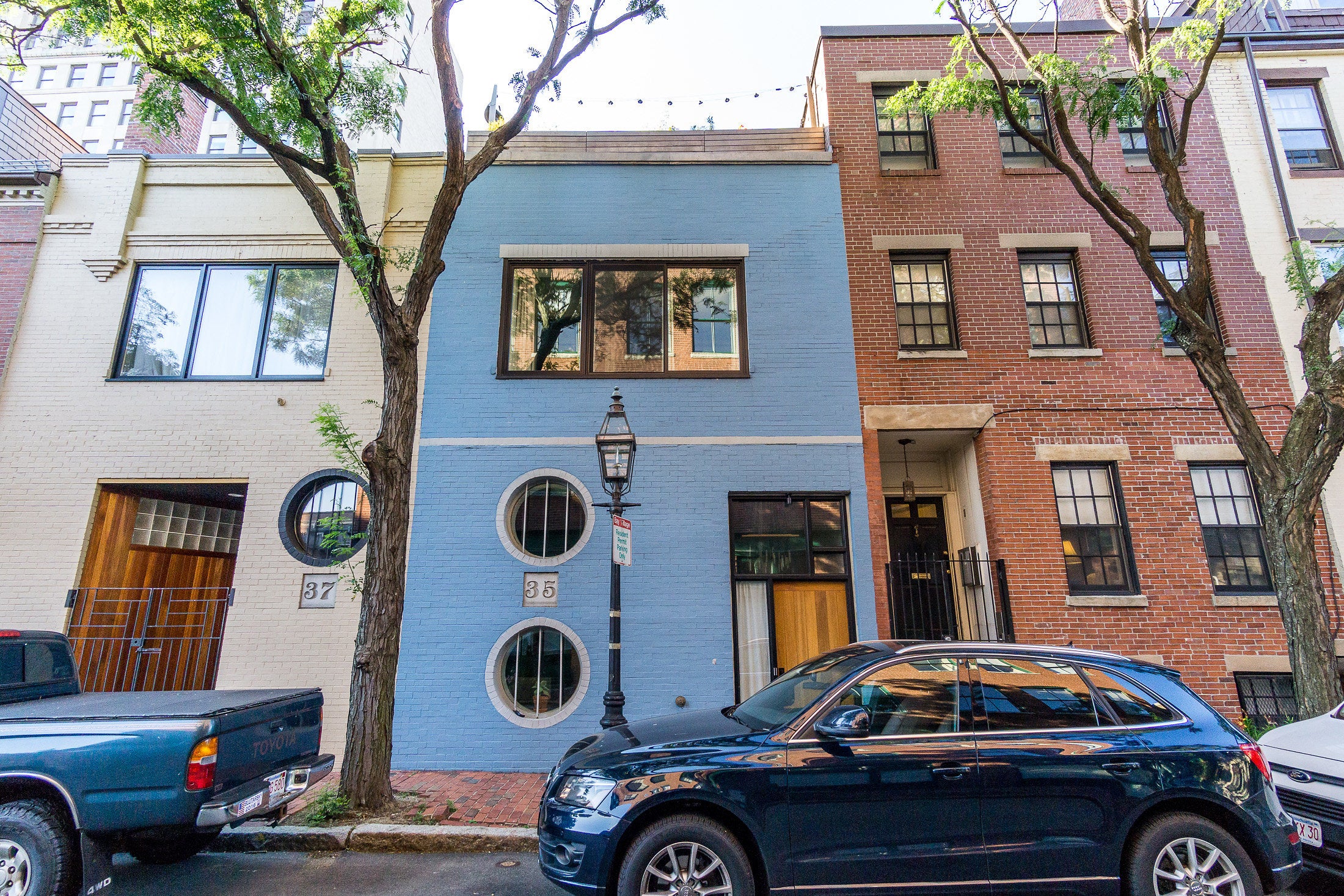
At the entry, a new grid of glass and 6-inch-by-3-inch tubular steel dramatically frames a solid mahogany door. The Bay Village Historic District Commission allowed Young to redesign the opening, making it larger. The exterior cadet-blue paint, though, had to stay.
The facade, which Young says appears to have been rebuilt in the 1920s, also features two ocular windows that belie the building’s age. These two “eyes” into the sitting area gave Young an idea. What if he could also use them to peek — and bring light — into the level below? To make that happen, thick laminated glass was built into the floor, creating an unusual view of the basement kitchen and allowing natural light into the space, which also receives light from the rear stairwell.

A painted backsplash and clear glass pendants also work to bounce light around the kitchen interior. Here, too, limited space is maximized. The island transitions into a dining table. A coffee table in the nearby sitting area can be raised to the same height as the din- ing table, and the two can be connected for dinner parties.
Because there is effectively only one egress (the lone window in the stairwell provides access to a terrace and neighboring apartment and technically counts as a fire escape), a sprinkler and pump-and- tank systems were installed. Young squeezed the 300-gallon tank for the latter into a utility closet off the kitchen.
Although the space was completely redesigned, now, just as when they first walked through the front door, the homeowners can see all the way to the skylights above. “It’s the smallest footprint I’ve ever worked in,” says Young of the 171⁄2-foot-wide building. “It felt like an architecture school project!” Yet despite its slim frame, the house never feels cramped. “It’s all about using every square inch,” Young says.
See more photos of the home:





To comment, please create a screen name in your profile
To comment, please verify your email address
Conversation
This discussion has ended. Please join elsewhere on Boston.com