
This one-story house in Maine was designed to hang over the sea
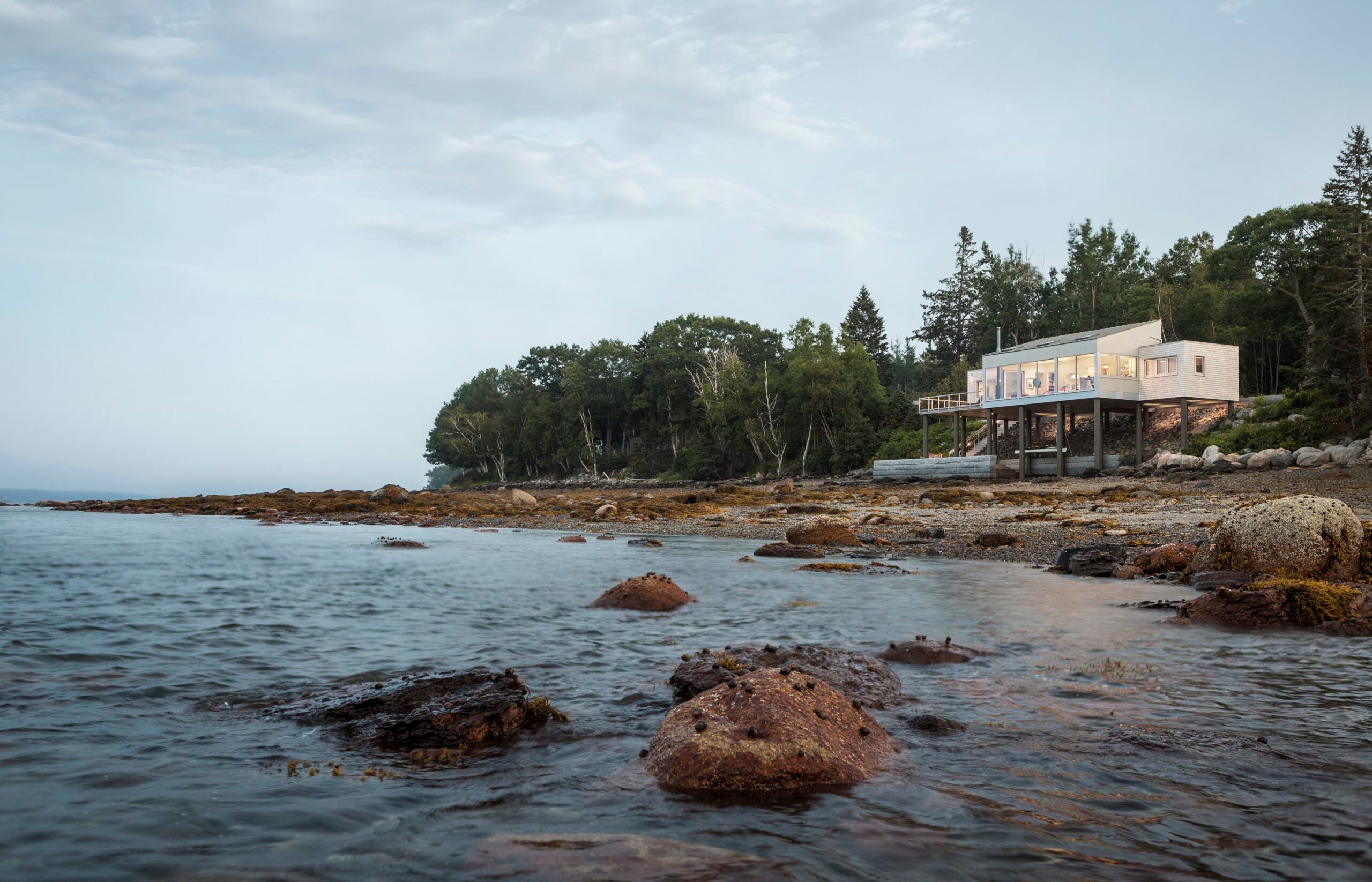
The coast of Maine is lined with elegant houses beside the sea, but homes over the sea are something rare. Normally, state shoreland zoning and federal flood plain regulations prohibit building right to or even over the water, but in special cases, such as when existing structures sit on pilings or sea walls, an exception may be made. That’s the case with the shipshape house Elliot & Elliot Architecture of Blue Hill, Maine, designed as a second home for Ken and Dee Gray.
The Grays’ snug, one-story, 1,450-square-foot home is built on 20 cement-filled piers as it hangs over a bay not far from Blue Hill. From a distance, the flat-topped little building with its central clerestory popping up beneath a shed roof might be mistaken for a fish shack or boathouse, but it is in fact a two-bedroom house that is a fine example of the high-style minimalism that characterizes much of Elliot & Elliot’s work.

Ken Gray, a hedge fund manager from Philadelphia, is an avid sailor. He and his wife, Dee, had been cruising Maine waters for years when, about five years ago, they decided to purchase a place ashore. On a long peninsula dotted with modest cottages and commercial buildings they found a rather nondescript cottage, the main structure of which had once been a concession stand at the Blue Hill Fairgrounds. The 1950s cottage was perched over the water and had been added onto over the years in the best Maine tradition, so the Grays turned to Elliot & Elliot to renovate the mongrel structure.
Corey Papadopoli, project architect for the house, had to inform his clients that “probably the best thing is to build new.”
“It’s on a 5,000-square-foot site with a 22-foot-grade change from top to bottom,” says Papadopoli. “There was nothing to work with. You couldn’t move it, and there was nowhere to move it to. Basically, it needed to be on piers.”
So the Grays made the decision to build new, which, given the property’s proximity to the water, would involve a complicated permitting and construction process.

“The biggest challenge was working with Mother Nature,” says contractor Mark Purvis of MK Purvis Construction in Blue Hill. “You have two tides a day to deal with. Every day we had to pump water and seaweed out of the footing hole and we had to use bridge-building construction guidelines for setting the concrete. The house is a simple, clean design, but everything from the footing to the deck was a challenge.”
The house sits on a steel and wood-frame platform, the roadside face clad in Eastern white cedar shingles, the clerestory in vertical tongue-and-groove cedar siding, and the sea side a wall of triple-glazing. The main living, dining, and kitchen area is at the center of the house beneath the clerestory, with the master bedroom and guest bedroom suites in the ells to either side.
Custom cabinets, closets, built-ins, and a kitchen island built by cabinetmaker Owen Gray of Brewer, Maine, hide the appliances and give the house a contemporary nautical feel. The television, for instance, is contained within a handsome teak box that forms a coffee table when the lid is closed. Storage compartments beneath the Grays’ custom-made bed feature flush ring pulls like those often found on yachts.
The floors throughout are maple, save for the master bath, where sand-blasted Glassos tiles cover the floor (polished glass tiles cover the walls).

The palette inside and out is subtle and deliberate. The Grays personally painted 22 colors on the white facade of the old cottage before they settled on a cashmere gray for their new house. To find the most natural and unobtrusive color for the support piers, they laid 4-by-8-foot sheets of plywood in the intertidal zone and painted sample swatches until they settled on a dark gray that blended nicely with the marine ledge upon which the house sits.
Gas, water, and electric lines all enter the house beneath the footbridge from the road to the entrance. The gap over which the bridge passes makes the house appear to float. On the water side, an ipe wood deck with stainless steel cable railings adds to the maritime aesthetic.
A granite stairway leads down from the deck to a stone terrace with steps right into the water at high tide. Ken keeps his rowing shell suspended beneath the house.
“He still thinks he’s on a sailboat,” jokes Dee.
“It is like being on a boat,” says Ken, “except it’s rock solid.”
Solid idea, both in design and construction. Time and tide may bear away all things, but this house over the sea looks very much as though it will be here 200 years from now.





To comment, please create a screen name in your profile
To comment, please verify your email address
Conversation
This discussion has ended. Please join elsewhere on Boston.com