
This family preserved a 70-acre historic Rhode Island farm with incredible views
A climb to the top of the old lichen-covered silo at a farm near Goosewing Beach in southeastern Rhode Island rewards the visitor with one of the most bucolic vistas New England has to offer. Hay and alfalfa fields, orchards, and pastures — a mix of crops and livestock including a couple of Holsteins named Jackie and Rose — remain part of an agricultural enterprise that has defined this landscape since the late 17th century. Two ponds and the Atlantic Ocean bound this 70-acre working farm, where the islands of Cuttyhunk and Martha’s Vineyard form the distant horizon.
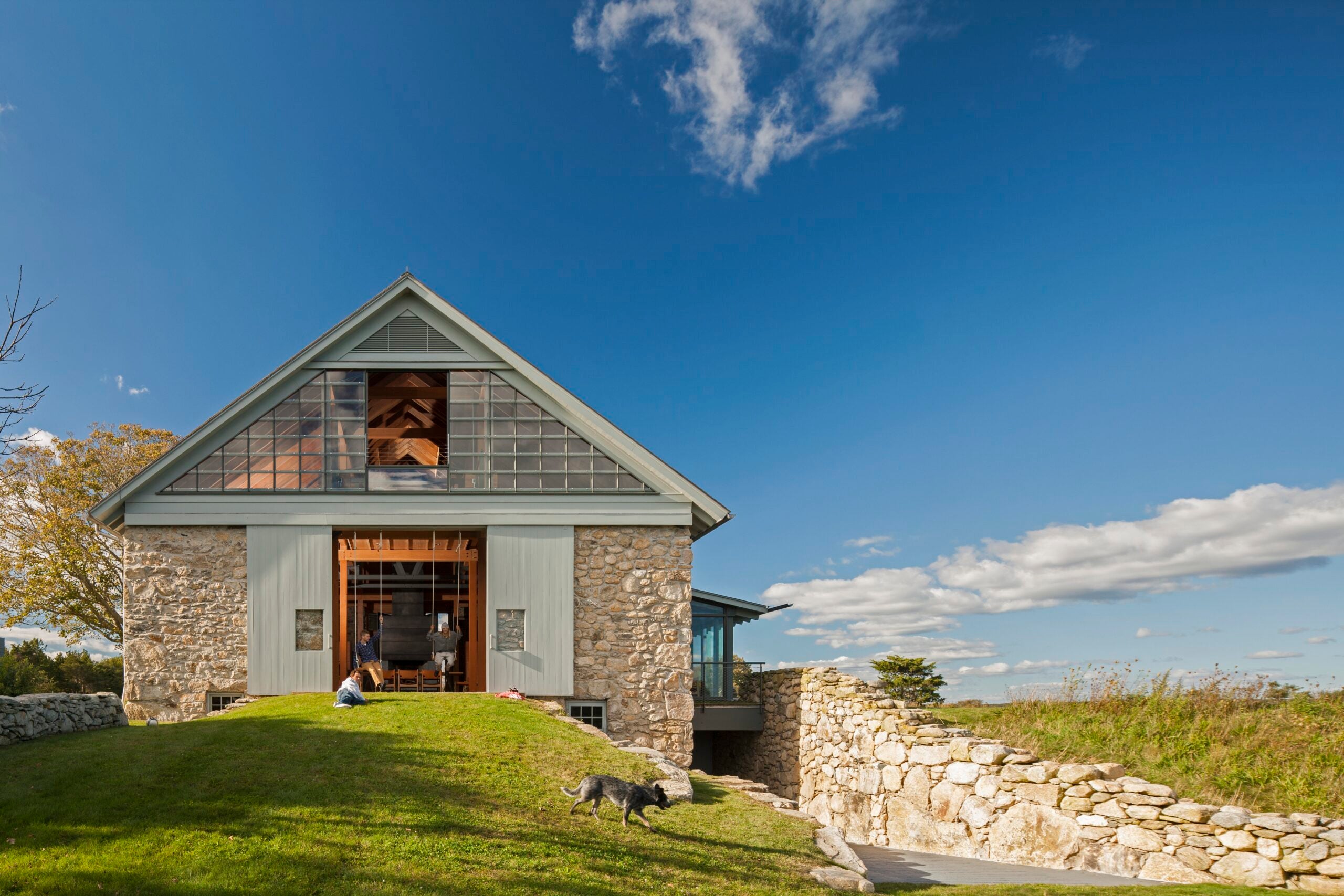
The silo is attached to an 1840s fieldstone barn that has been rebuilt as the center of the farm’s domestic life. This symbol of Yankee husbandry marks the completion of a 20-year rescue project for this once hardscrabble farm, which includes the barn and two farmhouses, in a remarkable collaboration between a family determined to preserve the continuity of an ancient landscape and one of America’s foremost architectural firms.

The barn benefactors, a married couple who met as high-school students in Florida, discovered the area in the 1970s when they were working in Boston and ventured south for weekend bike rides. So taken with the farm, they rented the main house and have never left; when the farm came up for sale in the 1990s, they bought it. As renters, they considered themselves “lucky to be part of someone else’s history,” says the husband, but ownership meant “it became family.” They commuted to New York for many years, earning the capital that allowed them to transform the farm into a permanent home as well as a trust for their heirs. (They have a grown son, who visits often from his home in San Francisco, a daughter, who lives on an adjacent horse farm, and one grandchild.)
The enthusiastic landowners recall their home as a having a “ramshackle quality, mothballed by rust.” Long worked by a tenant farmer, it had received few upgrades over the years. Some architects counseled the couple to raze the house and build a mansion, or they could have subdivided the land into building lots. But this unspoiled peninsula deserved conservation — and to be made better than they found it.
“Intervening with sensitivity” was their goal, says the husband, and soon after they purchased the property, they launched a search for “the best architect in the world.” Setting out to educate themselves about architecture, they considered the work of hundreds of architects and extensively traveled to see important houses. They requested information from 250 firms, whittled their list down to 50, and eventually to 10, before choosing Bohlin Cywinski Jackson.

Founded in Wilkes-Barre, Pennsylvania, 50 years ago, BCJ, as it is familiarly called, now also has offices in Pittsburgh, Philadelphia, Seattle, and San Francisco. Behind spectacular commissions, like the flagship Apple Stores, Pixar Animation Studios, and the home of Bill Gates, is a distinguished record of university and corporate work. Its principal Peter Bohlin was awarded the Gold Medal of the American Institute of Architects in 2010. “All our work,” Bohlin says, “is about making things for humans. How we can be thoughtful and inventive.”
Arguably, BCJ’s best work has been residential, and Bohlin was the ideal partner for a two-decade-long working relationship with his Rhode Island clients, which began in 1997 with the renovation of the 1894 Samuel Lisson farmhouse. The exterior of the unpretentious foursquare structure was restored to what it looked like at the turn of the 20th century, while the interior was refashioned with modern open spaces and lightened up by ingeniously inserted skylights.

“The singular characteristics of one house,” Bohlin says, “will grow out of the nature of the client, how they see the world,” as well as “the topography, the light, the air, and the history of a place.”
With landscape architect Michael Vergason of Michael Vergason Landscape Architects in Alexandria, Virginia (with whom he has done six houses), Bohlin devised a master plan that, he says, “exploited the rich variety and nuances of this historic New England farm.” He calls the project “one of our favorite things.”
The second phase was the restoration of the Cape Cod cottage that had originally been home to the Head family, who began farming the land in 1708. Now a guesthouse, it is connected by a glass passageway to a complementary new structure with a modern kitchen. Bohlin’s harmonious stitching of the older vernacular to the contemporary is seen here and throughout the farm. “We could have done a harder Modernism here,” says the architect, “but the spirit of this place is modest, humble.”

The 40-by-50-foot barn was designed to be the farm’s emotional heart — its living room. It is the final piece of what the owners call “a mosaic, embracing all that came before, and which becomes the prologue to our family’s destiny.” The barn’s stone walls needed total rebuilding, and none of the original interior framing was salvageable. A new timber frame of Douglas fir was inserted into the shell, augmented by a dramatic superstructure of steel trusses, painted the same “submarine gray” that coats the steel interventions in the other buildings. A dramatic steel chimney and soapstone hearth, which allows the barn to be used most of the year, anchors this gathering space. A large monitor along the ridge brings light into the space, as do ingenious glass shingles on the pediment of the south wall. Most fun, however, is a platform, inserted where the hayloft had been, from which there is a vista of land and sea.
The warm tones of the wood transform this grand but eminently flexible space into a comfortable site for group gatherings, like a daughter’s wedding or her father’s retirement party. But there is something treehouselike about relaxing on the viewing platform, looking out over the fields to the ocean.
Even more evocative of the delights of childhood are a pair of rope swings suspended from the transom of the large barn door below. All the work at the farm was done in the hope that future generations will summer and perhaps settle here. Maybe the grandchild who now loves to swing out from the barn toward the sea will someday see his own kids joyously doing the same.





To comment, please create a screen name in your profile
To comment, please verify your email address
Conversation
This discussion has ended. Please join elsewhere on Boston.com