
A Connecticut couple replaced their lawn with a meadow of wildflowers
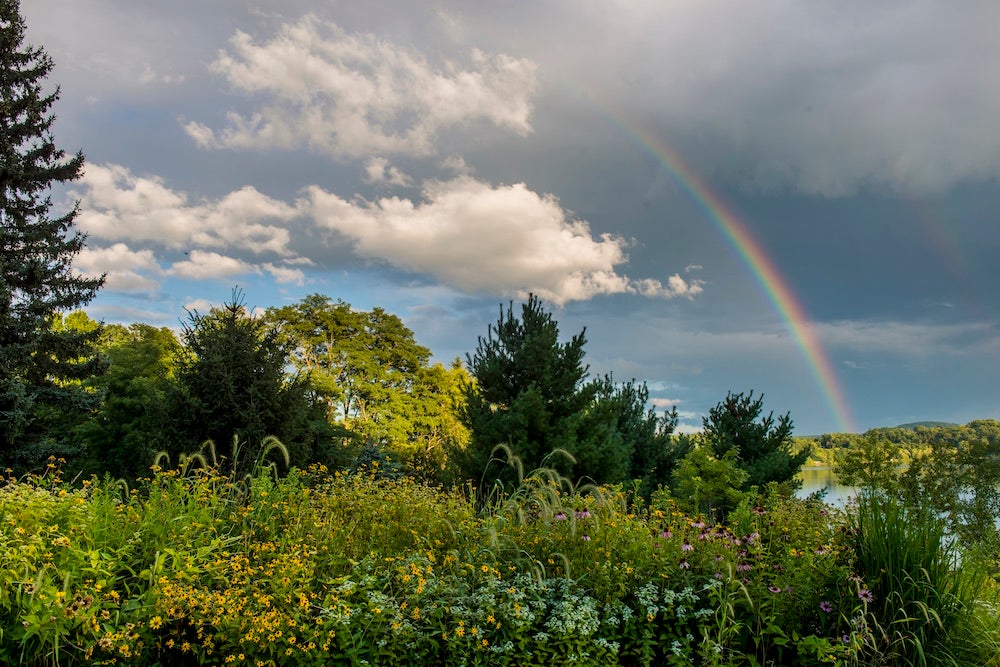
Close your eyes and picture a wall-to-wall carpet of intricately interwoven blossoms running the length of a long, lean lot. Imagine a property bouncing with butterflies and humming with bees. That’s the extraordinary reality of Bill Montgomery and Elizabeth Glazer’s decision to replace the lawn around their Lakeville, Connecticut, home with a deftly designed tapestry of wildflowers on their Lake Wononscopomuc landscape.
Theirs is no garden gone wild. It’s art — a collaboration with nature meticulously orchestrated to continue evolving into the distant future.
This landscape makes lawn look lazy. Only native wildflowers are in residence. No weeds are allowed to root; the “bad guys” of the botanical type are dispatched posthaste. Built to nourish and attract pollinators, the land provides habitat for innumerable creatures great and small.
The meadow was not part of the game plan when the couple bought the 3-acre property in 2006. With just a small bungalow on the site, more living space was the priority. “Plus, we wanted a guesthouse,” says Montgomery. So the original house, farther removed from the lake, was left in place for company, while they positioned a new Arts and Crafts-style house designed by Alan Wanzenberg Architect/Design of Ancram, New York, within a friendly handshake of the water.

While the view of the lake was lovely, Montgomery and Glazer wanted to see more from the house and its generous bank of wraparound windows. They contacted Jamie Purinton, whose firm, Jamie Purinton Landscape Architect, is also in Ancram, to come up with an eco-sensitive design plan that would include vegetable beds around an outdoor grilling area and vines to soften the look of the new brick house.
Purinton engulfed the structure in climbing hydrangea and euonymus, Virginia creeper, trumpet honeysuckle, and purple clematis. A small apple orchard, also on the owners’ wish list, was sited where the fruit trees are easily accessible for harvest. On the periphery of the property, a loose hedge of oaks, pines, and black tupelo provides soft green privacy screening. Other than those directives, Montgomery and Glazer were content with the usual plantings hugging the footprint of their house. The meadow came later.
After living in the house for a year and partaking of the stone barbecue/sitting area and the porch overlooking the lake, the couple decided to install a dining patio within footsteps of the kitchen and overlooking the lake. Purinton designed it with brick set into bluestone, and patio soon became the go-to place for meals whenever weather permitted. Next, a railing wall that obstructed the view of the lake from the porch came down, a further sign that Montgomery and Glazer were bonding with their land.

But the lawn on the sloping bank wasn’t sitting well with them. Never utilized for sports activities and merely serving as a place holder around the patios, the lawn wasn’t earning its (substantial) keep. “Basically,” says Montgomery, “we were bored with grass.” In 2008, they tried throwing out some wildflower seed in a section of the yard as an experiment. “We liked the results enough to wonder what would happen if we did it for real,” says Montgomery. Meanwhile, Purinton, fresh from a lecture by Larry Weaner, a landscape architect known as the “meadowmeister” because of his advocacy of the meadow concept, presented the idea to her clients. After a few consultations with Weaner’s firm, Larry Weaner Landscape Associates of Glenside, Pennsylvania, they were game to give it a try. “After all,” says Montgomery, “we could always go back to lawn.”
Glazer wanted a custom meadow that was low and uniform in height and would not obscure the property’s stone walls. “A lot of thought was put into the architecture,” Weaner says, “and they wanted the areas of the meadow to blend — which is a good thing.” Glazer requested blossoms and swaths of color running through the plantings. Based on aesthetics as well as the diverse ecological conditions on the property, Weaner designed several custom meadow mixes that included aggressive spreaders that would choke out weeds.

But first the lawn had to go to give the wildflower seeds an opportunity to germinate without competition. It was sprayed with herbicides twice before the meadow mix was planted. Some slower germinating plants such as bluestem were installed as plugs to give them a headstart. Larger nursery-size ornamental grasses and similar accents were also planted. No fertilizers were applied, as food would just encourage weeds. Even so, a certain amount of weed removal was essential to prevent ultra-aggressive varieties such as Canada thistle from becoming garden thugs and choking out the meadow flowers. Then it was a waiting game while the meadow took hold. “The first year it looked pretty bad,” Montgomery says. “But the second year it was OK. And by the third year, it was great.”
Designed to be impressive in every season, the meadow presents an ever-changing palette. “There is no constant,” says Montgomery. “It’s always evolving into a better product. And it’s thrilling to watch year to year and season to season.”
Initially, Weaner installed plants that would hold the space while deeper-rooted grasses such as the little bluestem became established. Over time, coreopsis and other quickly maturing plants were muscled out by slow-but-steady varieties such as mountain mints, milkweeds, and butterfly weed. It’s all part of the plan. “It has settled down into a stable condition,” Weaner says. “New species continue to sprout, but at a much slower rate.”

The meadow also serves to keep noisy, messy Canada geese, which don’t like to walk through tall vegetation like the swamp milkweed, bee balm, and obedient plant at water’s edge, away from what lawn is left immediately around the house.
Maintenance, though, is required — approximately 100 hours worth each year, Montgomery figures, which is less than a formal garden but more than a lawn. However, the perks are much more impressive. In addition to the visual pleasure that the meadow gives, “butterflies and hummingbirds are everywhere,” Montgomery says of the viceroys, skippers, and crescents he sees regularly.
Initially, Glazer and Montgomery saw the project as experimental. But now that they have achieved this satisfying accord with nature, there is no going back.




To comment, please create a screen name in your profile
To comment, please verify your email address
Conversation
This discussion has ended. Please join elsewhere on Boston.com