
At Winvian Farm, the chef makes the menu using the garden outside his kitchen
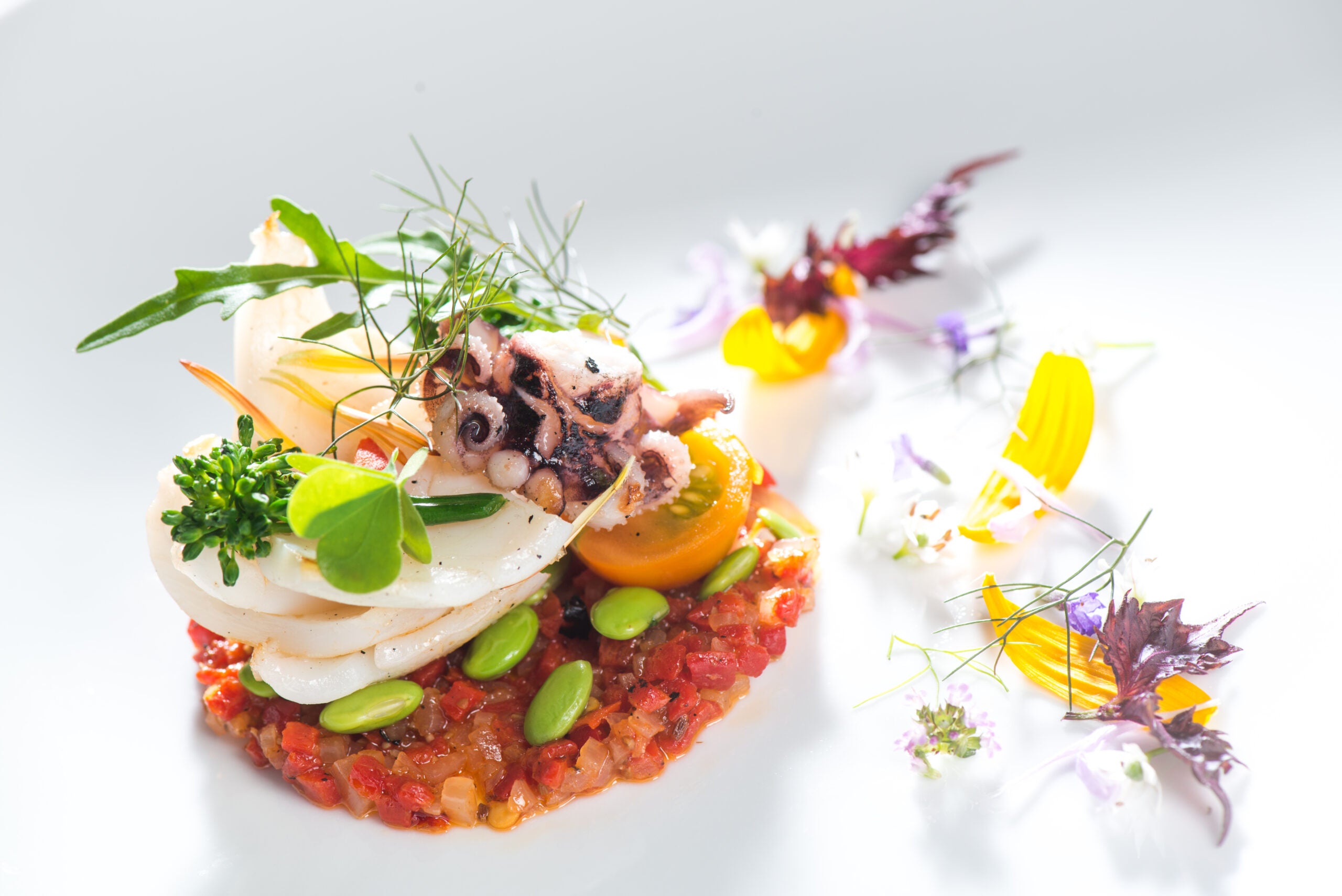
Never tried sunchoke ice cream or cardoon soup? Do you doubt for a nanosecond that kale cake can be absolutely lip-smacking scrumptious? You need to book dinner at Winvian Farm, the five-star Relais & Chateaux resort, spa, and restaurant in Connecticut’s Litchfield Hills. Known for its idiosyncratic accommodations — a beaver lodge, log cabin, lighthouse, silo, Arts & Crafts bungalow, or Sikorsky helicopter tucked discretely into the landscape — the 113-acre property also offers an unparalleled dining experience that starts with chef Chris Eddy pulling together his daily menu for The Restaurant at Winvian Farm by strolling through three acres of vegetable and flower gardens flush with organic produce.
Eddy, a Vermont native, began his cooking career in St. Louis and then worked in New York City with star chefs Daniel Boulud and Jean-Michel Bergougnoux. Feeling the need to round out his resume, he went to Las Vegas in 2005, where he worked at Alain Ducasse’s Mix, making a bargain with his wife Kate that they would stay in Nevada for just one year.

Meanwhile, in Connecticut, Maggie Smith was converting property her parents-in-law, Winthrop and Vivian Smith, had bought in 1948 and named Winvian (a combination of their given names), into a distinctive and imaginative resort. Eddy arrived in June 2006 and Winvian had its soft opening in November of that year. The land’s deep agricultural roots (Winthrop and Vivian had raised animals and vegetables on the farm), appealed to the young chef, and he immediately saw potential for his cuisine. “What could be more luxurious for a chef,” he says, “than vegetables growing in your own garden.” Even so, the practical gourmet asked for only a modest vegetable garden in 2007, focusing primarily on zucchini, radicchio, jalapenos, arugula, fresh herbs, and sunflowers, which would become a seminal ingredient in his cooking. “I had no idea,” he says. “When I sprinkled the petals into salads, the flavor was exceptional.” Soon, the dimensions of the vegetable garden began their steady expansion to 3 acres of organic gardens and four greenhouses.
Eddy had no experience with gardening, but read everything he could get his hands on (Barbara Damrosch’s The Garden Primer, 1988, Workman Publishing Company, was a dog-eared companion) and experimented continually. “I had to educate myself,” he says. “But once I got the bug, so to speak, I was on a mission. I had to invest in the land. It was such a thrill.” He immediately recognized that organic gardening was the way to go. Only by feeding, nurturing, and building up the soil could he achieve the very best results: land capable of pumping out quantities of healthy, succulent, insect-resistant produce. But the restaurant rubric allows no slack and his plantings had to pull their weight on a limited budget. Not to worry, before long the garden was not only supplying the restaurant, excess produce was being sold at local farmer’s markets. “We probably grow a little too much,” he acknowledges with a bow of appreciation to David Taccuri, who is Winvian’s gardener/farmer.

The difference his home-grown vegetables and herbs make is remarkable allowing him to create dishes in which they are the standalone star such as basil cake with berries. “Chef Eddy showed me that desserts go beyond the sweet side,” says the restaurant’s pastry chef, Selena Gearinger. “They can also be a savory experience. So I make a beet mousse and pair it with rose and honey or champagne.”
Simple dishes such as chilled asparagus soup, mélange of vegetables, and salads are treats upon the palate. Freshly harvested baby carrots are delectable little pop-in-your-mouth nuggets. “A fresh currant berry is so attractive and delicious, why would I want to mask its individual flavor?” asks Eddy. But he believes there is an even bigger message. “I hate to say the over-used term ‘connect’” he says, “but the food really helps people make the connection with the land.”
Eddy is obsessive about getting the most from his acreage. He wastes nothing. He doesn’t just go for the obvious application, but explores how other cultures utilize different parts of the plant in their cuisines. For example, beyond using the tubers of sunchokes, he makes a soup with the flowers. “Let parsley go to seed,” he says, “and that seed has an amazing taste.” He grows scented-leaf geraniums for aromatic dining table centerpieces, but he also sprinkles the flowers on summer soups. “The garden is the inspiration for the menus,” says Patrick Espinoza, Winvian’s chef de cuisine. “It’s the beginning of our daily journey; it all starts in the field.”

While vegetable and herb growing has expanded to two acres across the street from the original Winvian complex, the core garden remains on a very visible sunny acre beside the restaurant. Given its location, the garden has to be gorgeous as well as hard working, so Eddy has added flowers to the mix. Not only do they add beauty to the plot, they are used to make arrangements for the cottages and common areas on the campus. Of course, he also grows as many edible flowers as possible. Borage, calendula, and nasturtiums were obvious choices to garnish his dishes, but the sunflowers were an unexpected treat. “The petals taste great,” he says.
The flowers also lure pollinators and thus are strategically placed. Anise hyssop, for example, is planted around summer squash (whose own flowers are a favorite ingredient in Eddy’s cuisine), and the tomatoes that delight restaurant diners.
“This garden is an impetus for creativity,” says Eddy as he tallies the progress of his produce. At past venues, he might have served beet ice cream, beet sorbet, and beet foams in late summer, but here his menu might feature spritely young succulent beets whisked in from outdoors with their greens still tender and juicy. He roasts the bulbs, adds fresh herbs, artisanal greens, and a spritz of a savory sauce and voila, a dish that’s a rhapsody for the taste buds.




To comment, please create a screen name in your profile
To comment, please verify your email address
Conversation
This discussion has ended. Please join elsewhere on Boston.com