
Behind an almost conventional facade, this Martha’s Vineyard home is anything but
To see this story with its original layout in the digital edition of Design New England, click here.
This is a building of a somewhat duplicitous nature, but it’s a ruse with an honest purpose. Set in an established neighborhood on Martha’s Vineyard, an island off the coast of Massachusetts, it appears from the street as a vernacular shingled Cape Cod cottage. It has a simple, clean exterior that any historic commission would approve, even with the two-story glass corner that exposes an open modern staircase and hints there might be more to the structure than this handsome, if somewhat conventional facade.
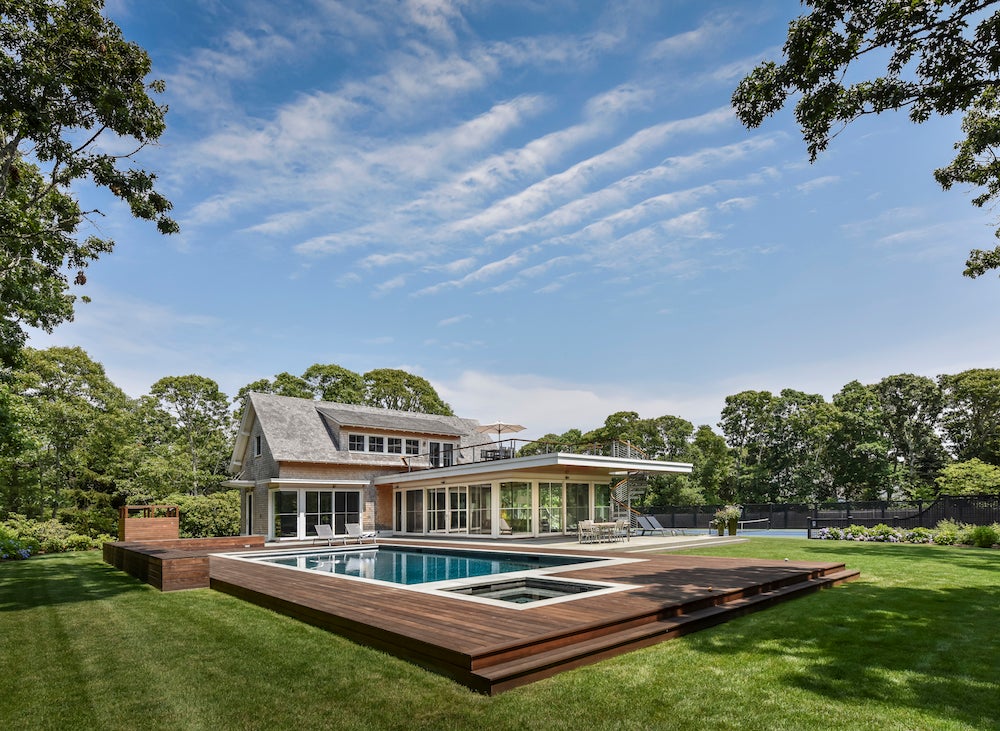
Walk to the back of the building and it is clear why Ben Kelly of Building Shelter in Oak Bluffs, Massachusetts, the general contractor on the project, dubbed it the Half-Glass House. From this vantage point, the structure morphs into a Modern rectangle with a at roof and floor-to-ceiling glass walls on three sides (reminding some observers of the famous full Glass House by architect Philip Johnson). Here, old and new do not collide, rather convention and innovation gracefully meld with one seeming a natural extension of the other.

Credit the wily genius of Keith Moskow and Robert Linn, partners at Moskow Linn Architects of Boston, who designed the building for Sam Lambroza and Marybeth Burke, a married couple with three grown children, who have been coming to the island for more than a dozen years. With sons in Los Angeles and Houston and a daughter in Washington, D.C., they found their Vineyard home was the place where all the family loved to gather, so when their neighbor decided to sell the property next door, they were quick to buy it, adding an acre to their one-acre lot.
Landscape architect Kris Horiuchi of Horiuchi Solien Landscape Architects in Falmouth, Massachusetts, was instrumental in planning the outdoor space selecting the bluestone and ipe for the decking around the salt-water pool and siting the tennis court. “Having your own tennis court is an amazing thing,” says Lambroza, an enthusiastic player and one-time high school tennis coach. He built the full-size court as a replica, including color and material, of the one used for the U.S. Open in New York.
It took some engineering to build an almost all glass house, says Moskow. Thus, he and Linn designed it with a steel frame.

The first floor consists of a living area, kitchen, full bath, and exercise room. Upstairs, there is a mini kitchen and powder room that services the roof deck. There is also a guest suite that can be closed with a sliding barn-style door, so guests need not be disturbed when the roof is in use, which it often is for sunset cocktails or dinner under the stars. “It really feels like a retreat,” adds Burke. “You don’t see any houses from the peaceful quiet living room. And there is no television in the house.”
Which doesn’t mean this is a low-tech operation. There is smart-house automation that allows the owners to control the heat, the shades on the glass doors, and the audio and security systems from their phones. The house also has a high-efficiency boiler and is super insulated. “That is where to put your money,” says Moskow. “If you make a tight envelope with air exchangers, a fancy heat system is not needed.”
“This turned out much better than we envisioned,” says Lambroza. Burke agrees, adding, “The pool, hot tub, and roof deck have become the cultural and social center for our family.” In fact, says Lambroza, “no one wants to go to the beach anymore.”




To comment, please create a screen name in your profile
To comment, please verify your email address
Conversation
This discussion has ended. Please join elsewhere on Boston.com