
How a husband-and-wife team crafted a kitchen in an iconic 1890s Vermont barn
To see this story with its original layout in the digital edition of Design New England, click here.
In 1996, Vermont architect Joan Heaton and her husband, builder Andrew Furtsch, teamed up on their first collaborative project — the conversion of a historic 1868 schoolhouse to a two-family home in New Haven, Vermont. Since then, they’ve developed a regional reputation for renovating “architecturally significant old buildings,” says Furtsch. “We preserve the historic fabric while creating something unique.”
In 2010, a local real estate agent called the couple with news that The Beams, an iconic 1890s barn on the main road in Middlebury, Vermont, was for sale. Intrigued by its solid post-and-beam structure and wide-open spaces, they quickly bought the building. “Then the challenge was, ‘What are we going to do with it?’” says Heaton, whose firm, Joan Heaton Architects, is in Bristol, Vermont. “We weren’t sure. We just knew there was potential and opportunity.” The project was a great fit for their professional expertise: Heaton, a Cornell University–trained architect, has built her practice around historic preservation and sustainable design, while Furtsch and his company, Bald Hill Builders Inc. in Lincoln, Vermont, specialize in buying old properties and renovating them as high-end rentals.

To start, Heaton developed a design for a single-family home with three levels, three bedrooms, and a two-car garage. The scheme was guided by the post-and-beam frame, which dictated the placement of most of the living spaces and windows. She also focused on two key design features: the expansive view looking west to the Adirondack Mountains, and the original wide-plank wooden floorboards that the couple wanted to save.
Meanwhile, Furtsch hired crews to lift the building and pour a new foundation, resiting the barn 15 feet farther away from busy Route 7. He also salvaged as much as he could, using wire brushes to hand-scrape the faded whitewash from the old wood paneling and preserving the slate roof and sliding barn doors.
On the first floor, eight original barn bays — four on each side of a 50-foot-long central hallway — defined the living space. At the front of the house, two bays on one side were combined to create a master suite, while two bays on the opposite side became an office and a powder room. The remaining four bays at the back of the barn were combined into a spacious great room, with a living area, dining area, and open kitchen.

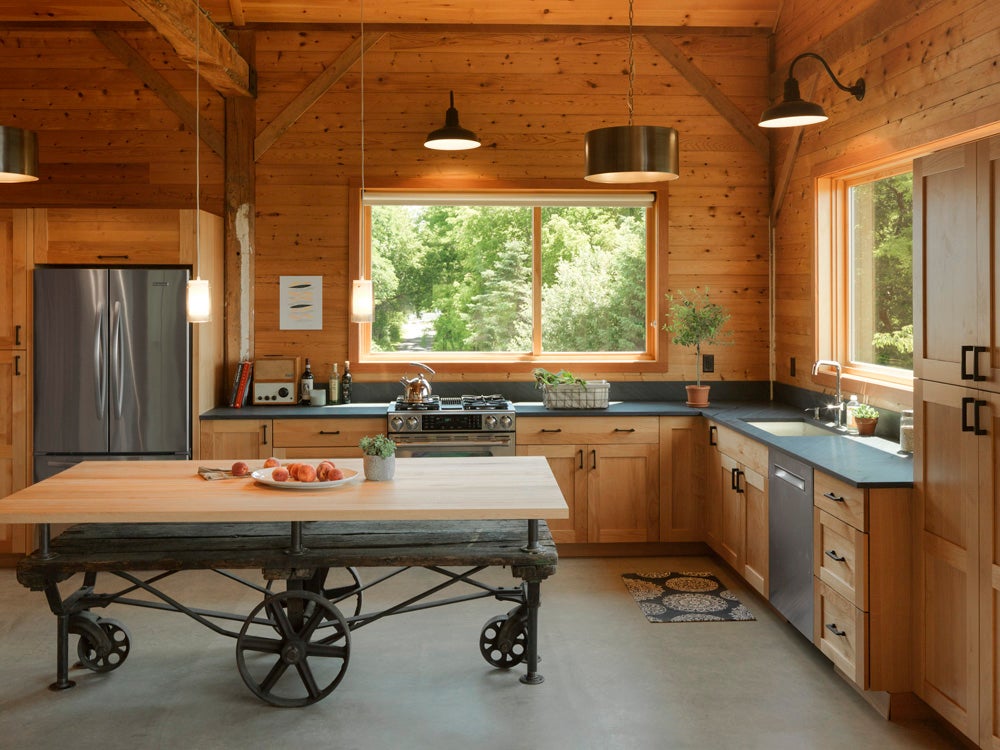
The focal point of the kitchen is an industrial cart that Heaton and Furtsch found for sale in a Vermont driveway several years ago. Furtsch used it to haul lumber around the barn during the three years he spent working on the project, then repurposed it as a kitchen island with a new maple butcher-block top. It sits on a polished concrete floor with radiant heat.
“The kitchen is intended to be very functional,” says Heaton. “It’s simple and uncluttered, designed to take advantage of the light and the views.” To achieve this, she grouped cabinets at each end of the slate-topped counters and built a pantry, framed with skip-sheathed horizontal pine boards and accessed by one of the original sliding barn doors, at the back of the room.
“One of the challenges of designing an open space is hiding the things you don’t want to see,” she says. “The skip-sheathed pantry accomplishes that while allowing natural light to come into that space.” Additional lighting comes from pendants, gooseneck fixtures, and steel-drum lights by RH, described by Heaton as the project’s “big splurge.” In keeping with the semi-industrial theme, the kitchen appliances are stainless steel, including a KitchenAid refrigerator, Jenn-Air range, and Bosch dishwasher.

A broad staircase with a steel frame and cable railings leads from the middle of the barn to the second floor, where the former haylofts have been converted into two bedrooms, a bathroom, and a study. The original hay hook hangs from the roof ridge, “in the place where you’d normally find a big crystal chandelier,” says Furtsch. At the walk-out basement level, there’s a two-car garage, a mudroom, storage, and a big playroom with sliding glass doors to the lawn.
“The biggest challenge of this project was the barn itself,” says Furtsch. “Nothing was square, nothing was plumb, nothing was straight. It wasn’t built that way, and it required all of my experience and resolve to have it be perfect — or close to perfect — in the end.”
Heaton followed a sustainable-design checklist that includes using salvaged and locally produced materials and energy-efficient lighting, mechanical equipment, windows, and insulation. “My job was easier than his,” says Heaton. “We wanted to mix old and new, to preserve the historic fabric of the building while creating something unique. I think we succeeded.”
Long-term tenants now occupy the house, and Heaton and Furtsch are busy with their respective clients — and keeping an eye out for their next husband-wife project.




To comment, please create a screen name in your profile
To comment, please verify your email address
Conversation
This discussion has ended. Please join elsewhere on Boston.com