
By gaining just 418 square feet, this Lexington house found room to breathe
To see this story with its original layout in the digital edition of Design New England, click here.
If you live in a home prime for renovation and one of your buddies is an architect, chances are, no matter how content you claim to be, change is in your future. Such was the case for Chris Hug, who had been living in his 2,866-square-foot house, built in 1949, in Lincoln, Massachusetts, for more than 15 years before he explored the suggestions made over the years by his pal Bill Hubner, principal at Incite Architecture in Lexington, Massachusetts.
“The house was getting to the end of its life,” says Hubner. “There was moss growing on the roof, siding was beginning to deteriorate, and the windows were well over 50 years old. It was time.”
The bulk of the work, which gave the house a net gain of 418 square feet of living space, expanded and reconfigured the center portion of the house by pushing out the back wall 16 feet to create a flat-roofed two-story addition. Although the kitchen was gutted to give it a whole new look, budget was always top of mind, so Hubner, interior designer Annie Hall of Annie Hall Interiors in Cambridge, Massachusetts, and the crew from Timberwolf Construction of Andover, Massachusetts, worked to keep costs down and the scope of the project within reason.

For example, nobody wanted to disturb the well-functioning radiant heating in the concrete floors, which were extended and resurfaced, so the sink was kept near its original location, allowing new drainpipes to tie into those embedded in the slab. “If we had to jackhammer up the floor,” Hubner says, “we might as well have torn down the house.”
When a pair of steel columns hidden in the walls of the old galley kitchen were uncovered, Hubner incorporated them into the design rather than replace them with costly overhead supports. The exposed columns now flank the curvaceous new kitchen island. To exaggerate its sinuous profile, Hall wrapped the base in a woven wire fabric. “Its deep cloud shape de-emphasizes the kitchen’s linearity and provides a sculptural presence,” she says. She topped it with soapstone to echo the smooth, wide expanse of polished concrete underfoot. Teak paneling, carried over from the dining room, provides warmth, while custom cabinetry painted in Sherwin-Williams’s Lagoon, a bright teal, adds whimsy.
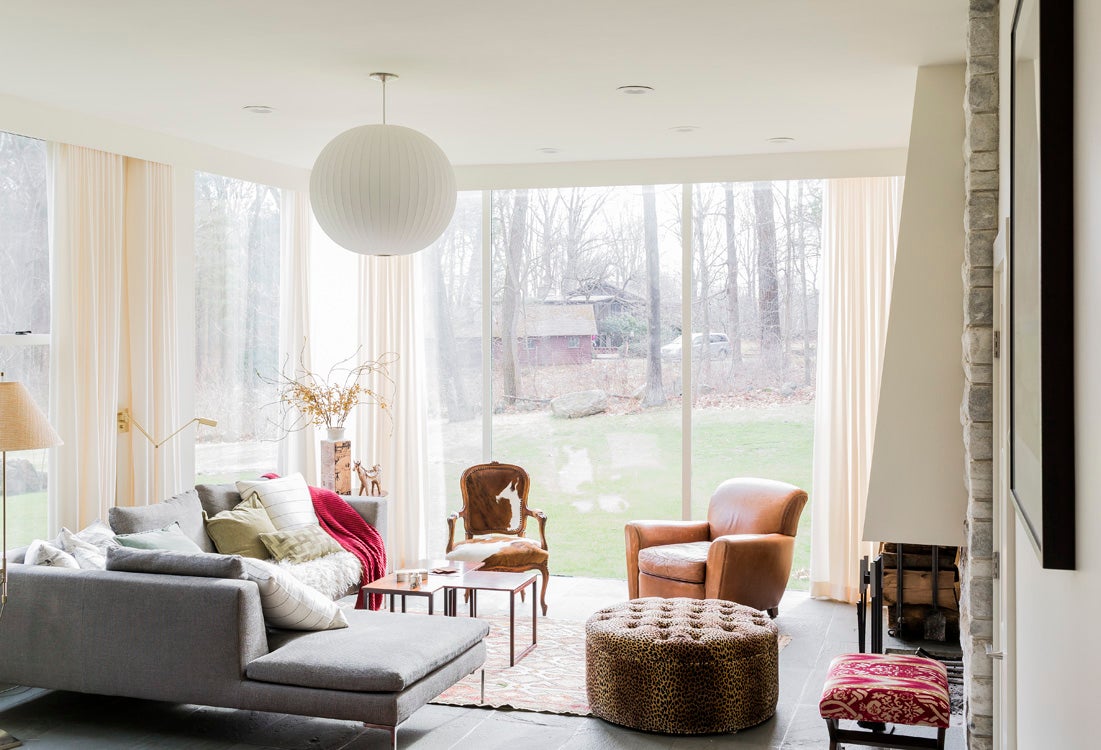
In the cozy sitting area, the original fireplace now has a granite surround finished so that it appears almost leathery. It is set flush in a wood-clad wall painted the same charcoal as the kitchen columns. A pair of vintage Midcentury Modern armchairs from Reside in Cambridge sits atop a dog-friendly cowhide rug. “It’s where Chris and his dog relax in the evening, especially in wintertime,” says Hall.

The adjacent sunroom-like dining area overlooks a new deck that juts into the grassy backyard. Hall lined the room with teak paneling, reflecting Hug’s love of sailing. A 112-inch-long mahogany, walnut, teak, and rosewood dining table by Midcentury Modern master Milo Baughman, surrounded by half a dozen reupholstered dining chairs from the 1960s and two Queen Anne chairs, fills the space perfectly.
On the second floor, Hubner transformed the dark hallway across the front of the house into a light-filled gallery by raising the roof and adding a series of clerestory windows. Hall painted the space including the stairs, from risers to rails, white. “It was a dated honey oak that didn’t mesh with the new teak finishes,” she says. Distressed white oak flooring made from a wood-topped composite that retains the radiant heat underneath lends a rustic texture yet keeps things airy.
Hubner converted a fragmented bedroom and bath into a proper master suite with a view of the pond out back. “Originally, there was a little room tucked under a dormer,” says the architect. “We exploded it into a larger box, lined it with windows, and wrapped the exterior in copper.”

Hall used a mix of furnishings in the serene space, including a custom-designed bed with a swooping headboard and a tufted bench with cabriole legs reupholstered in gray velvet. The windowed bump-out is painted a smoky blue that picks up on a color found in the vibrant kilim rug. The cocoonlike setting is completed with a contemporary cable-knit quilted sofa from Montage in Boston and an armchair (a curbside find) reupholstered with fabric left over from another job and topped with a sheepskin throw.
With the addition of a second-floor laundry, a mudroom off the kitchen, and the restoration of the two-car garage, this once-tired house is now a true four-bedroom, three-bath haven. “The house went from being a bit of an eyesore to a really stunning home,” says Hall. “And that’s exactly what any good renovation should do.”





To comment, please create a screen name in your profile
To comment, please verify your email address
Conversation
This discussion has ended. Please join elsewhere on Boston.com