
A landscape designer uses his own backyard to show clients what’s possible
Andrew Grossman believes in the power of color. The landscape designer advises his clients, who have gardens in Massachusetts, Rhode Island, Connecticut, and beyond, to mass plants of a single palette for maximum impact.
“One hydrangea in bloom is just one hydrangea in bloom,” he says. “If you have 15 or so in bloom, you have a showstopper. Unless I frame a doorway or a trellis, I never use just one plant.”

He also considers the big picture and chooses plants with long blooming periods. “It’s not about one plant looking good,” he says. “Everything has to look good and deliver a visual experience.” A plant that blooms for a long time, he points out, is easier to pair with complementary growth.
As principal of Andrew Grossman Landscape Design, he brings prospective clients to the gardens surrounding his Seekonk, Massachusetts, home and studio to show them what is possible. The property, which he purchased in 1998, measures slightly less than an acre and attracted him because it is surrounded by the Martin Wildlife Refuge and borders the Runnins River. Though on a main road, the site is secluded and verdant, with a dreamy backdrop of the curving river in the distance. Here, Grossman has created a series of display gardens that demonstrate his design principles while delivering colorful views through every window of his renovated circa 1880 Cape, where he lives with Puck, his miniature labradoodle.

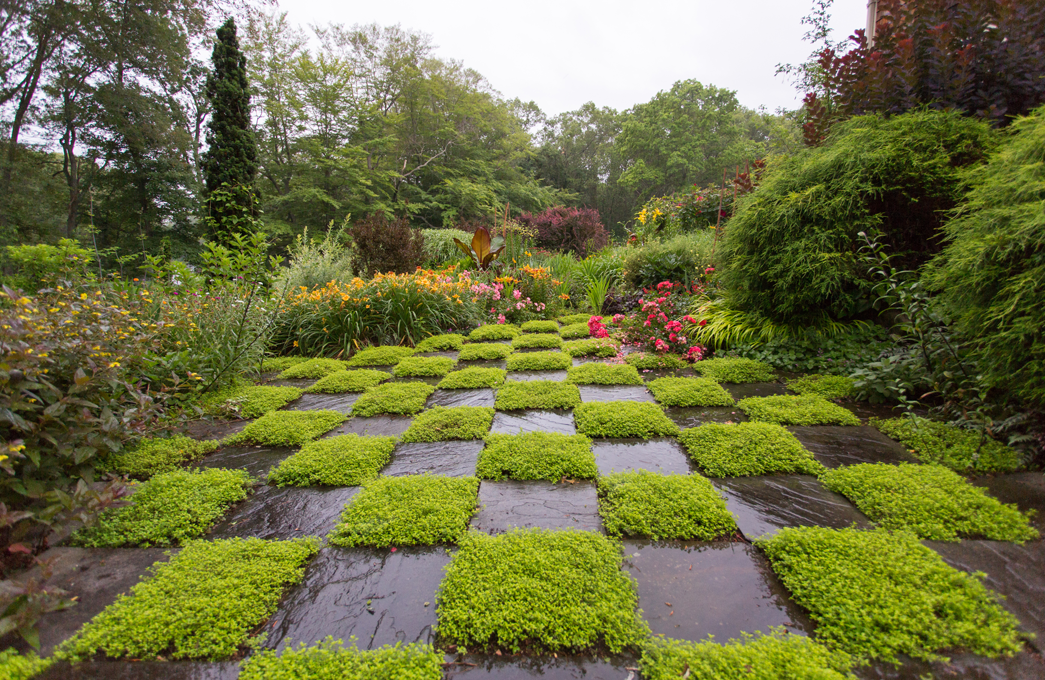
Before Grossman bought the house, its orientation was changed, and what was originally the front became the back. He put his first garden there, planting blue and white azaleas, tree peonies, spring bulbs, perennials, and flowering shrubs around the edges of a 10-by-20-foot lily pond. Next, he created a checkerboard garden between the pond and the house with square stone pavers alternating with squares of lemon thyme.
“Geometric makes sense up against a house,” Grossman says. “I don’t really like garden beds that look like they fell out of the sky. Shapes should not be arbitrary. There should be a reason for them to be there.” The door of the house leads into the blue-and-white garden, but does not line up with it. “The checkerboard blurs the line between them,” he says, “and is a good geometric transition between the house and the gardens.”
To one side of the checkerboard, Grossman planted a “hot” garden, so called because it is composed of red, orange, yellow, and magenta flowers. A mulch-lined path leads to the river from the lily pond. On the opposite side of the pond, arborvitae flank a path to an arbor.

Grossman, who is originally from Providence, Rhode Island, grew up gardening. “When I was at Bennington [College in Bennington, Vermont], I did garden maintenance to earn money,” he says. He worked as a dancer and choreographer in New York and, when he believed that profession had run its course, turned to his lifelong passion for a new career. He lists work as a floral assistant in New York as valuable design training.
The front of a house is the traditional location for a colorful cottage garden, says Grossman. For his own, he laid out intersecting gravel paths to create four enclosed rectangular beds that hold roses, including The Fairy, Betty Prior, and New Dawn, and perennials such as iris, lilies, asters, geraniums, and phlox in shades of pink, yellow, white, and blue. Fence posts and swagged ropes complete the enclosure. At the end of each gravel path is an arched trellis supporting roses and clematis.
After he developed the areas close to the house, Grossman created what he calls his “farm pond,” a circular pool surrounded by wetland plants such as hostas, yellow flag iris, and rodgersia. A lacy metal gazebo situated at the edge of the pond provides a seating area with a view of the house and its surrounding gardens. Rose beds line paths leading from one garden to another.

“The farm pond is my personal riff on Giverny,” Grossman says, recalling how he was influenced by Claude Monet’s famous gardens in the northern French community. “I had a friend who worked there, so for three days we went in when it was closed, and I could really walk around and look.”
He also credits the iconic English gardens of Gertrude Jekyll as an influence, especially in the cottage garden.
“This is a gardener’s garden,” he says. “It is planted so that it is always in bloom.”
That requires a lot of work.
“I do it all myself, working in the garden for several hours every day. It is now at the extent of what I can take care of.” He adds: “For clients who don’t want such a high-maintenance garden, I adapt with lots of flowering shrubs instead of perennials and annuals.”
In his own garden, however, Grossman has rules. He does not plant a vegetable garden. “I can buy fresh tomatoes,” he says, “but I can’t buy beautiful dahlia flowers like the ones I grow. I am not a farmer; I love to grow things for the beauty.”
He also does not devote time to fussy plants. “My plants have to be team players,” he says. “If they need coddling, they’re not for me. I have not succeeded with delphiniums, so I don’t try to grow them anymore.”
And he finds satisfaction that under his stewardship, after nearly two decades, the garden has taken on a life of its own.
“At this point, I feel more like a curator than designer in this garden,” Grossman says. “I edit as it grows.”





To comment, please create a screen name in your profile
To comment, please verify your email address
Conversation
This discussion has ended. Please join elsewhere on Boston.com