
What American homes looked like, from 1900 to 2015
American homes have certainly changed a lot in the past 115 years.
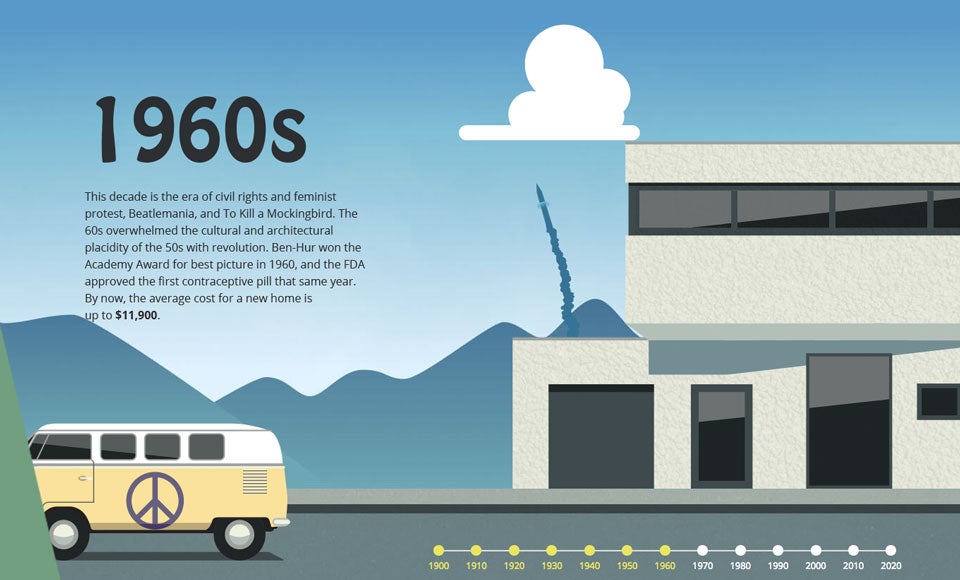
From stately Colonial Revival homes that led the early 20th century to a wave of McMansions built in the early 1990s, American homes have certainly changed a lot in the past 115 years.
iMove, a business that pairs moving companies with homeowners in need, recognized this transformation and made a graphic to illustrate the shifting tides in what homes looked like from 1900 to 2015 and beyond. Take a peek and maybe you’ll spy a style of home you’ve lived in.
Some trends were adorable and camp (the California bungalow of the 1920s), while others were huge eyesores. (I’m looking at you, Brutalist homes of the ‘60s.)
Other interesting trends included the Prairie style of 1910, which focused on sleeping porches to promote Americans getting fresh air, and the Art Deco homes of the 1930s that often had “obsessively white kitchens,’’ repeating geometric floor patterns, and tubular steel furniture.
Other key trends include the emergence of attached garages in the ‘40s, large kitchen islands in the ‘50s and built-in furniture in the ‘60s.

But probably the weirdest-looking homes were the “deconstructivist’’ models of the 1980s, which occasionally had wall-to-wall mirrors, carpeted bathrooms, and a preponderance of floral patterned-furniture. We can also thank this era for the finished basement – every angsty teenager’s dream.
McMansions exploded in the 1990s, got even larger in the 2000s, and now?

After the recession and collapse of the real estate market, the 2010s have finally seen resurgence in smaller homes, yet the average price to buy one has continued to climb. We’ve seen this in Boston with the micro-apartment trend. Open floor plans are pretty common and some people have turned their garages into “mancaves.’’
What’s next? iMove predicts that in the 2020s, families will be smaller than ever at about three people per household, but homes will be at their largest yet at 2,600 square feet. There might be an emphasis on energy saving systems, and home automation tech is expected to grow in popularity.
Check out iMove’s full graphic here.
Innovative ideas for your outdoor space:




To comment, please create a screen name in your profile
To comment, please verify your email address
Conversation
This discussion has ended. Please join elsewhere on Boston.com