
Watertown House’s Paper Trail Sheds Light on Early Home Restoration
William Sumner Appleton renovated Watertown’s Abraham Browne House in 1919. He documented the process along the way, so that future preservationists could better understand the house’s history.
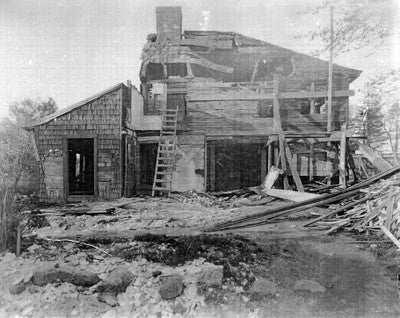
When William Sumner Appleton renovated Watertown’s Abraham Browne House in 1919, he left a paper trail.
“It’s one of the very early documented restoration efforts,’’ Historic New England Preservation Manager Colleen Chapin said, referring to the various lists and photographs Appleton left behind. His painstaking documentation of the work he did on the near ruinous 17th century home allowed future preservationists like Chapin to learn about history, construction, and conservation.
Not much is known about Abraham Browne, the original owner of the land on which the property now sits, but he was one of the first Watertown settlers, according to Historic New England. Browne also held “many important’’ positions in Watertown through the 1640s, including land surveyor and tree conservator.
It was one of Abraham’s sons, Captain Abraham Browne Jr., who built the house that still stands today. Like his father, Captain Abraham left his mark on early Watertown, serving as the town assessor, clerk, treasurer, and captain of the local militia. Browne’s descendants lived in the home until 1897.
But the preservation of the Browne House in 1919 almost didn’t happen.
According to Historic New England, Appleton briefly considered dismantling the structure and moving it to Saugus “as he thought that the framing was its most important feature.’’ But a friend and fellow preservationist Norman M. Isham intervened, writing Appleton a letter that said the house was too important to be taken apart and moved.
“My advice is to stick to your lease scheme and keep the old building in situ,’’ Isham wrote. “It has too many secrets to reveal. It has more to tell us than a little, not particularly about framing, which is really about all you could preserve if you took it down and stored it, but about windows and stairs… DO NOT TEAR THE HOUSE DOWN!!’’
Isham’s letter must have worked, because Appleton left the house in Watertown and began the Browne House’s massive five-year face-lift, replacing the roof, rebuilding chimneys, and mending the main structural beams¬ finding hidden gems along the way. Some of the interesting finds included the original fireplace, stairwell, and an extremely unusual diamond–patterned, three-part casement window frame.
“It’s hinged on the side,’’ Chapin explained, “…more Medieval style.’’
Appleton was unique in that he was able to see through the wreckage that was the Browne House in 1919, to a structure with “exceptionally rare’’ surviving architectural features, Chapin said. Appleton eventually described the home as “one of the very best old houses still standing in New England.’’
“It’s pretty incredible he saw this old house in that,’’ Chapin said laughing, describing the “before’’ pictures Appleton took of the house. “It tells an interesting story, and it also shows you that you don’t have to tear down everything when repairing an old house. You can breathe new life into it.’’
After Appleton’s renovations on the 1698 Watertown home were complete, he rented out the northern addition of the house to tenants, and rented the first floor of the house as a tearoom. He later donated the home to Historic New England, the nonprofit historic preservation organization he founded in 1910. The Browne House is thought to be the oldest home in Watertown.
By looking to past documents, Chapin said preservationists can figure out answers to questions like, “How is best to do a wood-shingled roof,’’ or “How do I find a contractor for painting?’’ and “What can you do to take care of trees on a landscape?’’
Several additions were added to the house over time, and Appleton kept two of them intact:one from the 18th century and one from the mid-19th. Chapin said he removed a wing whose roof was in danger of collapse, however, exposing more of the 17th century structure.
Today, Historic New England operates the Browne House as a museum, and visitors can tour the property by appointment.
To fund the home’s preservation, Historic New England relies heavily on grants, donations, and memberships, Chapin said. The organization works with local contractors who specialize in historical renovations, and it has an in-house carpenter crew.
While this winter has been tough for many of the 36 historical properties the organization owns, Chapin said the Browne House has remained blissfully unscathed.
“The Browne House has a very steep roof that helps shed snow, but some others aren’t and are holding snow, and we are getting little leakages and ice dams,’’ she said. “You just got to keep moving.’’
Chapin said she loves how preserving a historic home can create a window into the past. Because the layout of the original Browne House is essentially one large room atop another, Chapin said historians conjecture that families shared a single space for eating, cooking, and sleeping.
“It helps shed light on how we have evolved to using living spaces now,’’ she added.




To comment, please create a screen name in your profile
To comment, please verify your email address
Conversation
This discussion has ended. Please join elsewhere on Boston.com