
There’s an Environmental Fight Happening Over Affordable Housing in Needham
A Needham lawmaker is once again seeking an environmental buffer zone between a proposed affordable housing project and a major highway.
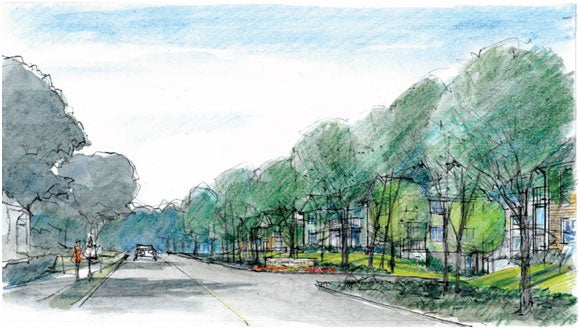
A Needham lawmaker is once again seeking an environmental buffer zone between a proposed 108-unit affordable housing project and a major highway.
Rep. Denise Garlick, a Needham Democrat, re-filed a bill that would create a 150-foot buffer between the site of the proposed Greendale Mews project and Route 128.
Garlick’s bill, “An Act Providing for a Highway Buffer Aone in the Town of Needham,’’ would allow MassDOT to purchase the land at “fair market value’’ by eminent domain “for the purposes of creating a highway buffer zone.’’
The bill is co-sponsored by Senators Mike Rush (D-West Roxbury) and Richard Ross (R-Wrentham).
The developer, Mill Creek Residential, originally proposed a 300-unit project, but could only get approval to develop 108 units from Needham officials.
Garlick is specifically concerned with the potential effects of air pollution from vehicles travelling along Route 128 on the development’s occupants.
“This buffer will ensure the health and safety of present and future residents,’’ Garlick told Boston.com.
Dr. Mike Kraft, an environmental health psychologist and Needham resident, agrees with Garlick’s claims.
Kraft provided his own analysis of potential health risks that pollutants from the highway could have on Greendale Mews’s future residents. He identifyied potential problems such as exacerbation of asthma, heart disease, impaired lung function, and a greater risk of cardiovascular disease.
“The risk is equivalent to smoking one pack of cigarettes per day,’’ Kraft said in an email. He is also concerned for the project’s potential residents, which might include elderly residents and families with young children, because these groups face greater vulnerability to those conditions.
“People of lower socioeconomic status already bear a higher burden of asthma, diabetes, coronary heart disease, and pre-term births,’’ Kraft said. “If you put them in a building this close to the ultrafine particle highway pollution it will only hasten, exacerbate, and create new disease burden.’’
Garlick also voiced concerns over how the project could strain a storm water drainage system in the area, increasing the risk of flooding. Garlick’s office raised this concern in a letter to then-MassDOT Secretary Richard Davey in 2013.
This isn’t the first time Garlick has lobbied for a buffer zone.
In August 2014, former Gov. Deval Patrick vetoed a similar bill filed by Garlick, because it would block the construction of affordable housing. Garlick believes the 2014 bill, which successfully passed both chambers of the legislature, failed when the non-profit group Citizens’ Housing and Planning Association took their objections directly to Gov. Patrick as the legislative session was winding down. A spokesperson for the group declined to comment on this story.
“I think it became a casualty of misinformation,’’ Garlick told Boston.com. But with a new administration in office, Garlick is hopeful the bill will get a fair shake.
“Hopefully, [Gov. Baker] will look at it with fresh eyes and give us the chance to the have conversation we need to have,’’ she added.
Massachusetts Secretary of Energy Matt Beaton’s office provided the following statement to Boston.com:
While Garlick insists her proposal won’t impede the project’s development, an executive for Mill Creek Development said her proposal is intended to stop the project entirely.
“Rep. Garlick made it clear at the [Zoning Board of Appeals] hearings that she was doing this to stop the production of market rate and affordable housing on that property,’’ Robb Hewitt, senior managing director Mill Creek Development, said in a statement provided to Boston.com. “No other portion of land along 128 is mentioned in the legislation. Mill Creek is confident that we will win our appeal at [the Housing Appeals Committee] and look forward to building a quality housing community on Greendale Avenue.’’
A spokesperson for Mill Creek said the company has already complied with its environmental requirements stipulated by the Massachusetts Environmental Policy Act.
In addition, Mill Creek claims the project has already received the necessary environmental approval. The company shared with Boston.com an Environmental Notification Form (ENF) issued by EEA on April 11, 2014, which said the project does not require an environmental impact report and “the project’s environmental impacts can be avoided.’’
Garlick offered a rebuttal to Hewitt’s statement to Boston.com which reads, in part, “to paint real concerns and issues that need to be addressed with a broad brush as opposition is patently unfair to me and my community.’’




To comment, please create a screen name in your profile
To comment, please verify your email address
Conversation
This discussion has ended. Please join elsewhere on Boston.com