
Roxbury’s Whittier Neighborhood Seeks $30 Million for Revitalization
Boston Housing Authority and the City of Boston are asking for $30 million from the federal government to improve quality of life in Roxbury’s Whittier neighborhood.
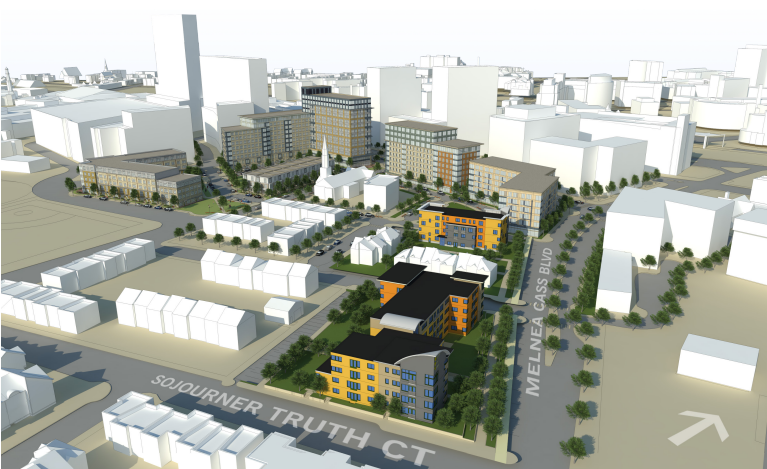
Boston Housing Authority and the City of Boston are asking for $30 million from the federal government to improve quality of life in Roxbury’s Whittier neighborhood.
BHA announced Monday that it applied for an implementation grant through the U.S. Department of Housing and Urban Development’s Choice Neighborhoods program.
The federal program, which first began receiving funding in 2010, targets low-income neighborhoods with distressed public housing or HUD-assisted housing. It aims to help city governments and other local stakeholders address challenges associated with housing, inadequate schools, and high crime rates.
The transformation plan for the Lower Roxbury neighborhood and the surrounding Dudley Square area include bringing new housing investments to replace deeply subsidized existing housing and build new units.
The neighborhood transformation plan also calls for investments in neighborhood infrastructure and public safety, as well as a plan to create union construction jobs in the neighborhood and improve educational opportunities.
“The vacant parcels that have stood for decades blighting the area and representing the City’s disinvestment have more recently become viewed as the key to the neighborhood’s revitalization,’’ the plan reads.
Whittier has a population of 9,292 with 59 percent being black or African American and 34 percent Hispanic or Latino. About 75 percent of the population receives housing or other public subsidies, and 47 percent currently live below the federal poverty level, according to the plan.
Grant recipients will be announced in September, Kate Bennett, BHA deputy administrator for planning and sustainability, told Boston.com. The $30 million would be paid out over a four and a half year grant period, she added.
BHA won a planning grant of $300,000 through HUD in 2012 to develop the transformation plan for the Lower Roxbury neighborhood adjacent to the Roxbury Crossing and Ruggles MBTA stations.
BHA, along with the city and partners Madison Park Development Corporation and Preservation of Affordable Housing will carry out the proposal, if approved.
If Boston does not receive the grant, elements of the service commitments, educational initiatives, and some infrastructure improvements could still move forward, Bennett said. “But we wouldn’t be able to move forward with the housing initiatives without the seed grant,’’ she added.
In 2011, the Woodledge/Morrant Bay neighborhood in Dorchester won a $20.5 million implementation grant from the HUD program, making Boston one of the first five cities to participate in the Choice Neighborhoods initiative. The grant helped fund the 129-unit Quincy Heights housing development project and the redevelopment of a 2-acre lot, formerly the Pearl Meat Factory, into a food production facility and small business center.
“Boston is seen as a national leader on Choice, in part because we’re one of the first funded cities, but we’ve also been the first ones to get a project pretty far along,’’ said Robert Gehret, the Department of Neighborhood Development’s deputy director for policy development and research.
The Choice Neighborhood program was preceded by a HUD program called HOPE VI, which began in the early 1990s to replace or fix distressed public housing. Several Boston housing projects, including one in Roxbury, have been funded through HOPE VI.
But while HOPE VI focused more on distressed public housing, the Choice program takes a more holistic neighborhood approach, said Rolf Pendall, director of the Metropolitan Housing and Communities Policy Center at the Urban Institute. This includes improving intangible factors, not just physical infrastructure.
“Most people I talk to consider [Choice] a positive step and good evolution in federal housing policy,’’ Pendall said. “Because we’re seeing housing, neighborhood development, and human social development all go together.’’





To comment, please create a screen name in your profile
To comment, please verify your email address
Conversation
This discussion has ended. Please join elsewhere on Boston.com