
Empty lab space keeps piling up around Greater Boston
Nearly one-third of lab space in the region is empty, and more is still under construction.
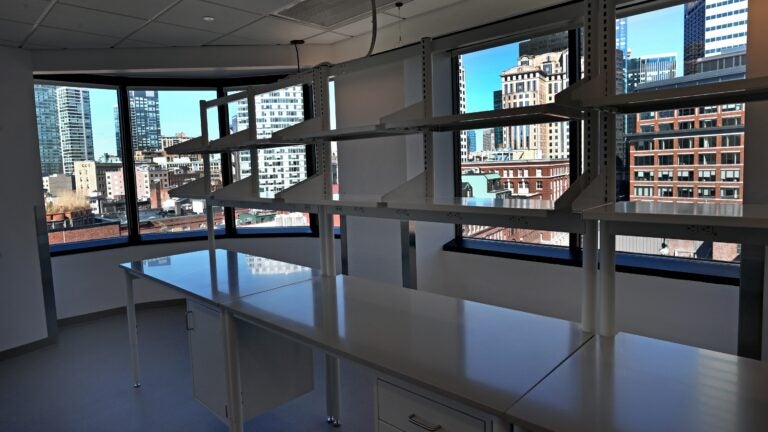
When the Boston Planning and Development Agency board meets Thursday evening, the members are scheduled to certify completion of nearly 1 million square feet of brand new lab space across the city.
Some of it is in the new Boston home of Eli Lilly & Co., a $700 million research and development facility along Fort Point Channel. That lab started construction without a tenant, but the pharmaceutical giant eventually leased the whole thing and moved in last year.
Meanwhile, at the other end of Boston’s Seaport District, a new lab and amenities building developed at the former headquarters of Au Bon Pain is opening empty. That project began construction with a tenant signed: Ginkgo Bioworks. Last year, amid broader financial troubles, the company said it no longer needed the space and would not move in. And in Boston Landing, sandwiched between the Celtics’ Auerbach Center and the Bruins’ Warrior Ice Arena, stands a 350,000-square-foot, $545 million lab that will open empty but for a first-floor coffeeshop. The BPDA board is scheduled to certify both buildings complete.
The duality is a hallmark of Greater Boston’s lab market these days. Bright spots surely remain, such as big new lab buildings for AstraZeneca and Takeda under construction in Kendall Square. But many more life-science buildings are empty, with little demand to fill them — and little obvious function other than lab space.
Nearly one-third of lab space across the region is available for lease, either directly from a landlord or via sublease from an occupant who no longer needs it. And while the first quarter of this year marked the first time since 2022 with no new labs wrapping construction in Greater Boston, there are still some 3 to 4 million square feet worth of space underway, research from Newmark and Colliers shows, enough to grow the market by more than 5 percent.
That vacancy is going to linger — and will have many landlords facing loans they can’t pay back, said Jeff Myers, research director at real estate firm Colliers. That could lead to some sales at rock-bottom prices.
“You’re going to have a mounting amount of distress that’s going to force these buildings to change hands,” Myers said. “Distress is probably going to increase and linger in the market. I don’t see an easy way around that.”
Colliers research shows there’s some 16.3 million square feet of lab space available in Greater Boston. But there’s just 1.9 million square feet of tenants looking for space.
“We still do have tenants that are active in the market,” Myers said. “The pipeline is not as robust as it was a few years ago, but it’s not zero. It’s not empty.”
Indeed, Cambridge and Greater Boston remain the world’s preeminent biotech hub, with long-term fundamentals that will remain strong, industry proponents say. But there’s growing worry that the sector’s vitality faces unprecedented threats from President Trump’s administration.
Trump’s administration has moved to make deep cuts to National Institutes of Health funding and other federal investment in biomedical research, and Governor Maura Healey has warned that every dollar cut from research activity results in $2-3 more dollars lost in economic activity. They also threaten to cut off new research at the knees before it can help power the sort of companies that need big labs here.

– Jessica Rinaldi/Globe Staff
Some life-science tenants looking for space aren’t even looking for labs — just offices. BXP, the office development giant, formerly known as Boston Properties, recently told analysts it had closed one such deal in Waltham and was negotiating another.
“These life science companies are looking exclusively for office space as they focus their capital on acquiring de-risked products that are in trials rather than pure drug discovery and therefore, don’t need lab infrastructure,” BXP President Doug Linde said on a recent earnings call.
An oversupply of life science laboratories and research and development space isn’t just a Boston problem — a surge of new labs are opening empty across the country this year, according to a recent report from CBRE. And state officials have made clear they know what filling that space means to the Massachusetts economy.
Indeed, just last year the Legislature approved $500 million over 10 years toward the state’s life science initiative. (That funding, however, was just half the initial $1 billion Healey sought.) The first decade-long, $1 billion life-science initiative launched in 2008 under former Governor Deval Patrick, with a five-year, $500 million extension approved in 2018 by former Governor Charlie Baker.
“Nothing happened by accident,” said House Speaker Ron Mariano at an event for industry group MassBio last month. “The cluster of innovation that we enjoy here today is a product of the deliberate policy choice and of a long-term strategy by the Massachusetts Legislature to capitalize on our world-class universities (and) hospitals to create a true innovation economy.”
Mariano touted the commonwealth’s 117,000 biopharma employees and Massachusetts’ longstanding reign as the NIH‘s top-funded state per capita.
“We are as of today,” Mariano said at the April 7 event. “Which is subject to change, I guess.”




To comment, please create a screen name in your profile
To comment, please verify your email address
Conversation
This discussion has ended. Please join elsewhere on Boston.com